

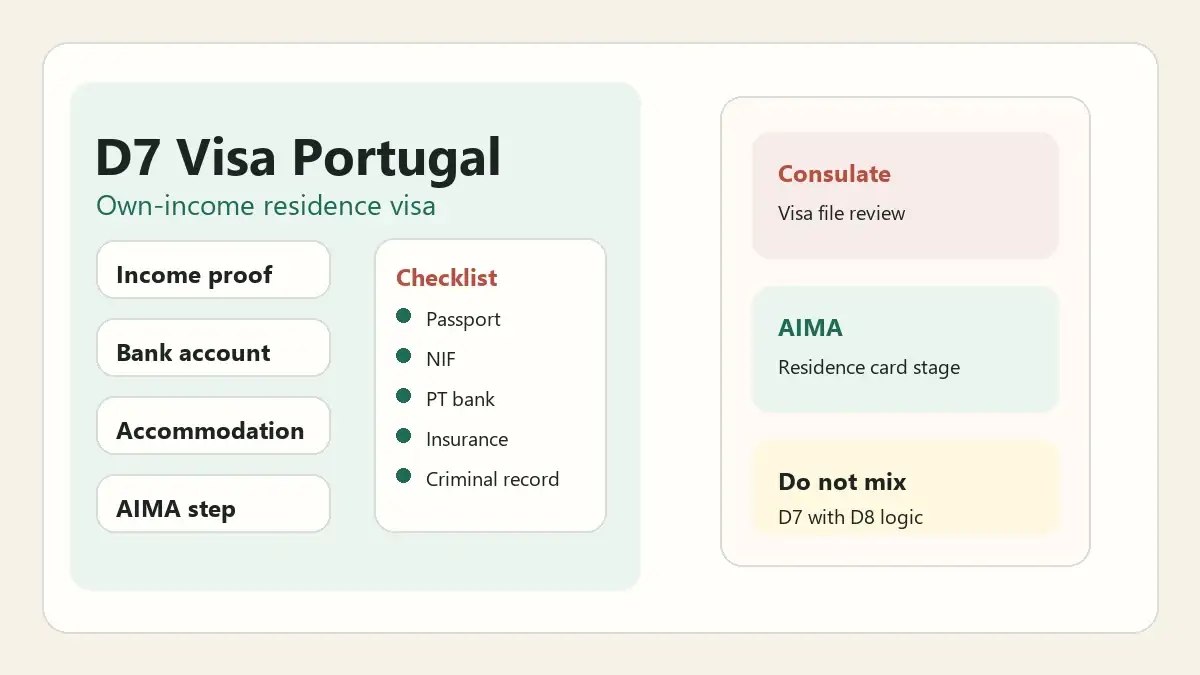
The Portugal D7 visa is a residence visa for non-EU/EEA/Swiss citizens who want to live in Portugal and can support themselves mainly from pensions or their own regular income.
For 2026, the Portuguese mainland minimum monthly wage is €920. That gives a useful statutory means-of-subsistence reference of €920 per month for the first adult, with additional amounts for family members. But the exact documents you must submit are determined by the Portuguese consulate, embassy, or VFS centre handling your jurisdiction.
If your income is mainly a salary or freelance income from remote work, do not assume D7 is automatically the right visa. Portugal has a separate remote-work residence visa, commonly called the D8 digital nomad visa.
How I checked this update: for the August 2026 version, I checked the current visa-fee law itself, the national gov.pt D7 requirements, Article 58 of the Immigration Law, AIMA’s Article 77 requirements and AIMA’s fee table effective from 1 March 2026. This matters because the gov.pt D7 service page still displays the old €90 visa fee, while the current consular-fee law sets national visas at €110.
Quick Answer: In 2026, the D7 is for retirees and people living mainly from their own regular income. Use €920 per month for the first adult as the statutory planning reference, budget €110 for the national visa, and expect a 60-day official decision period before the separate AIMA residence-permit stage.
| Question | 2026 answer |
|---|---|
| Who is the D7 for? | Retirees and people living from their own regular income |
| Main 2026 income reference | €920/month or €11,040/year for the first adult |
| Additional adult reference | 50% = €460/month or €5,520/year |
| Dependent child reference | 30% = €276/month or €3,312/year |
| National D7 visa fee | €110 under the current consular-fee law |
| Official visa decision period | 60 days |
| Initial residence visa validity | 4 months |
| Entries allowed on the residence visa | 2 |
| Where do you apply? | The competent Portuguese consular post, embassy/consulate, or its VFS partner |
| Can you normally apply as a tourist inside Portugal? | No. The normal D7 route starts with a residence-visa application abroad |
| What happens after approval? | Enter Portugal and complete the residence-permit stage with AIMA |
| First residence permit validity | Normally 2 years, then renewable for successive 3-year periods |
| Standard 2026 AIMA first-permit fees | €133 analysis + €114.30 issue = €247.30 in person; €185.60 total if a qualifying digital route is available |
The €920 figure is a reference point, not an approval guarantee. A consular post can examine whether your income is stable, available and sufficient for the household, and your local checklist may require additional banking or accommodation evidence.
How Much Does the Portugal D7 Visa Cost in 2026?
There are two separate government-fee stages: the national residence visa abroad and the residence permit with AIMA after you arrive.
| Fee | 2026 amount | When paid |
|---|---|---|
| National residence visa (D7) | €110 | Consulate / visa application stage |
| AIMA: receipt and analysis of first temporary residence request | €133.00 in person / €99.80 digital | Residence-permit stage |
| AIMA: issue of temporary residence permit | €114.30 in person / €85.80 digital | Residence-permit stage |
| AIMA first-permit total | €247.30 in person / €185.60 digital | Residence-permit stage |
| Baseline visa + in-person AIMA fees | €357.30 | Across both stages |
The €110 visa fee is the current legal amount. Portaria n.º 91/2025/1 changed the administrative fee for national visas from €90 to €110 from 11 March 2025. The gov.pt D7 page still displays €90, so I would use the legal €110 figure when budgeting and follow the payment instruction issued by your consulate or VFS centre.
AIMA updated its fee table again from 1 March 2026. The current standard first temporary-residence amounts are €133 for receipt/analysis and €114.30 for issuance. AIMA gives a 25% reduction where the relevant application can actually be submitted through a digital channel; not every first D7 residence-permit case currently has that option.
What is not included in €357.30?
The baseline does not include:
- the VFS or other external service-provider fee, which varies by country
- courier or passport-return services
- travel medical insurance
- criminal-record certificate fees
- apostille or legalisation fees
- certified translations
- bank or document-delivery costs
For example, VFS Portugal in the United States currently lists a US$43.91 service fee per visa application in addition to the visa fee. Do not copy that amount to another country: local VFS fees and payment methods differ.
My budgeting rule would be: treat €357.30 as the current adult government/AIMA baseline for the normal in-person route, then add the costs shown by your own consulate/VFS checklist.
Is the D7 the Right Visa for You?
The easiest way to avoid building the wrong application is to identify the source of your income first.
| Your main situation | Route to check first |
|---|---|
| Pension or retirement income | D7 |
| Rental income, dividends, royalties or other own income | D7 |
| Salary from a foreign employer while working remotely | D8 digital nomad visa |
| Freelance services performed remotely for foreign clients | Check D8 first; active remote professional work has its own residence-visa route |
| Starting or running a business in Portugal | D2 visa |
| Portuguese employment contract | Work-residence route rather than D7 |
The official D7 category is described by gov.pt as a residence visa for retirees, religious applicants and people who live from their own income.
That distinction matters. A strong remote salary does not automatically make D7 the best category if the actual purpose of the move is remote professional work.
Portugal D7 Visa Income Requirements in 2026
Portugal’s 2026 mainland minimum monthly wage is €920.
Portaria n.º 1563/2007 sets the means-of-subsistence percentages at:
- 100% for the first adult
- 50% for each additional adult
- 30% for each dependent child
Using the 2026 €920 reference:
| Household | Monthly reference | 12-month reference |
|---|---|---|
| 1 adult | €920 | €11,040 |
| 2 adults | €1,380 | €16,560 |
| 2 adults + 1 child | €1,656 | €19,872 |
| 2 adults + 2 children | €1,932 | €23,184 |
| 1 adult + 1 child | €1,196 | €14,352 |
These figures are useful for planning, but do not treat them as a universal consular approval threshold. Your consulate may look at the type of income, how long you have received it, the household size, accommodation costs and whether the funds are actually accessible.
What income does the official D7 route require?
The national gov.pt page does not publish a closed list of every acceptable income type. It requires either:
- proof of the amount of a pension, or
- proof that you have income sufficient to support yourself in Portugal.
That is more precise than calling D7 a visa for any form of “passive income.” If your file is not pension-based, the evidence should make the source, regularity and availability of the income clear to the consular post.
Are savings alone enough for a D7 visa?
Savings can strengthen a D7 application, but the official category is built around retirees and people living from their own income.
A large bank balance is therefore not the same thing as showing a recurring income source.
If you have substantial savings but little or no recurring income, check your competent consulate’s D7 requirements before assuming the savings alone will satisfy the category.
Is a Portuguese Bank Account Mandatory for the D7?
This is one of the most confusing D7 questions because the answer depends on which checklist applies to you.
The national gov.pt D7 page lists:
- application form
- passport
- photographs
- travel insurance
- criminal-record documents
- accommodation
- means of subsistence
- proof of pension or other qualifying income
It does not present a Portuguese bank account as a single universal requirement for every applicant worldwide.
However, individual consulates and VFS centres can publish more specific operational checklists and may require a Portuguese bank account or a particular level of funds.
So the practical rule is:
- Find the Portuguese consulate or VFS centre that has jurisdiction over your legal residence.
- Download its current D7 checklist.
- Follow that checklist even if a generic D7 guide says something different.
If you do need one, see how to open a bank account in Portugal as a foreigner.
Do You Need a NIF Before Applying for the D7?
A Portuguese NIF is not listed on the national gov.pt D7 page as one of the universal visa-stage documents.
But a NIF becomes useful very quickly for Portuguese banking, leases, taxes and the later residence stage.
AIMA’s general Article 77 residence-permit requirements include proof of registration with the Portuguese tax administration where applicable.
So there are two separate questions:
- Visa application abroad: check whether your local consulate/VFS checklist asks for a NIF.
- Residence stage in Portugal: AIMA’s Article 77 page asks for proof of Portuguese tax registration where applicable.
See our NIF Portugal guide if you still need one.
D7 Accommodation Requirement: Do You Really Need a 12-Month Lease?
The national gov.pt D7 requirement is proof of accommodation.
It does not create one simple global rule saying that every applicant in every country must use exactly the same accommodation document or exactly the same lease length.
Your local consular checklist may be much more specific.
The national page does not prescribe one universal document format. The local consulate/VFS checklist is therefore the source that determines whether your jurisdiction accepts a lease, property ownership, hosting declaration or another form of accommodation evidence, and whether it imposes a minimum lease duration or registration requirement.
Before signing an expensive lease just for the visa
I would not sign a 12-month lease solely because a blog says every D7 applicant needs one. The national gov.pt D7 page requires proof of accommodation but does not itself set one universal lease duration.
Check these four things first:
- What exact accommodation proof does your consulate/VFS require?
- Does it specify a minimum duration?
- Does the lease need to be registered with the Portuguese Tax Authority?
- If you are hosted, what documents and signature formalities are required from the host?
This is safer than relying on a blanket internet rule such as “every D7 applicant needs a 12-month lease.”
Portugal D7 Visa Document Checklist
Use this as the base checklist, then add whatever your local consulate or VFS centre requires.
| Document | Base requirement / purpose | Check locally? |
|---|---|---|
| National visa application form | Core application | Yes, use current form |
| Passport | Valid travel document | Yes, check validity/blank-page rules |
| Passport photos | 2 identical, recent passport-style photos | Check local photo specifications |
| Travel medical insurance | Must cover necessary medical expenses, including urgent medical assistance and possible repatriation | Check local policy wording |
| Criminal record certificate | From the country of origin or the country where you have lived for more than 1 year | Check age, apostille/legalisation and translation |
| Permission for Portuguese criminal-record check | Signed request authorising the Portuguese authorities to check your record | Use the current form |
| Accommodation proof | Shows where you will live | Yes, requirements vary significantly |
| Means of subsistence | Shows ability to support yourself | Yes |
| Pension / own-income evidence | Proves D7 eligibility | Yes |
| Proof of legal residence in application country | Needed where the post requires proof that it has jurisdiction over you | Check local checklist |
| Personal statement / motivation letter | Not on the national gov.pt base list | Submit only if your post asks for it |
| Portuguese bank evidence | Not on the national gov.pt base list | Submit if your post asks for it |
| NIF | Not on the national gov.pt base list | Submit if your post asks for it |
The two photos, travel-insurance wording, foreign criminal-record rule, accommodation and means-of-subsistence requirements above come directly from the national D7 service page. Local posts can add operational requirements, but these are not guesses from expat forums.
Documents that commonly cause last-minute problems
Pay particular attention to:
- criminal-record certificate issue date
- apostille or legalisation
- certified translations
- passport validity
- proof of legal residence in the country where you are applying
- accommodation dates
- bank-statement date ranges
- names and addresses that do not match across documents
Do not collect time-sensitive documents too early if your VFS appointment is still months away.
How to Apply for the Portugal D7 Visa Step by Step
Once you have confirmed that D7 matches your income, follow these seven steps:
Step 1: Find the correct Portuguese consular jurisdiction
Gov.pt says the application is made through the competent Portuguese consular post, or the embassy/consulate with jurisdiction where appropriate.
Do not assume you can choose any VFS office because it has an earlier appointment.
If you are applying in a country of which you are not a citizen, expect to show that you are legally resident there if your local checklist requires it.
Step 2: Download the current local D7 checklist
The national rules define the visa category. The local consulate or VFS checklist tells you what that office expects you to submit.
Save the checklist again shortly before the appointment in case it changes.
Step 3: Prepare income and financial evidence
Build a document trail that makes the source of your income easy to verify. Depending on the source, that may include:
- pension letters
- rental contracts and rental-payment evidence
- dividend or investment statements
- tax returns
- bank statements showing receipt of the income
The objective is to make the income traceable and understandable, not simply to add as many documents as possible.
Step 4: Prepare accommodation evidence
Use the exact form of accommodation proof required by your jurisdiction. If you rent, check whether the local checklist requires registration evidence or a particular lease duration. If you are hosted, check what documents and signature formalities are required from the host.
Step 5: Prepare criminal-record, apostille and translation documents
Check:
- which country or countries must issue the certificate
- how recent it must be
- whether an apostille or legalisation is required
- whether a certified translation is required
Do not order time-sensitive documents too early if your VFS appointment is still months away.
Step 6: Attend the D7 visa or VFS appointment
Bring the documents in the format required by the local checklist.
Follow the document order, copy requirements and passport instructions published by your own centre. Before the appointment, verify whether the original passport will remain with the application if you have travel planned.
Step 7: Track the application and respond to requests
A consulate can request additional evidence. Respond within the stated deadline and submit exactly what was requested.
A request for more documents is not the same thing as a refusal.
Portugal D7 Visa Processing Time in 2026
The official gov.pt D7 service states a 60-day decision period.
That does not mean every applicant receives the passport back exactly 60 days after walking into VFS.
The real calendar can also include:
- time for VFS to transfer the file to the consulate
- requests for additional documents
- verification work
- local appointment availability
- passport return or courier time
D7 timeline using the official 60-day decision period
| Stage | What happens |
|---|---|
| Before submission | NIF/banking/accommodation and document preparation as needed |
| Day 0 | Application submitted |
| Official decision period | 60 days |
| If more evidence is requested | Decision can effectively take longer |
| After approval | Residence visa is placed in the passport |
| Visa validity | 4 months, with 2 entries |
| In Portugal | Complete the residence-permit stage with AIMA |
If you are choosing a moving date, build in a buffer rather than booking a non-refundable move around day 60.
How to Track a Portugal D7 Visa Application
The tracker you use depends on which stage you are in.
Before the D7 visa is approved
If you submitted through VFS, use the Portugal VFS tracking service for your application country where available.
VFS normally asks for:
- the application reference number from your receipt/invoice
- your last name
VFS tracking is mainly useful for the visa application’s handling and passport-return status. It does not give you the same detailed residence-process statuses you later see with AIMA.
If you applied directly through a Portuguese consular post, follow the status or contact instructions given on your application receipt.
After you enter Portugal and apply for residence
Once you have reached the AIMA residence-permit stage, the VFS visa tracker is no longer the right tracker.
Use our AIMA process tracker guide for the residence application.
A useful way to remember it is:
| Stage | Where to check |
|---|---|
| D7 visa application abroad | VFS/consular tracking |
| Passport returned with D7 visa | Check visa sticker and AIMA appointment information |
| Residence permit application submitted to AIMA | AIMA process tracker |
| AIMA approved but card not received | CTT/card-delivery troubleshooting |
Does VFS Keep Your Passport During a D7 Application?
There is no single answer that should be applied to every Portuguese VFS jurisdiction.
Passport-submission and temporary-retention practices can differ by consulate/VFS centre and can change.
Before your appointment, verify:
- whether the original passport must be submitted
- whether there is any passport-retention or retrieval procedure
- whether courier return is mandatory or optional
- whether retrieving the passport affects processing
This is worth checking before you book travel during the application period.
Can You Apply for the D7 While Already in Portugal?
The normal D7 process is a residence-visa application made through the competent Portuguese consular post abroad.
Being in Portugal as a tourist does not turn the normal D7 route into an in-country application.
Can You Apply for a D7 From a Country That Is Not Your Nationality?
Possibly, if you are legally resident there and the Portuguese post has jurisdiction over your place of residence.
Do not choose a different country or VFS office only because appointments look faster. Check the post’s jurisdiction rules and what evidence of legal residence it requires before booking.
This matters for applicants who, for example, hold one passport but live permanently in the UK, Canada, Mexico, the UAE or another country.
Can a Husband, Wife or Children Apply With the D7 Applicant?
Article 58(5) of Portugal’s Immigration Law expressly allows the residence visa to cover the accompaniment of qualifying family members, and says the applications may be submitted at the same time. Local consulates/VFS centres still control the operational checklist for each family member.
The financial requirement rises with household size, so calculate the family means of subsistence before applying.
If the family will join after the main applicant already has residence in Portugal, see our Portugal family reunification guide.
Your D7 Was Approved: What Happens Next?
The D7 visa is not the residence card. It is the residence visa that lets you travel to Portugal and complete the residence-permit stage.
It is normally valid for four months and two entries. Portugal’s general temporary residence permit is normally valid for two years, renewable for successive three-year periods.
When Can You Actually Move to Portugal After D7 Approval?
Check the valid-from date printed on the visa sticker. That is the date from which you can use the D7 visa for entry.
You do not need to wait for the later AIMA appointment before moving, because the residence visa is specifically designed to let you enter Portugal for the residence-permit stage.
Do not confuse three different dates:
| Date | What it controls |
|---|---|
| Visa valid-from date | Earliest date you can use the residence visa for entry |
| Visa expiry date | End of the visa’s printed validity |
| AIMA appointment date | Date for the residence-permit stage |
How Do You Find Your AIMA Appointment After D7 Approval?
AIMA says the Ministry of Foreign Affairs normally creates the residence-permit appointment when the consular visa is issued.
Look at the lower-right part of the visa sticker for the appointment link. AIMA gives http://agd.sef.pt/ as an example of the type of link shown on the visa. Open the link to see the AIMA office, date and time.
If the link does not work or no usable appointment was created, AIMA’s current route for a non-CPLP residence-visa holder is:
- Open the AIMA Contact Form.
- Select Autorização de Residência.
- Select Autorização de Residência com Visto Consular (Não CPLP).
- Enter the passport number and visa number.
- Upload a scanned copy of the passport and visa.
AIMA also lists its Contact Centre as (+351) 217 115 000. For the full troubleshooting route, use our AIMA appointment guide.
I would check the visa sticker and appointment link as soon as the passport is returned, not a few weeks before the visa expires.
What Documents Should You Take to the AIMA D7 Residence Appointment?
AIMA’s current general Article 77 requirements include:
- valid passport or travel document
- valid residence visa
- proof of means of subsistence
- sworn address declaration explaining your right to live at the property
- property/landlord evidence depending on whether you own or rent
- proof of family relationship where relevant
- proof of Portuguese tax registration where applicable
- proof of Social Security registration where applicable
- health insurance or proof of SNS coverage
Re-check AIMA shortly before the appointment rather than relying on the document list you used months earlier at VFS.
How Much Should You Expect to Pay at AIMA?
Using the 2026 fee table explained earlier, the standard first temporary-residence stage is €247.30 in person. If AIMA makes a qualifying digital first-permit route available for your case, the reduced total is €185.60. Re-check the live table before the appointment because AIMA reindexes its fees.
Is a NISS Mandatory for Every D7 AIMA Appointment?
AIMA’s general Article 77 page describes Social Security registration as required where applicable. This matters for retirees and other D7 applicants who may not yet have a Portuguese employment relationship.
If Segurança Social says a NISS is not applicable to your situation, keep evidence of the response and check the current AIMA requirement for your case. See our NISS Portugal guide for the application process.
What If the AIMA Appointment Is After the Visa Expiry Date?
Do not assume that an appointment date after the printed visa expiry date means the appointment is invalid. Keep the appointment confirmation and your residence-visa records.
Be more careful with international travel after the physical visa or residence document expires. Residence status and airline/border-document acceptance are separate issues. See our expired residence card and pending AIMA travel guide.
What Happens After the AIMA Appointment?
After submission, treat the residence process and card delivery as separate stages:
| Problem | What to use |
|---|---|
| I do not know my AIMA status | AIMA process tracker |
| My process is approved but no card arrived | AIMA card / CTT tracking |
| I need to travel with an expired/pending residence document | Expired residence card travel |
Two D7 Problems That Need Special Handling
VFS or the consulate asks for a document that is not on a generic checklist
Use the current instructions from the post handling your application. The national page describes the visa category, while the local post controls the operational submission process for its jurisdiction.
If something new is requested at the appointment, ask exactly what document is required, in what format, and how it can be submitted. Keep proof of any later upload or email.
Your D7 application has been pending for more than 60 days
Gov.pt states a 60-day decision period, but the real end-to-end calendar can be longer where the file needs additional documents or other processing.
Keep your submission receipt, tracking information, additional-document requests, proof of your replies and passport-return records together. Follow up through the consulate or VFS channel handling the visa file; the AIMA residence-process tracker does not apply before you reach the Portuguese residence-permit stage.
Seven Days Before Your D7 Appointment
Do this final check one week before submission:
- Correct consulate/VFS jurisdiction confirmed
- Current local D7 checklist downloaded
- Application form completed and signed
- Passport validity and blank pages checked
- Passport-handling rules checked if you need to travel
- Criminal record still within the accepted age limit
- Apostille/legalisation completed where required
- Translations completed where required
- Accommodation proof matches the local checklist
- Income source is easy to trace through supporting documents
- Bank statements cover the required period
- Portuguese bank/NIF requirements checked for your jurisdiction
- Copies and paper order match VFS/consular instructions
- Moving date is not based on an assumed guaranteed 60-day approval
Bottom Line
For a 2026 D7 application, the safest sequence is:
- Confirm that your income actually fits D7 rather than D8 or D2.
- Confirm the Portuguese consular/VFS jurisdiction where you are allowed to apply.
- Use the 2026 means-of-subsistence figures as a planning reference, not an automatic approval guarantee.
- Follow the current checklist for your own jurisdiction for banking, accommodation, criminal-record and formatting requirements.
- Treat the official 60-day decision period as a decision benchmark, not a guaranteed passport-return date.
- After approval, enter Portugal from the visa’s valid-from date and complete the AIMA residence stage.
- Once the AIMA application is submitted, use the separate process-status and card-delivery guides for the next problem.
The key distinction is simple: the law defines the D7 category and core numbers; your competent consulate or VFS post defines the operational file you submit.
For this reason, I would treat any D7 page that gives a universal lease length, universal Portuguese-bank requirement or old €90 visa fee without identifying the source as a starting point—not as the final checklist.