

If you live in Portugal, you do not have to choose permanently between the SNS public system and private healthcare. A common setup is to register with SNS and use private care when faster non-urgent access or a particular specialist matters.
This guide is mainly for foreign residents. Visitors and short stays have different rules for EHIC/GHIC, travel insurance and payment.
Quick Answer: A foreigner with legal residence in Portugal can register with SNS and use public healthcare. Private insurance is not required simply because you are foreign, although immigration paperwork can have separate health-cover requirements. A número de utente identifies you in SNS, but the number alone does not guarantee that every cost is covered. If local public access is slow, you can also book private care directly or use private insurance.
Healthcare in Portugal for foreigners at a glance
| Situation | First option to consider |
|---|---|
| Routine GP care | Health centre if accessible; private GP if you need a faster appointment |
| Specialist appointment | SNS referral or direct private booking |
| Acute problem but no immediate danger | Call SNS 24 on 808 24 24 24 |
| Life-threatening emergency | Call 112 |
| No family doctor assigned | You can still be registered with SNS; use the health centre, SNS 24 and private care where needed |
| Ongoing chronic condition | Register with SNS and check private-insurance exclusions carefully |
| Need faster diagnostics or second opinion | Private healthcare can be useful |
| Recently arrived and still sorting registration | Private/self-pay care can bridge the gap, but complete SNS registration if you are eligible |
If you are entitled to SNS, I would register even if you expect to use private healthcare most of the time. Having both options is useful when local waiting times change.
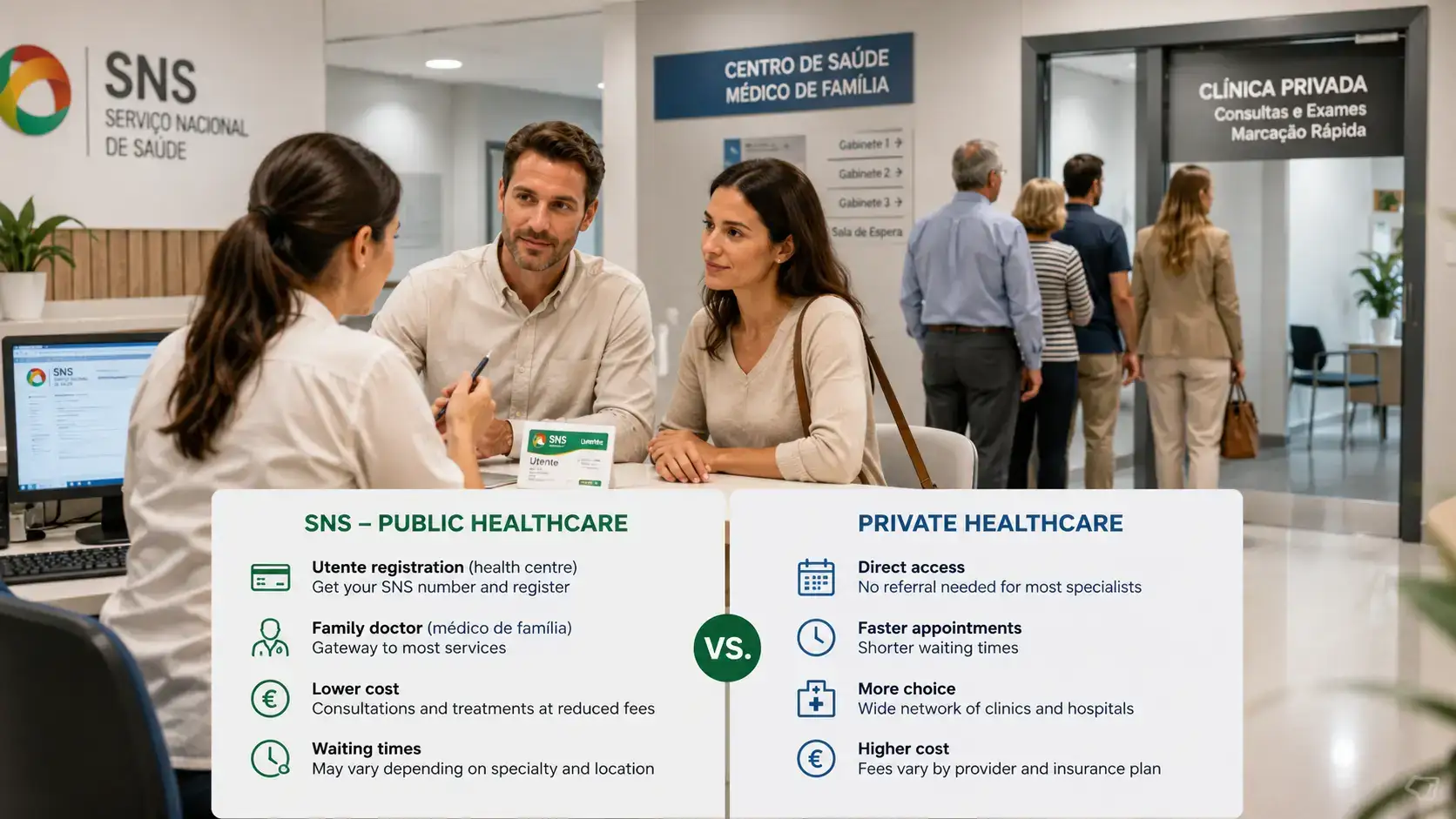
Can foreigners use public healthcare in Portugal?
Yes.
Portugal’s government says that a foreign national with legal residence in Portugal can obtain an SNS user number and receive medical assistance through public SNS units.
A foreigner may be assigned a número nacional de utente the first time they use a public health unit such as a health centre or hospital.
Having an utente number and having the data needed for SNS cost coverage are not identical. gov.pt specifically warns that the number alone does not guarantee coverage.
For a resident, the record normally needs the relevant identification, Portuguese NIF, Portuguese address and valid residence authorization attached to it, subject to legal exceptions.
Do you need a NISS to get an SNS number?
Do not confuse NISS (Social Security) with the número de utente (SNS healthcare number).
The government’s SNS coverage checklist for foreign residents lists identification, NIF, address and residence authorization; it does not list NISS as a condition for obtaining the utente number. NISS matters separately for Social Security and for some other services, including eligibility routes connected to the European Health Insurance Card.
If you need the healthcare number itself, use the utente number guide. If the issue is Social Security, see How to Get a NISS in Portugal.
Is healthcare free in Portugal for foreigners?
Not completely.
For a properly registered resident, most SNS care is publicly financed and most taxas moderadoras have been removed. There are still costs outside that headline:
- ERS says a hospital emergency user fee can apply if you attend without prior SNS referral and are not admitted;
- prescriptions can still require a patient contribution, depending on the medicine and reimbursement rules;
- routine adult dental care is not universally free through SNS, although public dental services and cheque-dentista programmes exist for eligible patients.
For an acute problem that is not immediately life-threatening, calling SNS 24 first can both triage the problem and create the appropriate referral. For a life-threatening emergency, call 112.
Número de utente vs health-centre registration vs family doctor
They are three different steps.
1. Número de utente
Your número de utente identifies you in the SNS.
2. Health-centre registration
A foreign national with a Portuguese residence authorization can register at a centro de saúde. gov.pt says to give preference to the centre serving your area of residence.
You can also obtain an utente number while registering if you do not already have one.
If you are preparing the registration, keep your residence and address records consistent. Our proof of address guide and NIF guide cover those documents separately.
3. Family-doctor assignment
Being registered at a health centre does not guarantee that a médico de família will immediately be assigned to you.
Family-doctor assignment depends on local capacity, and community reports vary sharply by health centre. Being registered without a doctor does not cancel your SNS registration.
For the routes available while waiting, see Family Doctor in Portugal for Foreigners.
What if the health centre says it cannot register you?
Ask exactly which step is being refused: creating/updating the utente record, registering you at the health centre, or assigning a family doctor. They are different processes.
gov.pt states that a foreign national with a residence authorization can register at a health centre. If staff say the unit cannot complete the registration, ask what document or condition is missing and, if necessary, request the reason in writing.
I would not accept “there are no family doctors” as an explanation that your utente number itself cannot exist. Lack of capacity to assign a doctor is a different problem from SNS identification and registration.
If you believe access rights are being incorrectly restricted, ERS is the healthcare regulator and publishes information on patient rights and complaints.
Can you rely only on SNS after moving to Portugal?
Yes, some residents do. The problem is usually access speed, not whether SNS exists as a healthcare system.
Community discussions repeatedly describe the same trade-off: public care can work well once you are in the system, but non-urgent appointments become harder when a local unit has no family doctor available. Private care is then used for faster GP visits, direct specialist booking, diagnostics or an English-speaking doctor.
Can you use SNS without a family doctor?
Yes. No assigned médico de família does not mean you have lost SNS access.
You can still:
- ask your health centre about consultations available without an assigned doctor;
- call SNS 24 for an acute problem;
- use public hospital services when referred or medically necessary;
- book private care when you need faster non-emergency access.
SNS 24 can also arrange a video medical consultation after telephone triage where appropriate.
For an established chronic condition, I would not cancel private cover just because an utente number has been issued. First check how you will maintain prescriptions, follow-up and specialist care in your local area.
Where to go for urgent care in Portugal: SNS 24, health centre or hospital?
| Problem | First route |
|---|---|
| Routine follow-up, vaccination, prescription or primary care | Health centre |
| Acute illness, unsure where to go | SNS 24 — 808 24 24 24 |
| Immediate threat to life | 112 |
| Non-urgent specialist and you want faster access | Private provider |
| Public specialist care | Usually through SNS referral |
SNS 24 operates 24 hours a day for clinical triage, advice and referral.
For symptoms that suggest an immediate life-threatening emergency, do not delay emergency assistance just to obtain an SNS 24 referral. Call 112.
Do foreigners need private health insurance in Portugal?
Not simply because they are foreign.
Once you are legally resident and properly registered for SNS coverage, private insurance is optional healthcare access, not the source of your basic right to use SNS.
Immigration paperwork is different. Depending on your nationality and visa/residence route, you may need to demonstrate health coverage at a particular stage of the immigration process. That immigration requirement does not automatically mean you must keep the policy forever after SNS registration.
If you are moving from the United States, healthcare planning also involves questions that are separate from Portugal’s SNS. See Moving to Portugal from the US and, for retirees, the separate guide on Medicare when moving to Portugal.
How much does private healthcare cost without insurance?
You can book private care as a particular (self-paying patient) without insurance.
Prices vary by hospital, doctor and speciality. As one current benchmark—not a Portugal-wide average—CUF Tejo’s February 2026 self-pay list shows medical specialist consultations around €104–€125 and adult urgent attendance at €135, before additional acts or medication that may be billed separately.
Self-pay can make sense if you only use private care occasionally or if the treatment you need is excluded from your policy. Check the specific unit’s current preçário particular before booking.
Health insurance is not the same as a health plan
The names are easy to confuse.
Portugal has both seguro de saúde and plano de saúde products.
According to the ASF:
Health insurance (seguro de saúde) transfers medical-cost risk to an insurer under the terms of the policy. It may use a contracted provider network, reimbursement, or both.
A health plan (plano de saúde) is closer to a discount arrangement. You pay for access to reduced prices within participating providers, but it is not an insurance contract and does not transfer the same medical-cost risk.
A cheap health plan can therefore reduce consultation prices without providing the same risk cover as insurance.
Even a real seguro de saúde does not mean private care becomes free: policies can use copayments, deductibles, provider networks, annual limits and pre-authorisation.
Before paying, I would ask explicitly whether the product is seguro de saúde or plano de saúde, then check the copay and network for the doctors you actually expect to use.
Pre-existing conditions and private insurance
Do not assume a private policy will take over treatment of a condition you already have.
ASF explains that known pre-existing illnesses are covered unless the contract expressly excludes them, but exclusions are common. A policy can also impose a waiting period for pre-existing-condition coverage within the legal limit.
Before buying, ask in writing:
- Is my existing condition excluded?
- Is there a waiting period?
- Does previous continuous insurance change the terms?
- What is the annual hospitalisation limit?
- Are consultations and diagnostic tests covered differently?
- Do I need pre-authorisation?
- Which hospitals and doctors are in-network?
- Is this insurance or only a health plan?
Do not rely on a salesperson saying a condition is “covered” without checking what the contract says about that specific coverage.
SNS or private healthcare — which setup makes sense?
| If this describes you | Practical setup |
|---|---|
| Healthy resident with usable local SNS access | SNS may be enough; private is optional |
| Newly arrived and still registering | Complete SNS registration; use self-pay/private care if you need faster access meanwhile |
| Registered but no family doctor | Keep using SNS routes, but private care can fill non-urgent gaps |
| Need frequent specialists or diagnostics | SNS + private often gives more flexibility |
| Significant pre-existing condition | Register with SNS and examine private exclusions before depending on insurance |
| Family with children | Register everyone with SNS and decide whether faster private paediatric/specialist access is worth the premium |
| Only need occasional private appointments | Compare self-pay costs with the annual cost of insurance |
You do not have to choose one system permanently. For many foreign residents, SNS is the public-care base and private care is the faster fallback.
Whether insurance is worth the premium depends less on being an expat and more on your age, medical history, local SNS access, expected private use and the exclusions in the policy.