

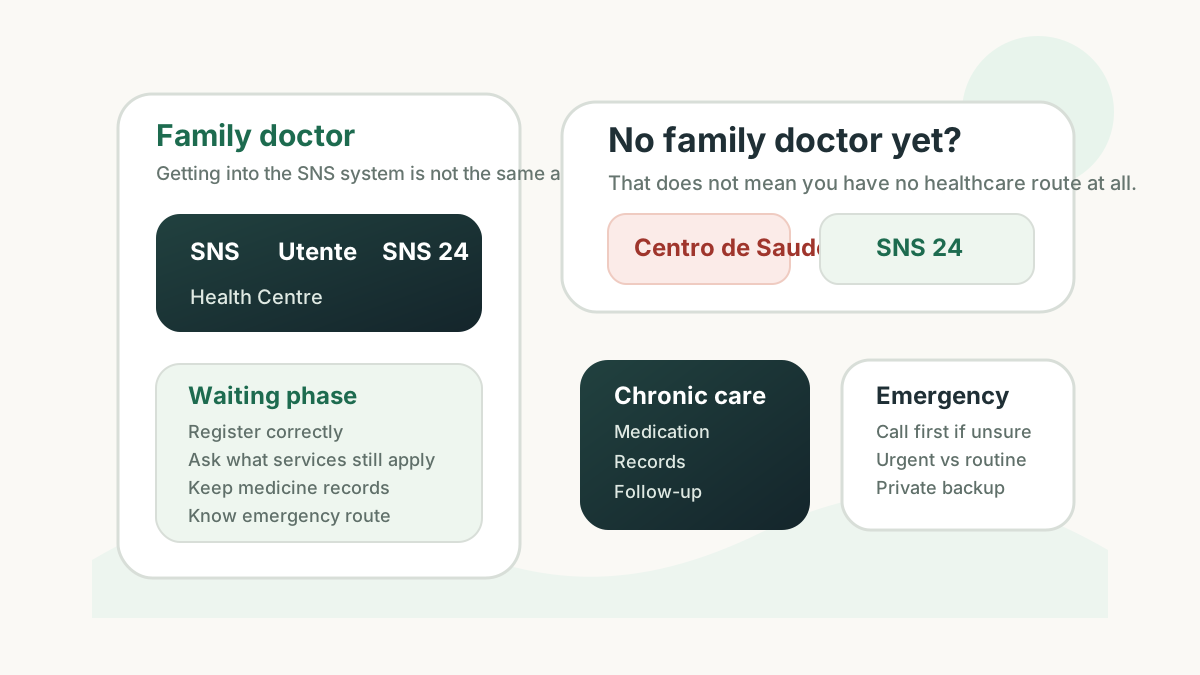
You went to your centro de saúde, got an utente number, and were told there was no family doctor available. What now? First, check whether your SNS registration is complete. Then ask your health centre how it provides consultations to people without an assigned doctor. You do not have to wait for a permanent médico de família before seeking medically necessary care.
Quick Answer: To apply for a family doctor in Portugal, register with your local public health centre, make sure your National Health User Register (RNU) record is registo atualizado, and request assignment to a family health team. If there is no vacancy, ask for the unit’s consultation route for unassigned patients. For a new or worsening non-life-threatening problem, call SNS 24: 808 24 24 24 for clinical triage. For a life-threatening emergency, call 112.
Last verified: 24 September 2026. The national registration rules below are distinct from each health centre’s appointment arrangements. Check your local unit’s current procedure.
First, identify where your application is stuck
Getting an SNS number, joining a health centre and receiving a family doctor are three different events. The RNU record’s administrative status is a fourth detail that now matters for eligibility and payment.
| Your situation | What to do next |
|---|---|
| You have no número de utente | Visit an SNS unit with your identification to request registration. You can usually arrange health-centre enrolment at the same visit if eligible. |
| You have a number, but no confirmed health-centre enrolment | Ask the centre to check your RNU registration type and your inscrição nos cuidados de saúde primários (CSP) separately. |
| You are enrolled but have no doctor | Ask whether your family is recorded for allocation and exactly how to request a consultation with an available clinician in the meantime. |
| You have a named doctor but cannot get an appointment | Contact the unit for its alternative-clinician or clinically appropriate urgent-access route; don’t assume being assigned guarantees an available slot. |
You can inspect some registration information through the SNS 24 portal or app. If the details are missing, unclear or outdated, ask the health-centre administrative team to check the RNU directly.
How to apply for a family doctor in Portugal
1. Register with the health centre serving your address
Find the centro de saúde that serves your residential area. If you don’t know which one it is, call SNS 24 and ask which local unit handles your address. Registration at a health centre is free.
Bring the documents relevant to your situation:
- A passport, Citizen Card or other accepted identification.
- Your existing SNS user number, if you have one. You do not need a previously issued number simply to approach an SNS unit for registration.
- Your NIF and residence documentation, where required for your registration category. EU residents staying more than three months may need their municipal EU registration certificate.
- Your Portuguese residential address and supporting evidence if the centre needs to verify it. The proof-of-address guide explains common Portuguese documents.
The ACSS says a residence permit can confirm an address; where that document is unavailable, the RNU process can accept evidence such as a rental agreement or utility bill. Exactly which additional residence information is needed depends on your nationality and circumstances. If you are starting without an SNS number, see the separate utente-number guide.
2. Ask the receptionist to confirm three separate statuses
A useful question at the desk is:
“Podem confirmar se o meu registo no RNU está atualizado, se estou inscrito nesta unidade e se tenho médico de família atribuído?”
Can you confirm that my RNU record is up to date, that I am enrolled at this unit, and whether I have an assigned family doctor?
Do not settle for “you are in the system”. Ask for clarification on the precise step that is outstanding. If you are eligible for enrolment but were previously removed from the primary-care list while your RNU record was incomplete, correcting the RNU record does not automatically restore that enrolment: ask the unit to arrange re-enrolment.
3. Request allocation and check whether your household has priority
Ask the unit to register your request for a family health team and make sure the household information is correct. In 2026, the ACSS allocation rules give priority to families that include a pregnant person, someone with a chronic illness or multiple conditions, or a child up to age 12.
Priority is not a guaranteed immediate appointment or doctor. Allocation still requires available family-doctor places at the relevant unit, an eligible RNU record and the other applicable criteria. If priority may apply, take relevant medical information and ask how the health centre records it; don’t assume staff will infer it from your address or an older clinical file.
If there are no vacancies, ask how the unit records your request and how you will be contacted if allocation becomes possible. Do not rely on an assumed national waiting-list duration or a promised allocation month.
The 2026 SNS registration rule that can block an application
The most consequential check for foreigners is whether their RNU record is complete, not simply whether an SNS number appears on a document.
| RNU status | What it means for a resident trying to get a doctor |
|---|---|
| Registo atualizado | Required data are present. The person may be eligible for primary-care enrolment and family-doctor allocation, subject to the remaining conditions and vacancies. |
| Registo em curso | Some required data are missing during the initial 180-day period. The person is not eligible for regular primary-care enrolment on this status; funding and prescription subsidies may differ. |
| Registo incompleto | Required data remain missing after 180 days. Enrolment eligibility and financial coverage remain affected until the record is corrected. |
According to the ACSS’s July 2026 RNU guidance, an incomplete record can place a person under third-party-payer conditions, rather than the normal SNS funding arrangement. This can affect what they pay for healthcare, medicines and diagnostic tests. Applicable exceptions and international coverage arrangements must be assessed individually. An incomplete administrative record is not a reason to refuse medically necessary assessment.
For foreign adults residing in Portugal, common RNU information includes identification, NIF, relevant residence details and a complete Portuguese address. Foreign minors have exceptions: the ACSS says a NIF and residence permit are not mandatory for their updated RNU registration. Do not delay a child’s healthcare while trying to meet an adult’s document checklist.
What if your residence card has expired? An expired date recorded in the RNU does not automatically change an otherwise updated record to incomplete. The unit may contact you to update the recorded residence information; bring your available evidence and have staff check your specific case rather than treating expiry as automatic loss of SNS registration.
What if you can’t travel to update your details? The ACSS says an authorised family member, caregiver or representative can present the necessary documents when you cannot attend in person. Ask the unit what it needs from the representative.
No family doctor available: how to see an SNS clinician
First establish whether you need planned care or assessment for a new health problem. These are not necessarily booked through the same channel.
For routine care, blood-test follow-up or an existing condition
Contact the health centre where you are enrolled and explain that you are an utente sem médico de família. Ask how the unit schedules a medical consultation for patients without an assigned family doctor. The local health administration (ULS) determines the arrangement: it might involve an available clinician, a designated unassigned-patient service or another appointment pathway. A ULS Lisboa Ocidental patient guide gives one operational example, not a guarantee that every centre uses the same system.
When booking, state the task rather than merely asking for “any appointment”: monitoring an existing diagnosis, interpreting an abnormal result, reviewing treatment or obtaining a clinically necessary specialist referral. Bring your existing reports so the clinician can decide what needs to happen next.
For a new illness or worsening symptoms
Call SNS 24 at 808 24 24 24. The clinical triage service can advise on the appropriate level of care and, when indicated and available, route you towards a health-centre consultation, teleconsultation or urgent assessment. An SNS 24 call is not an on-demand family-doctor appointment or a substitute for ongoing chronic-disease follow-up.
If symptoms are severe or you suspect an immediate threat to life, call 112. Do not wait for an ordinary health-centre appointment or a callback.
If you had a doctor, but they retired or became unavailable
Ask the centre whether you are still listed against that doctor, have been reallocated, or now appear as an unassigned patient. Then request a safe route for any current clinical need. A name still visible in the system is not proof that appointments are available.
Could you have lost your assigned doctor because you stopped using the SNS? The 2026 ACSS RNU rules allow a family-doctor place to be released after more than five years without contact with any SNS service—not merely five years without visiting your family doctor. People whose records remain updated keep primary-care enrolment even if they lose that allocation. If you recently noticed your doctor’s name disappear, ask the centre to check your last recorded SNS contact and allocation status rather than assuming your healthcare registration was cancelled.
If the problem is a system-wide shortage, changing centres solely to find a vacancy can have unintended consequences. Confirm enrolment and allocation arrangements with both units before requesting a transfer.
Ask whether your area has a separate service for unassigned patients
Some municipalities and local health units run additional consultation programmes for residents without a family doctor. For example, Leiria’s Projeto Bata Branca works alongside the SNS at participating local centres; the Caranguejeira parish published its April 2026 consultation timetable. This is a local example, not a nationwide appointment service. Ask your own health centre or ULS whether an equivalent programme exists, which patients qualify and where the current timetable is published. Do not rely on an older month’s schedule.
Can you keep a regular private GP without losing your SNS place?
Yes. You can see a private GP for ongoing care while remaining registered with the SNS. But a private doctor is not automatically your assigned SNS family doctor, even if they also work in the public system. Before booking, ask who pays for the consultation, whether the clinic has an actual SNS agreement covering that specific appointment, and how results and records will be shared. If your aim is a publicly funded specialist referral or diagnostic test, the ordinary rules in the blood-tests section below still apply.
Repeat prescriptions when you have no family doctor
There is no need to wait silently until your existing medication runs out. Contact the health centre early, tell it when the prescription expires and ask which clinician handles continuing medication for unassigned patients.
If your medicine appears under habitual medication in your SNS 24 account, you may be able to request a renewal digitally. Submitting a request does not itself renew the medicine: a prescriber must review and approve it, and not all prescriptions or medicines qualify. Where the portal route does not work, ask the health centre for its alternative procedure.
Bring a current medication list, doses, previous prescriptions and any relevant results. If medication is time-critical, explain the deadline when requesting clinical assessment. A pharmacy may explain lawful dispensing and availability, but do not assume it can supply a prescription-only medicine without an appropriate prescription.
Can a private doctor prescribe subsidised medicines? An ordinary private doctor can issue an electronic prescription, and some eligible medicines may still receive statutory SNS reimbursement where the prescription and the patient’s coverage meet the relevant conditions. However, reimbursement is not guaranteed for every medicine or every patient: an incomplete RNU record, medicine-specific rules and prescriber requirements can change what is payable. Check the actual prescription and coverage at the pharmacy.
Blood tests: can a private doctor order them through the SNS?
This is where paying for one private appointment can create an unexpected second bill.
A private doctor can order blood tests or scans, but a request from an ordinary private consultation is not automatically an SNS-funded diagnostic-test requisition. Under the prescribing rules explained by ULS Lisboa Ocidental, an SNS clinician cannot simply copy or transcribe private requests to make them publicly funded.
If you want the tests assessed for SNS coverage, book a clinical consultation through your health centre and take the private doctor’s report, symptoms and relevant history. The SNS clinician must make an independent medical decision and can request tests if clinically indicated. The same applies when an overseas doctor recommends follow-up tests after you move to Portugal.
Before paying privately, ask the clinic and laboratory what the consultation and tests will cost, whether any insurer covers them, who receives the results and who will act on abnormal findings. Using private care does not cancel an otherwise valid SNS registration, but it does not make every private test publicly funded either. Specialist exceptions and dedicated pathways, including certain pregnancy-care arrangements, may have different rules: ask the relevant SNS service rather than assuming the general private-test rule covers every situation.
For a broader comparison of costs and coverage, see public versus private healthcare in Portugal.
If you’re pregnant, have a child or need continuous monitoring
The allocation priority described earlier is about obtaining a family health team; it is not a reason to postpone care while waiting for one.
- Pregnancy: tell the unit immediately that you need prenatal follow-up. Ask which maternity or primary-care service will provide it, including any applicable tests and scans. Do not assume a privately requested pregnancy examination follows the ordinary private-laboratory reimbursement process.
- Children: ask your local unit about child-health consultations and the national vaccination programme independently of family-doctor assignment. A ULS patient guide confirms its vaccination service can arrange national-programme vaccines even for children without an assigned doctor; confirm local scheduling requirements.
- Chronic illness or multiple conditions: ask for a named route for clinical review and repeat monitoring, not merely allocation status. Take the diagnosis summary and any results that need action before your next visit.
If your current health needs cannot safely wait for the next routine slot, tell the unit that explicitly and use SNS 24 for clinical triage.
The health centre says no: what exactly has been refused?
“There are no family doctors” and “we cannot register you” are different problems, with different solutions.
- No doctor vacancy: ask the centre to confirm your primary-care enrolment, explain the allocation process and identify its current consultation arrangements for unassigned patients.
- RNU record not eligible: ask which exact fields are missing, which documents will correct them, and whether your primary-care enrolment needs to be created again after the update.
- No available appointment despite a clinical need: explain the medical timescale, ask what alternative clinical-access route the unit offers, and contact SNS 24 if this is an acute issue requiring triage.
If administrative explanations remain inconsistent, write down the date, unit and reason given. Request clarification from the unit’s administrative lead or Gabinete do Cidadão within its ULS. If unresolved, the Health Regulatory Authority (ERS) explains patient rights and complaint routes; the official Livro de Reclamações is another formal route. A complaint does not replace clinical triage when care is needed now.
A short message you can show at reception
Portuguese: “Tenho número de utente, mas ainda não tenho médico de família. Podem verificar a tipologia do meu registo no RNU e a minha inscrição nesta unidade? Preciso de saber como marcar uma consulta para [motivo clínico] enquanto aguardo a atribuição de médico.”
English: “I have an SNS user number but no family doctor. Could you check my RNU status and enrolment at this unit, and tell me how to book a consultation for [health reason] while I wait for allocation?”
Ask for the correct appointment or administrative procedure and a way to follow up. There is no single nationwide appointment-release time, waiting-list length or guarantee of an English-speaking clinician.