

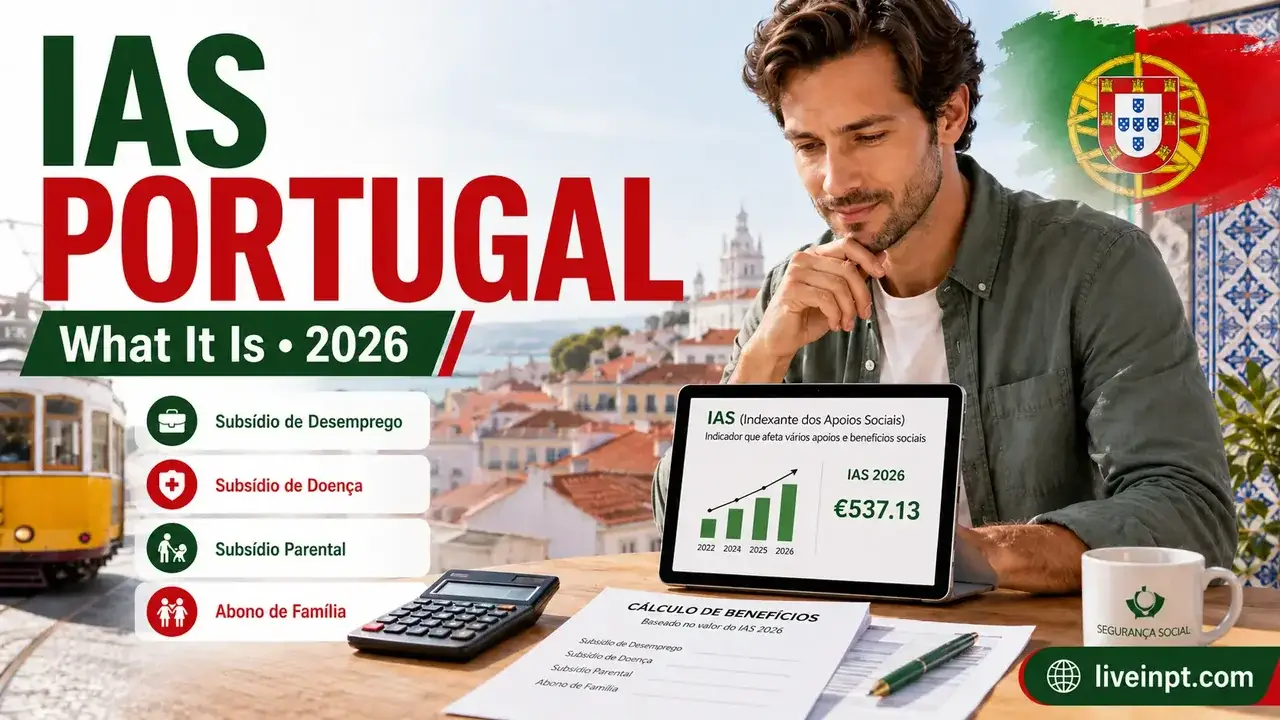
The IAS value in Portugal is €537.13 in 2026. It applies from 1 January 2026 under Portaria n.º 480-A/2025/1.
If you are seeing €522.50 or €509.26 on older pages, those are not the current IAS. They are the official values for 2025 and 2024.
Quick Answer: IAS stands for Indexante dos Apoios Sociais. It is a reference amount used in Portuguese social-security and tax rules. The 2026 IAS is €537.13, up 2.8% from €522.50 in 2025.
IAS Portugal 2026 at a glance
| Year | IAS value | Change |
|---|---|---|
| 2026 | €537.13 | +2.8% |
| 2025 | €522.50 | +2.6% |
| 2024 | €509.26 | +6.0% |
The government updates the IAS annually. The 2026 increase was €14.63 per month compared with 2025.
IAS is not a benefit payment by itself. Different rules use the index in different ways: as a minimum, maximum, income threshold, asset threshold, tax deduction or exemption limit.
Common IAS multiples in 2026
If a rule says “2× IAS” or “55× IAS”, these are the corresponding 2026 amounts:
| IAS multiple | 2026 amount | Where you may see it |
|---|---|---|
| 0.5× | €268.57 | Reference amount in some social-support rules |
| 0.8× | €429.70 | Income threshold used in certain social benefits |
| 1× | €537.13 | The 2026 IAS itself |
| 1.15× | €617.70 | Minimum unemployment benefit in certain cases |
| 1.5× | €805.70 | Used as a multiplier in some support schemes |
| 2× | €1,074.26 | Used as a multiplier in some support schemes |
| 2.5× | €1,342.83 | Maximum standard unemployment-benefit ceiling |
| 3× | €1,611.39 | Used as a multiplier in some support schemes |
| 8.54× | €4,587.09 | 2026 IRS specific deduction reference |
| 12× | €6,445.56 | Twelve times the monthly IAS |
| 55× | €29,542.15 | 2026 IRS Jovem exemption limit |
| 240× | €128,911.20 | Movable-assets threshold in several means-tested benefits |
The arithmetic is simple: multiply €537.13 by the IAS multiple in the rule you are checking. The important part is confirming that the rule actually uses the 2026 IAS, because some calculations refer to income or thresholds from an earlier year.
Why you may still see €522.50 or €509.26
This is one of the easiest IAS mistakes to make, and it’s usually the first thing I have to correct when someone forwards me a benefit calculation that doesn’t add up.
- €537.13 = IAS for 2026
- €522.50 = IAS for 2025
- €509.26 = IAS for 2024
Older Segurança Social pages, archived guides and search snippets can continue to show the previous year’s amount. Some schemes also assess income from a previous reference year, so an older IAS can legitimately appear inside a current-year calculation.
For example, family-benefit income bands can depend on the income year being assessed. If you are checking an abono de família calculation, use the IAS specified for that calculation rather than automatically substituting €537.13.
For a simple question — “what is the IAS value today in 2026?” — the answer is €537.13.
What the IAS changes in practice
Unemployment benefit
Portugal’s standard unemployment benefit is calculated from reference earnings, but IAS sets important limits.
In 2026:
- the general IAS reference is €537.13;
- where the salaries used in the calculation are at least the 2026 minimum wage, the minimum can be 1.15× IAS = €617.70;
- the maximum is 2.5× IAS = €1,342.83, subject to the other statutory limits.
When someone tells me their unemployment estimate doesn’t match this ceiling, it’s almost always because they’re mixing last year’s salary bracket with this year’s IAS. That is why knowing the IAS matters even when the benefit starts from your previous salary.
IRS and IRS Jovem
IAS also appears outside Segurança Social.
For 2026, the Portuguese Tax Authority states that:
- the specific deduction for employment and pension income uses 8.54× IAS = €4,587.09;
- the IRS Jovem exemption limit is 55× IAS = €29,542.15.
The AT’s own annual newsletter states these limits as multiples of IAS rather than spelling out the euro figure, which is exactly why the numbers need recalculating each time the index moves. So a change in IAS can affect tax thresholds as well as social benefits.
Family and means-tested benefits
Some social benefits use IAS to define income or asset limits.
A common example is 240× IAS. In 2026 that equals €128,911.20. gov.pt uses this figure as the movable-assets ceiling in the family-benefit rules it publishes. I’ve seen people apply the current year’s IAS to an asset test that’s actually keyed to a different assessment year, then get confused when their own math doesn’t match what Segurança Social tells them.
Other benefits use different percentages or multiples, so do not assume that every Segurança Social payment is simply “one IAS”. Use the specific rule for the benefit you are checking.
For the wider system, see the Portugal social security benefits guide.
IAS vs Portugal’s minimum wage
They are separate figures.
| IAS 2026 | Mainland minimum wage 2026 | |
|---|---|---|
| Amount | €537.13 | €920 |
| Main purpose | Reference for social-security and tax calculations | Minimum monthly pay for covered employment |
| Same figure? | No | No |
Whenever someone asks me if a minimum-wage increase means their benefit went up too, I have to explain that the two figures move on completely separate schedules. A rise in the minimum wage does not automatically make IAS the same amount. Each figure has its own legal role.
If you are trying to understand an employment salary rather than a benefit threshold, see the employment contract guide.
Where IAS commonly appears
You may come across IAS while dealing with:
- unemployment benefit;
- sick leave;
- parental leave;
- child benefit;
- IRS Jovem;
- other Segurança Social income and asset tests.
If you are new to the Portuguese system and still need your Social Security number, the separate NISS guide explains that process.
Frequently asked questions
What is the IAS value in Portugal in 2026
The official 2026 IAS is €537.13. The value took effect on 1 January 2026.
What does IAS Valor mean
“Valor do IAS” simply means the IAS value. IAS is short for Indexante dos Apoios Sociais, the reference index used in many Portuguese social-security and tax calculations.
Is €522.50 still the IAS value
No. €522.50 was the 2025 IAS. For 2026, use €537.13 unless the specific rule you are checking deliberately refers to a previous reference year.
How much is 2.5 IAS in 2026
2.5× IAS = €1,342.83 in 2026.
How much is 55 IAS in 2026
55× IAS = €29,542.15 in 2026. This is the 2026 IRS Jovem annual exemption limit identified by the Portuguese Tax Authority.
Where can I verify the IAS officially
The legal 2026 value is in Portaria n.º 480-A/2025/1 in the Diário da República. DGAEP also publishes an official table showing IAS values by year.
For 2026, the number to use as the current IAS is €537.13. Check the multiplier and reference year in the rule you are applying before turning it into a benefit, tax or eligibility amount.