

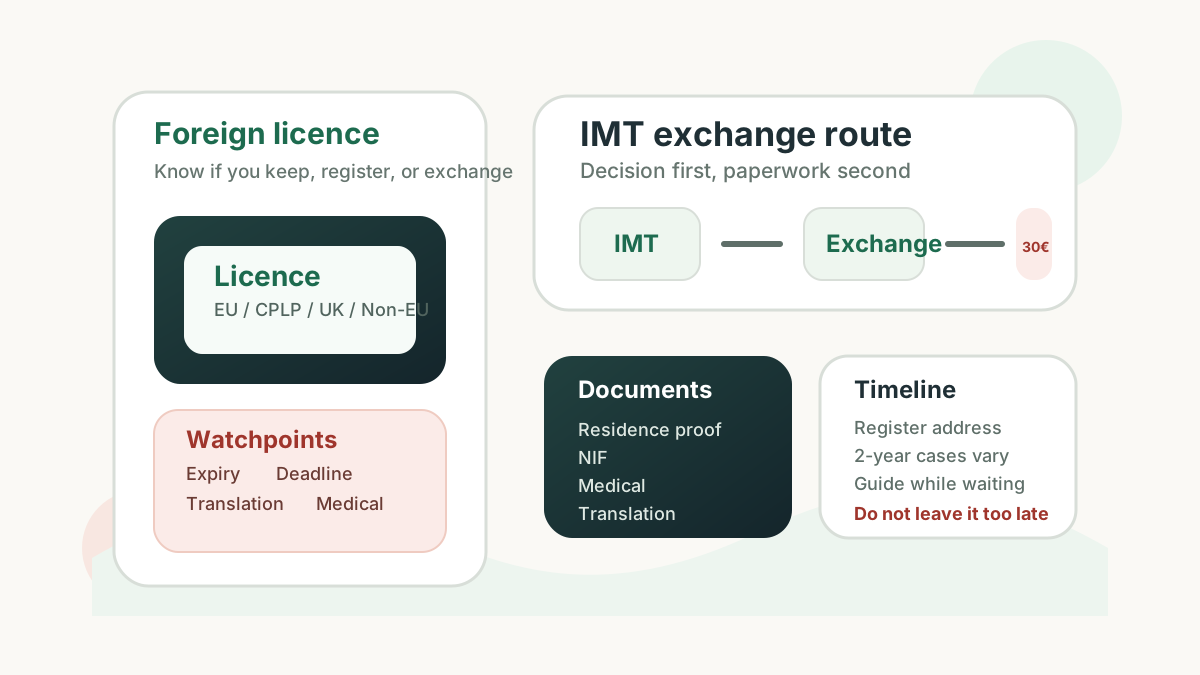
Driving in Portugal with a foreign licence looks simple until you become a resident, buy a car, or discover the rule for your country isn’t the rule your neighbour quoted you at a barbecue.
That is where most bad advice starts. People repeat “you have two years,” “you only need to register,” or “UK licences are fine,” without checking whether the advice matches their residency status and the specific country that issued their licence. In practice, Portugal splits foreign licences into five separate regimes, and each one has its own deadline, its own document list, and its own fee structure.
This guide walks through IMT’s current rules in the right order: can you drive as you are, do you only need to register your address, or do you need to exchange the licence now, and exactly how to do that through the correct portal.
Last verified: July 30, 2026, against IMT’s own country-by-country pages and gov.pt. IMT refreshed its country-group pages on 1 June 2026 and gov.pt refreshed its master service page on 6 March 2026, so this article reflects the current text of both. Rules, fees, and country lists can still change; always cross-check anything time-sensitive against IMT directly before you rely on it.
Quick answer
Quick Answer: Some foreigners can keep driving in Portugal on their foreign licence indefinitely. Others must register their address with IMT. Others must exchange the licence for a Portuguese one, on a deadline that depends on when they got their residence permit. The answer depends on:
- the country that issued the licence, and which of IMT’s five regimes it falls under
- whether you’re already resident in Portugal, and for how long
- whether the licence is still valid, and whether it has an expiry date at all
- what category of vehicle the licence covers
If you become resident in Portugal, don’t assume the licence question can wait until you buy a car or until the foreign document expires. For most non-EU/EEA countries, residency starts a clock that keeps running whether you notice it or not.
Who this guide is for, and where it stops
This guide is for foreigners who already drive in Portugal, or who are still moving from the US or elsewhere and want to know if their current licence will still work once they land. It covers private cars and motorcycles under the standard categories. It doesn’t cover professional certification for taxi, TVDE, or heavy-goods driving beyond a short note on where that connects to the exchange, and it doesn’t cover renewing a Portuguese licence you already hold. It’s general information, not personal legal advice, and not a substitute for confirming your specific case with IMT.
The five regimes, at a glance
IMT sorts every foreign licence into one of five groups. Everything else in this guide follows from which group yours falls into.
| Your licence is from… | Can you drive on it now? | Do you ever have to exchange it? |
|---|---|---|
| EU or EEA (Norway, Iceland, Liechtenstein) | Yes, until it expires | Only if you want to, or if it has no expiry date (then within 2 years of residence) |
| The 17-country OECD/CPLP list (see below) | Yes, indefinitely, if you meet the conditions | No, unless you choose to |
| A country with a bilateral agreement, or a convention signatory not on the 17-country list | Yes, for 185 days as a visitor; then on a tiered deadline once resident | Yes, on the 90-day / 2-year tiers below |
| Not a party to any relevant convention | No, not at all | Yes, immediately, with driving exams |
| Ukraine, under temporary protection status | Yes, for 185 days, then on the same tiers as above | Yes, but fees are waived |
Foreign driving licence rules by country
The table below assumes an ordinary private-car licence (category B). Heavy and professional categories can involve additional medical, psychological, or testing requirements.
| Country | IMT regime | Can a resident keep using the foreign licence? | Is exchange required? | Main rule |
|---|---|---|---|---|
| United Kingdom | Named OECD/CPLP regime | Yes, if all conditions below are met | No; exchange is optional | The licence must be valid, the holder must be under 60, and no more than 15 years may have passed since issue or last renewal. People already resident in Portugal before Brexit follow the EU/EEA rules. |
| United States | Named OECD/CPLP regime | Yes, if all conditions below are met | No; exchange is optional | The same under-60, validity, and 15-year conditions apply. The permission is for driving in Portugal only. |
| Canada | Named OECD/CPLP regime | Yes, if all conditions below are met | No; exchange is optional | The same under-60, validity, and 15-year conditions apply. |
| Brazil | Named OECD/CPLP regime | Yes, if all conditions below are met | No; exchange is optional | For a voluntary exchange, certain Brazilian light-vehicle licences issued from 18 May 2017 with a QR code are exempt from the usual authenticity declaration. |
| Australia | Named OECD/CPLP regime | Yes, if all conditions below are met | No; exchange is optional | The same under-60, validity, and 15-year conditions apply. |
| New Zealand | Named OECD/CPLP regime | Yes, if all conditions below are met | No; exchange is optional | The same under-60, validity, and 15-year conditions apply. |
| Japan | Named OECD/CPLP regime | Yes, if all conditions below are met | No; exchange is optional | The same under-60, validity, and 15-year conditions apply. |
| Switzerland | Named OECD/CPLP regime | Yes, if all conditions below are met | No; exchange is optional | The same under-60, validity, and 15-year conditions apply. |
| India | International road-traffic convention country | Only during the first 90 days after taking up residence | Yes, to keep driving after 90 days | Visitors may drive for up to 185 days before becoming resident. Residents can request the exchange within 2 years without a practical test for an ordinary category B licence; after 2 years, a practical test is required. |
| Pakistan | International road-traffic convention country | Only during the first 90 days after taking up residence | Yes, to keep driving after 90 days | Pakistan is a party to the international road-traffic conventions. The same 185-day visitor rule and 90-day/2-year resident deadlines apply to an ordinary category B licence. |
Conditions for the named OECD/CPLP regime: the licence must be valid and not suspended or revoked; the holder must be under 60; no more than 15 years may have passed since issue or last renewal; and the holder must meet Portugal’s minimum age for the relevant category. This permission applies only in Portugal.
When you can drive with a foreign licence, and when the clock starts
The 17 countries where you may never have to exchange
Under Decreto-Lei n.º 46/2022, in force since 1 August 2022, IMT lets drivers from a specific list of OECD and CPLP countries keep driving in Portugal on their original licence, even after becoming resident, as long as they meet all of the following:
- fewer than 15 years have passed since the licence was issued or last renewed
- the holder is under 60 years old
- the licence is valid, and not seized, suspended, expired, or cancelled anywhere
- the driver meets Portugal’s minimum age for that vehicle category
The countries covered are Angola, Australia, Brazil, Cabo Verde, Canada, Chile, the United States, Iceland, Israel, Japan, Mozambique, New Zealand, the United Kingdom, South Korea, São Tomé e Príncipe, Switzerland, and Turkey. I keep seeing people assume this list is just “OECD countries,” but it’s a named list, not a category, so it’s worth checking your specific country against it rather than reasoning from the acronym.
This is an authorization to drive in Portugal, not a licence swap. It doesn’t let you add categories you don’t already hold, and it doesn’t cover professional annotations. If you want a Portuguese licence anyway, or you need to add a category, you still exchange it the normal way, and IMT waives the practical and theory exams for people in this group, though the medical and psychological fitness checks still apply.
If your country isn’t on that list, but is a convention signatory or has a bilateral deal
A much longer list of countries, including India, Poland, most of the EU’s non-member neighbours, and roughly ninety others, signed the 1949 Geneva or 1968 Vienna traffic conventions. A smaller separate list of countries, currently including Andorra, Angola, Cabo Verde, Mozambique, São Tomé e Príncipe, Switzerland, the United Arab Emirates, and Morocco, has a direct bilateral agreement with Portugal. Either status lets you drive in Portugal on the foreign licence for 185 days from the day after you enter the country, as long as you haven’t yet taken up residence. Don’t confuse this with the Schengen 90/180-day rule that governs how long you can stay in the first place; they’re separate clocks, run by separate authorities, and hitting one limit doesn’t reset the other.
Once you do take up residence, the deadline structure has three tiers, and this is the part most generic advice flattens into a single “two years” rule:
| Time since your residence permit was issued | Can you still drive on the foreign licence? | Can you still request the exchange? |
|---|---|---|
| 0 to 90 days | Yes | Yes, and you should file now |
| 90 days to 2 years | No | Yes, still without a driving exam |
| After 2 years | No | Yes, but only after passing a practical driving exam |
In other words, the foreign licence stops being valid to drive on well before your two-year window to request the exchange runs out. Filing the request on day 89 doesn’t buy you extra driving time. If you know you’ll need to drive for work, school runs, or anything else, file in the first 90 days, not the last week of year two.
If your country isn’t party to any relevant convention
These licences aren’t valid to drive in Portugal at all, from day one. If you want to drive, you request the exchange immediately, and you must pass both a multimedia theory test and a practical driving test for every category on your foreign licence. Each test costs an extra €30 on top of the base exchange fee, under Portaria n.º 1165/2010.
Registration vs. exchange, explained properly
Registration applies only to EU or EEA licence holders. You keep driving on the community licence until it expires; what changes on moving here is that you must register your Portuguese address with IMT within 60 days, free, at an IMT service counter for your area rather than through the exchange portal. The one exception: an EU/EEA licence with no expiry date printed on it (some older or “lifetime” formats) must still be exchanged within 2 years of taking up residence.
Exchange means surrendering the foreign licence to receive a Portuguese one. Everyone outside the EU/EEA and the 17-country list deals with this eventually, on the tiers above.
How to actually apply
IMT runs the foreign-licence exchange through a specific portal called A Minha Carta de Condução (aminhacartadeconducao.imt-ip.pt). This is not the same login as the general IMT Online site people use for renewals or replacements, which trips a fair number of applicants up when they can’t find the right form. The steps are the same across every regime that requires or allows an exchange:
- Get the medical certificate first. Your doctor issues it and uploads it directly to IMT’s electronic medical-certificate platform. You never submit a copy yourself; it’s transmitted automatically once your doctor files it. A same-day telehealth appointment with a private GP works fine for this and is often the fastest route, since the certificate only needs to reach the platform, not you.
- Log into A Minha Carta de Condução, register an account if you don’t have one, and fill in the exchange form.
- Attach your documents (see the table below) and submit.
- Pay the fee. Base cost is €30, reduced by 10% (to roughly €27) if you pay through the online portal rather than in person. In my experience it’s worth paying online beyond just the discount, since it timestamps your submission, and that timestamp matters if you’re racing the 90-day cutoff.
- Watch the portal and your email for IMT’s next instruction. Depending on your case, IMT can move the request into technical analysis, ask you to correct something, or tell you that an appointment is needed. If IMT calls you in, follow the attendance instructions shown for your request.
Already submitted? Use our IMT driving licence exchange status tracker for Em Análise, Requer Ação, Aguarde atendimento, appointment instructions, delays and issuance. This guide stays focused on eligibility and how to apply.
One more thing worth knowing before you start: the exchange mirrors your original licence, it doesn’t upgrade it. If your foreign licence only covers motorcycles, your new Portuguese one will too, and that’s only obvious the first time you try to rent a car and get turned away at the counter.
You can choose to have the new card mailed to an address of your choice, or collect it at an IMT counter.
Documents IMT usually asks for
| Document | When it applies |
|---|---|
| ID document | Always |
| Proof of residence via the Câmara Municipal | If you don’t hold a Cartão de Cidadão |
| Tax domicile certificate (Portal das Finanças) | If your address isn’t already on your residence document |
| Passport | If your residence document lacks a photo and signature |
| The foreign driving licence | Always |
| Psychological evaluation certificate | Only for categories C, D or E |
| Certificate of authenticity from the issuing authority or consulate | OECD/CPLP and bilateral/convention groups (see the Brazil note below) |
The certificate of authenticity is the one document that quietly derails timelines. It has to state which categories were obtained by exam and which by equivalence, and getting it usually means contacting the issuing country’s authority or its consulate in Portugal. If your country falls into a group that needs one, start that piece first, not last.
The Brazil exception worth knowing about
Brazilian licences issued from 18 May 2017 onward, identifiable by a QR code on the back, are exempt from needing the consulate’s authenticity statement for light-vehicle categories, a simplification gov.pt introduced in 2022. Heavy-vehicle categories still require a certidão from Brazil’s Denatran regardless of issue date. This carve-out is a few years old now, and I’d confirm it directly with IMT before you rely on it, especially if your licence sits close to that May 2017 boundary.
How Long Does IMT Take to Exchange a Foreign Driving Licence?
Gov.pt gives an average 60-day delivery period for the Portuguese licence, except when the exchange requires a practical driving test. That is an overall delivery average, not a guaranteed deadline for IMT’s Em Análise stage.
If you have already applied and are trying to work out why the request is not moving, use the IMT driving licence exchange status tracker. It explains the portal stages, Requer Ação, appointment messages and what the 60-day figure does and does not mean.
Group II, TVDE, and taxi driving: the annotation most guides skip
I get this question from readers doing TVDE or taxi work more often than almost any other part of this process, so it’s worth stating plainly. Portugal splits categories into Group I (AM, A1, A2, A, B1, B, BE, mopeds, agricultural tractors) and Group II (C1, C1E, C, CE, D1, D1E, D, DE, plus B or BE holders driving ambulances, fire vehicles, patient transport, school transport, or licensed passenger-for-hire vehicles, which covers taxis).
If you’re planning to drive TVDE or taxi on a category B licence, you’ll eventually need the Group II annotation, national code 997. For a foreign licence holder, IMT is explicit that you cannot get that annotation without first completing the full exchange to a Portuguese licence. There’s no shortcut where you keep the foreign document and just add the annotation on top.
Lost or stolen foreign licence
You can still request the exchange without the original document. Ask the competent authority in your licence’s country of origin for a certidão de título extraviado (a lost-title certificate), and submit that in place of the physical licence when you file. I’ve seen readers assume a Portuguese police report alone would satisfy this step; it won’t, since IMT wants the replacement certificate from the country that actually issued the licence.
Ukrainian citizens under temporary protection
Portugal’s temporary protection status under Lei n.º 67/2003 gets the same 185-day allowance and 90-day / 2-year tiers as the convention/bilateral group above, but with two differences: every fee is waived, for both the exchange and professional certification, and the resulting Portuguese licence is valid for one year, renewable if the protection status is extended.
A live fraud warning worth repeating
IMT has an active alert running for fraudulent SMS messages that impersonate the institute and link to malicious sites, and a longer-running warning about schemes on social media and SMS that promise to “obtain” a driving licence for a fee. IMT does not request payment or personal data by SMS, and it does not process any payment through social media. Paying for a fraudulent licence, and issuing one, are both criminal offences. If a message about your exchange asks you to click a link and pay urgently, that’s the tell, not the process working faster than expected.
Common mistakes
- assuming every non-EU licence follows the same rule, when Portugal actually runs five separate regimes
- confusing the 90-day driving cutoff with the 2-year filing deadline, and filing late because “I still have two years”
- treating the OECD/CPLP indefinite-driving list as if it covers every OECD country, rather than the specific 17 named countries
- forgetting that a lifetime or no-expiry EU/EEA licence still triggers a mandatory exchange within 2 years of residence
- uploading only the front of a residence card or ID document and leaving the back out, which is a small enough gap to stall a file for months without anyone flagging it to you
- starting the exchange without first sorting out the certificate of authenticity, then losing weeks waiting on it
- assuming the whole process is online, then being caught off guard by the mandatory in-person handover appointment
- buying a car or insurance before checking whether the licence issue is already time-sensitive, or whether your insurer is even comfortable with your current licence status
- responding to an SMS or social media message that asks for payment to speed up a licence
When to contact IMT
IMT’s Call Center is 210 488 488, staffed 9:00 to 17:00, and takes both national and international calls at your normal carrier rate. For anything written, use the contact form at imt-ip.pt/contactos, which has a specific category for “Troca de carta estrangeira” so your query routes correctly. Contact IMT directly if you’re not sure whether your case is registration or exchange, your issuing country is hard to classify against the lists above, or your licence is close to expiry.
If the application is already submitted and the problem is a portal status, missing notification, Requer Ação, appointment step or delay, check the status guidance first so you can tell whether IMT is actually waiting for something from you.
Practical checklist before applying
- Which of the five regimes does my issuing country fall into?
- Am I already resident in Portugal, and if so, how many days since my residence permit was issued?
- Do I only need to register my address, or do I need a full exchange?
- Is my licence still valid, and does it have an expiry date at all?
- Do I need a certificate of authenticity, and have I started requesting it?
- Do I already have my Portuguese tax number and residence proof ready? A NIF and current proof of address will both be asked for.
- Will I need Group II for taxi or TVDE work, and have I planned the exchange around that?
- Have I checked with my insurer before buying a car?
Frequently asked questions
How do I exchange a foreign driving licence at IMT in Portugal?
You apply through IMT’s dedicated portal, A Minha Carta de Condução, not the general IMT Online site. Submit your medical certificate electronically, attach your documents, pay the fee, then wait for IMT to schedule an in-person appointment to collect the physical licence and your biometrics.
Can I exchange a Brazilian driving licence for a Portuguese one?
Yes. Brazil is on the 17-country OECD/CPLP list, so a valid Brazilian licence lets you keep driving indefinitely without exchanging it, or you can exchange voluntarily. Licences issued from 18 May 2017 with a QR code skip the consulate authenticity statement for light-vehicle categories.
Is my UK driving licence still valid to drive in Portugal after Brexit?
Yes, the UK sits on the named 17-country list, so a valid UK licence works without exchange under the usual conditions. Anyone resident in Portugal before Brexit follows the EU/EEA rule instead.
Is an Indian driving licence valid to drive in Portugal?
Yes, India signed the international traffic conventions, so an Indian licence is valid for 185 days as a visitor and exchanges without a driving exam. India isn’t on the 17-country indefinite-driving list, so residents still work through the 90-day/2-year deadlines.
Can I still drive while my IMT licence exchange is being processed?
That depends on your licence regime, residence timeline and whether IMT has issued a valid provisional document for your case. A submitted or Em Análise status is not itself permission to drive. If you have already filed, the IMT status tracker explains how the pending status and provisional-guide stage fit together.
What is Group II on a Portuguese driving licence, and do I need it for TVDE or taxi driving?
Group II covers heavier categories and category B/BE drivers working ambulances, school transport, or licensed passenger-for-hire vehicles like taxis. Foreign licence holders cannot get the Group II annotation without first completing the full exchange.
What documents do I need to give IMT?
An ID document, proof of residence, your foreign licence, a tax domicile certificate if needed, a psychological evaluation for categories C, D or E, and usually a certificate of authenticity from the issuing country.
How much does it cost to exchange a foreign driving licence in Portugal?
€30 base fee, about €27 if paid online. Add €30 per theory or practical exam if your licence is from a non-convention country.
How long does IMT take to issue the new licence?
Gov.pt gives an average 60-day delivery period, but it is not a guaranteed deadline for the technical-analysis stage.
Is the process online or in person?
The application starts online through A Minha Carta de Condução. If IMT requires an attendance step for your case, the portal or notification tells you to book it. The current IMT workflow does not make the same in-person instruction apply identically to every applicant.
Summary
The biggest mistake with foreign driving licences in Portugal is treating every foreigner as if they face one rule. IMT runs five separate regimes, each with its own deadline and document list, and the gap between “I can still drive” and “I still have time to file” trips up more people than the paperwork itself.
Work out which regime you’re in, file within the first 90 days if you’re outside the EU/EEA and the 17-country list, and start the authenticity certificate early if your country needs one. Handled that way, it’s a fee and an appointment. Left until an insurance deadline or an expired licence forces the issue, it gets stressful fast.