

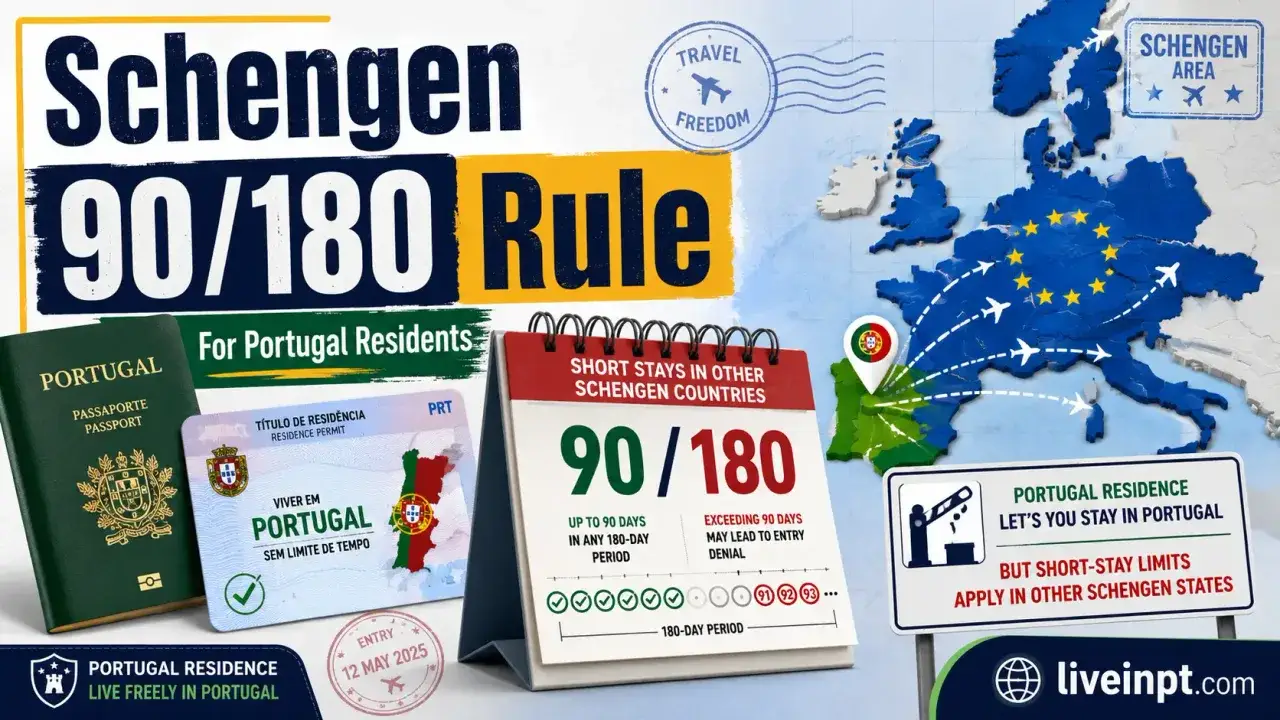
The rule itself is simple. Its interaction with a Portuguese residence card is where the confusion begins.
The Schengen 90/180 rule applies to short-stay visitors — not to people who live in the Schengen Area. If you hold a valid Título de Residência (residence card) or a valid Portuguese long-stay D visa, you’re not a short-stay visitor in Portugal. The clock doesn’t run against you while you’re home.
Cross into Spain for a long weekend, spend a month with family in France, or work a stretch from an apartment in Berlin — and the calculation changes. The 90/180 rule exists for you in all of those places. The common mistake is thinking the Portuguese exemption covers the whole of Europe.
This guide covers who is exempt and who isn’t, how days count when you travel outside Portugal, what the pending renewal period means for travel, and what to carry at border crossings.
Quick Answer: If you hold a valid Título de Residência (Portuguese residence card) or a valid Visto Nacional long-stay D visa, the Schengen 90/180 rule does not restrict your time in Portugal — Portugal is your country of legal residence. When you travel to other Schengen states, you can normally make short visits of up to 90 days in any rolling 180-day period, provided you carry a valid passport and residence document and meet normal short-stay conditions. Days in Portugal do not count toward that limit. Days in Spain, France, Germany, Italy, or any other Schengen member state do.
How the 90/180 Rule Actually Calculates
Under Regulation (EU) 2016/399 — known as the Schengen Borders Code — third-country nationals without a residence permit or long-stay visa may stay in the Schengen Area for a maximum of 90 days in any 180-day period.
The critical point most people miss is that the 180 days is a rolling window. It is not a calendar semester, not January to June, not six months from the date you first entered. Every single day, you look back exactly 180 calendar days from today and count. If your total presence in the relevant Schengen states is 90 or fewer, you’re within the rule.
Both your entry day and your exit day count as full days of presence. Someone who flies into Madrid on a Friday afternoon and returns to Lisbon on Sunday evening has used three days, not one night. Over several short trips, the difference between what people think they’ve used and what border records show can grow quickly.
Days in Portugal under your residence card or D visa are not part of this count at all. They don’t appear in the equation.
If You Hold a Residence Card, You’re Exempt — in Portugal
This is the part the official guidance glosses over without making obvious.
The 90/180 rule applies to short stays. A person holding a valid Título de Residência (autorização de residência) is not making a short stay in Portugal — they live there. The European Commission confirms this explicitly: periods of stay authorised under a residence permit or long-stay visa are not taken into account when calculating visa-free duration.
The same exemption applies if you hold a valid Portuguese Visto Nacional (long-stay national visa, also called a Type D visa). This covers the D7 passive income visa, the D8 digital nomad visa, the D2 entrepreneurship visa, the D3 qualified professional visa, and other long-stay categories. While your D visa is valid and you’re living in Portugal, those days in Portugal are outside the 90/180 calculation entirely.
This matters most in the first months after arrival. If you’ve entered Portugal on a D7 visa and are waiting for your AIMA biometrics appointment, you are not burning through Schengen days. Your days in Portugal while on a valid D visa don’t count. The clock is not running.
Traveling to Other Schengen States — What Article 21 Gives You
A valid Título de Residência, combined with a valid passport, normally allows you to enter other Schengen member states for short visits under Article 21 of the Convention Implementing the Schengen Agreement (CISA). This is a short-stay travel allowance, not EU free movement and not a right to live or work in another country.
The allowance is capped. You have 90 days in any 180-day rolling window across all other Schengen states combined. A month in France, three weeks in Germany, a long weekend in Amsterdam — all of it accumulates in a single bucket. It is not 90 days per country. It is 90 days total across all non-Portugal Schengen territory.
People who base themselves in Lisbon but regularly travel to other European cities for work need to track this carefully. Holding a D8 digital nomad visa gives you residence rights in Portugal. It does not give you unlimited time in Spain or Italy. Article 21 caps you regardless of which Portuguese visa or permit type you hold.
The Pending Renewal Gap — Where Real Problems Happen
AIMA (Agência para a Integração, Migrações e Asilo) is legally permitted to take many months to process a renewal. Your right to remain in Portugal while a renewal is pending is recognised under Portuguese law — this is called the direito de permanência (right to remain). Your legal status in Portugal doesn’t lapse the moment your card expires, provided you submitted the renewal application in time and can demonstrate that.
The problem is that this protection exists under Portuguese law. It is not the same as holding a valid Schengen travel document for other member states, and border officers in other Schengen countries are not bound by it.
When you present at another Schengen border with an expired Título de Residência and a Comprovativo de Submissão de Pedido (AIMA submission confirmation receipt), you are asking the officer to admit you based on a Portuguese-language document from a Portuguese immigration agency they may have no practical way to verify. Some people pass without difficulty. Others face extended questioning or are turned back. The outcome depends on the country, the crossing point, the officer, and whether your documentation looks complete and professional.
The cleanest approach during a renewal gap is to avoid non-Portugal Schengen travel entirely until AIMA issues your new card. If the trip cannot be postponed, carry your expired card, your AIMA Comprovativo de Submissão de Pedido, and every piece of AIMA-issued correspondence you have. The AIMA residence card guide covers the renewal process in detail, including what AIMA typically issues while a renewal is in progress.
EES and Digital Border Records — What Changes for Residents
The Entry/Exit System (EES) started on 12 October 2025 and was introduced progressively across Schengen external borders. It is designed for non-EU nationals travelling for short stays, not for holders of valid residence permits or long-stay visas.
For ordinary short-stay visitors, EES makes the 90/180 rule easier to enforce because entry and exit records become digital. For Portugal residents, the practical message is simpler: your valid passport and valid Portuguese residence card matter even more when a border officer needs to understand why your time in Portugal should not be treated as ordinary tourist days.
The expired-card problem during a renewal gap also becomes more sensitive. An officer who sees a fuller digital picture of your crossings may still need a valid residence document to understand your status. Carrying complete, current documentation of your legal status in Portugal is important, but it does not make an expired card equivalent to a valid Schengen travel document.
How to Calculate Your Days Correctly
The European Commission maintains an official short-stay Schengen calculator. Input your entry and exit dates for travel in non-Portugal Schengen countries and it helps you check whether your short stay fits the 90/180 rule. Use it before any trip where you are unsure of your count.
The practical habit worth building: keep a simple running log. Record every date you enter and exit a non-Portugal Schengen country. Do not rely on memory, especially if you’ve made several trips across the past six months.
The rolling window does work in your favour over time. Days from older trips fall off as the window moves past them. A three-week visit to France in January will no longer count against you by late July. But this benefit only materialises if you’ve tracked your dates accurately enough to know when previous days expire.
Who the 90/180 Rule Still Applies to Fully
The standard 90/180 rule applies without any exemption if you are in Portugal:
- Without a valid Título de Residência or Visto Nacional long-stay visa — including after an application refusal, after an overstay, or between statuses without legal cover
- On a Type C Schengen short-stay visa or visa-free as a tourist
- On a visa that has expired while waiting for an AIMA appointment, if no valid legal basis for continued presence exists
For these situations, days in Portugal count the same as days in any other Schengen country. There’s no residence-based exemption if you don’t hold the document that creates it.
Law vs Reality at the Border
| What the regulation says | What often happens in practice |
|---|---|
| Days in Portugal under a valid TdR are exempt from the 90-day count | Most Portuguese and EU border officers understand this and process residents smoothly |
| A valid TdR gives you Article 21 rights in other Schengen states | Generally accepted without difficulty when your card is valid and physically present |
| Pending renewals preserve your legal status in Portugal | Non-Portuguese Schengen border officers may not recognise or honour this |
| Both entry and exit days count as full days | Many travellers count only overnights; the law counts presence days — this gap creates apparent overstays |
| Permanent residency in Portugal does not confer EU free movement | Some long-term residents are surprised to learn they still face the 90-day cap in other Schengen countries |
| All non-Portugal Schengen days accumulate in a single 90-day bucket | Some travellers count per country rather than across all Schengen states combined |
What to Carry When Traveling Internationally
When you cross an international border, carry these:
- Valid passport — your Título de Residência does not replace it
- Valid Título de Residência — the physical card, not a photo of it; some border systems scan the chip
- If your card is in renewal: your expired card, the official AIMA Comprovativo de Submissão de Pedido, and any formal AIMA-issued letter or correspondence
- A travel record — your logged entry and exit dates for non-Portugal Schengen travel in the past 180 days
Airlines operating routes between Schengen and non-Schengen countries sometimes check residence cards at check-in, not just at border control. Having your card at the desk prevents unnecessary delays before you even reach passport control.
Common Mistakes
Mistake: Counting Schengen days from the date you arrived in Portugal
This is the most frequent calculation error. If you arrived in Portugal on a D7 visa and later made several trips to Spain and France, only the Spanish and French days go into your count. The Portugal days don’t exist in the equation. People who count from their Portugal arrival date think they’re at 110 days when they may have used 35 in other Schengen states.
Mistake: Treating the D7 or D8 visa as unlimited European travel
Your Visto Nacional tipo D is a Portuguese national long-stay visa. It is not an EU freedom-of-movement document. It exempts you from the 90/180 rule in Portugal. For other Schengen states, the short-stay allowance applies and the 90-day cap applies with it. Two months spent in Madrid counts as two months against your limit, regardless of your D-visa status.
Mistake: Treating the 90-day limit as applying per country rather than across all non-Portugal Schengen states combined
Four weeks in Italy and four weeks in the Netherlands equals about 56 days used, not two separate 28-day counts in independent buckets. This misunderstanding is how people reach 110 days across several countries while believing each individual trip was within limits.
Mistake: Not counting both the entry and exit days
The rule counts days of presence, not nights. Arrive in Spain on Saturday, return to Portugal on Monday, and you’ve used three days — not one weekend. Over ten trips per year, the difference between counting correctly and counting only overnights adds up to potentially 10 to 20 additional days.
Mistake: Traveling to other Schengen countries on only an expired card and a submission receipt
An expired Título de Residência with only an AIMA submission confirmation places you in an undefined position at non-Portuguese Schengen border controls. Portuguese law may protect your right to remain in Portugal — but it does not automatically require Germany, France, or another Schengen state to admit you on a Portuguese renewal receipt. If you need to travel during this period, carry everything, and understand there is genuine uncertainty involved. This is one of the common mistakes foreigners make in Portugal that tends to arrive as a surprise precisely because it feels like a technicality rather than a real risk.
Mistake: Assuming permanent residence removes the Schengen travel cap
Portugal permanent residence after five years gives you the right to live in Portugal indefinitely. It does not give you EU freedom of movement in other member states. As a third-country national with Portuguese permanent residency, you remain subject to the 90-day cap when you’re in Germany, France, Greece, or anywhere else in the Schengen zone that is not Portugal.
Real Scenarios
The remote worker who treats Spain as a second base
A Canadian on a D8 digital nomad visa lives in Lisbon. Every few weeks they travel to Barcelona for five to seven days to work alongside a client team. By month eight, those trips have added up to 68 days in Spain. They have 22 days left before they hit the 90-day cap — provided no days have yet fallen off the rolling window. The D8 gives them residence rights in Portugal. It does not exempt them from Article 21 limits in Spain. A simple travel log would have flagged this months earlier.
The couple in renewal limbo who want to visit family in France
A married couple holds Portuguese residence cards that expired in January 2026. They submitted renewal applications through AIMA in November 2025 and received a submission confirmation. It’s now April, and they want to fly to Lyon for two weeks to visit their daughter.
Their right to remain in Portugal is protected under Portuguese law. But presenting at the French border with expired cards and a Comprovativo de Submissão de Pedido in Portuguese creates an undefined situation. A French border officer has no obligation to admit them. Some would; others would request additional documentation or deny entry. If the trip cannot wait, they should carry every document they have and be prepared for extended questioning. If it can wait, waiting for the new cards is the right call.
The permanent resident who thinks the cap no longer applies
After five years in Portugal, someone receives their residência permanente (permanent residency). They’ve heard that permanent residents have more rights, and they assume the 90/180 rule no longer concerns them. In September 2026, they spend 45 days in Greece, then 45 days in Italy. By November they want to visit Germany for two weeks.
At any Schengen border control, that visit could create problems because it would push them to 104 days across non-Portugal Schengen territory in a rolling 180-day window. Permanent Portuguese residency is not equivalent to EU citizenship. Free movement rights in other member states are not part of it. The 90-day cap still applies.
Frequently Asked Questions
Does the Schengen 90/180 rule apply to Portugal residents?
Not within Portugal itself. If you hold a valid Título de Residência or a valid Portuguese long-stay D visa, the 90/180 rule does not limit your time in Portugal. When you travel to other Schengen countries, the 90-day limit per 180-day rolling window applies separately to those countries.
Does a Portuguese D7 or D8 visa exempt me from the Schengen 90/180 rule?
Your Portuguese D visa (Visto Nacional, long-stay national visa) exempts you from the 90/180 rule while in Portugal. It also normally allows short visits to other Schengen states for up to 90 days in a 180-day period — but that travel allowance is separate from your Portugal stay and is still capped.
Can I travel to other Schengen countries with my Portuguese residence card?
Yes. A valid Título de Residência combined with a valid passport normally allows you to enter other Schengen member states for short stays. You have up to 90 days in any 180-day period across those other states. Days in Portugal do not count.
How do I count my 90 days in the Schengen zone?
The 90-day limit works on a rolling 180-day window, not a calendar year. For any day you want to verify, look back exactly 180 days and count how many days you were present in Schengen states where the rule applies to you. If the total is 90 or fewer, you’re within the limit. Use the official European Commission short-stay calculator to check your dates.
What happens if my Portuguese residence card has expired and I want to travel to another Schengen country?
Portuguese law may protect your right to remain in Portugal while a renewal application is pending (direito de permanência). But this is not the same as a valid Schengen travel document for other member states. An expired card combined with only a Comprovativo de Submissão de Pedido may not be accepted at non-Portuguese Schengen border controls. Avoid non-Portugal Schengen travel during the gap if the trip is not essential.
Do I need to show my residence card at the border when entering Portugal?
You should carry both your valid Título de Residência and your passport when traveling internationally. At Portuguese border controls, your residence card establishes your right to enter without Schengen short-stay limits. Without it, a border officer has no way to confirm you’re exempt from the 90/180 rule.
Does time in Portugal count toward my 90 Schengen days in other countries?
No. Days spent in Portugal under a valid residence permit or D visa do not count toward your 90-day allowance in other Schengen states. The European Commission confirms this explicitly: stays under a residence permit or long-stay visa are excluded from the visa-free duration calculation. Only your days in other Schengen member states count.
What documents should I carry to prove my exempt status at EU borders?
Carry your valid passport and your valid Título de Residência. If your card is pending renewal, add your expired card, the official AIMA Comprovativo de Submissão de Pedido, and any AIMA correspondence. If you hold a temporary Autorização de Residência Temporária, carry that document. A photo on your phone is not a substitute for the physical card at border checkpoints.
Can a Golden Visa holder travel freely in the Schengen zone?
Golden Visa holders who have their Autorização de Residência card issued have the same Article 21 rights as other Portuguese TdR holders: up to 90 days per 180-day period in other Schengen states. However, the Golden Visa’s low minimum-stay requirement means some holders let their card approach expiry before renewal. That gap creates the same risk as any other expired card situation.
What is the rolling 180-day window and how does it work?
The 180-day window is not a fixed period — it moves every day. To check compliance, look back exactly 180 days from today and count how many days in that period you were present in Schengen states where the rule applies to you. The count must be 90 or fewer. The European Commission provides an official short-stay calculator for this purpose.
The line that matters most: your Portuguese residence card removes the 90/180 restriction in Portugal. It does not remove it elsewhere. Those other Schengen days accumulate, they count from both entry and exit, and they share a single 90-day limit regardless of how many different countries you visit.
Keep a travel log, use the official European Commission calculator before any trip you are unsure about, and carry your current Título de Residência at every crossing. If you’re approaching a renewal and haven’t started the AIMA process, the AIMA residence card guide explains what to prepare and how the renewal submission works.