

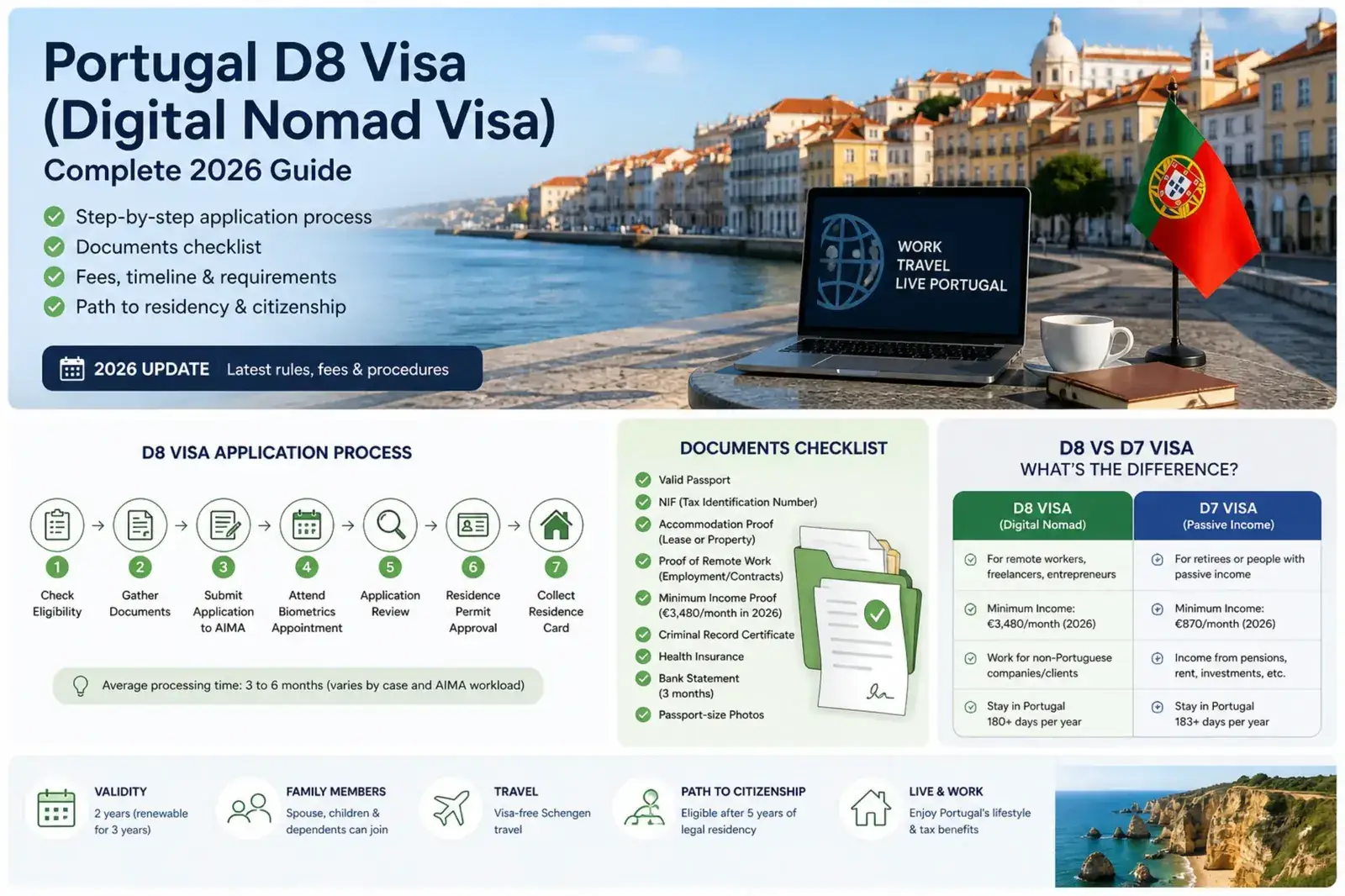
Portugal’s D8 visa is for people who work remotely for employers, clients or businesses outside Portugal and want to live in Portugal. The headline requirement is simple in 2026: your average monthly remote-work income over the previous three months must be at least €3,680.
The parts that cause more confusion are what counts as income proof, whether the figure is gross or net, whether you need a Portuguese bank account, what your employer letter should say, and whether you can apply after you have already entered Portugal.
This guide separates the national D8 rules from requirements that can vary by Portuguese consulate or VFS centre.
Important: The legal D8 requirements come from Article 31-A of Portugal’s immigration regulations. Your local Portuguese consulate or visa centre can still ask for additional supporting documents. Always check the checklist for the post that will process your application.
Quick Answer: In 2026, a Portugal D8 residence-visa applicant must prove average remote-work income of at least €3,680 per month over the previous three months. This is four times Portugal’s 2026 minimum wage of €920. Employees can use an employment contract or an employer declaration; independent workers can use a company contract, service contract or evidence of services provided. You also need proof of tax residence and the general documents required for a Portuguese residence visa. New D8 visa applications are made through the Portuguese consular system, not by arriving in Portugal as a visitor and applying in Lisbon.
D8 temporary-stay visa vs D8 residence visa
“D8” is commonly used for Portugal’s remote-work or digital-nomad route, but there are two different national-visa paths:
| Route | Best fit | What happens in Portugal |
|---|---|---|
| Temporary-stay remote-work visa | Remote stay of less than one year | Valid for the authorised temporary stay; it is not the route described below for obtaining the standard two-year D8 residence permit |
| Remote-work residence visa | Moving to Portugal as a resident | Residence visa is used to enter Portugal and complete the AIMA residence-permit stage |
This explains why some VFS or consular systems use labels such as temporary stay, residence, ER or DR instead of simply displaying “D8”.
If your goal is to relocate to Portugal and obtain the two-year residence permit, make sure you are following the residence-visa checklist rather than the temporary-stay checklist.
Portugal D8 visa requirements in 2026
For the D8 itself, the legal requirements are quite specific:
| Requirement | 2026 rule |
|---|---|
| Type of work | Professional activity performed remotely for outside Portugal |
| Minimum income | €3,680/month average |
| Income period | Previous 3 months |
| Employee proof | Employment contract or employer declaration |
| Freelancer / contractor proof | Company contract, service contract, or evidence of services provided |
| Tax residence | Document proving your current tax residence |
| General residence-visa documents | Passport, criminal-record documentation, accommodation, insurance/health cover and means of subsistence as required by the national and local checklist |
| Where to apply | Portuguese consulate/embassy or the visa centre serving your place of legal residence |
| National visa fee | €110, before any local VFS/BLS service charge |
| Residence visa validity | 4 months, 2 entries |
| First residence permit | 2 years |
| Renewal | Successive 3-year periods |
Portugal’s regulation says the applicant must show average monthly income from remote employment or independent work during the last three months equal to at least four Portuguese minimum wages. Portugal’s minimum wage is €920 in 2026, which makes the D8 threshold €3,680.
Can you apply for a Portugal D8 visa while in Portugal?
For a new D8 visa application, do not plan on entering Portugal as a tourist and then applying for the D8 visa from Lisbon.
A residence visa is a consular visa. Portugal’s government guidance says national visas can be requested through Portuguese embassies or consulates in the applicant’s country of residence.
Older articles may still refer to residence-permit routes that allowed some workers already in Portugal to regularise without first holding the corresponding residence visa. The visa-exemption procedures under Article 88(2) and Article 89(2) were revoked from 4 June 2024 for new cases.
There are transitional protections for certain people who were already inside the old system before the change. That is different from saying a new applicant in 2026 can simply arrive visa-free and submit a D8 application in Portugal.
If you are already in Portugal on another valid residence status, changing the basis of your residence can be a separate AIMA question. It is not the same procedure as applying for a D8 residence visa from inside Portugal.
How much income do you need for the D8 visa in 2026?
The minimum is:
€920 × 4 = €3,680 per month
The law refers to your average monthly income over the previous three months.
For example:
| Month | Remote-work income |
|---|---|
| Month 1 | €3,900 |
| Month 2 | €3,500 |
| Month 3 | €3,640 |
| 3-month average | €3,680 |
The statutory wording is based on the average, rather than saying every individual month must independently exceed €3,680.
My rule here is simple: treat €3,680 as a floor, not a target. Currency conversion, an irregular invoice or a borderline calculation can quickly create a problem.
What if your income is slightly below €3,680?
If your three-month average is below €3,680, you do not meet the published 2026 D8 income threshold.
A future pay rise or an employer letter promising higher income after you move may help explain your circumstances, but it does not change the three-month income evidence required by Article 31-A. The safer move is to wait until the actual evidence clears the threshold rather than ask the visa officer to rely on income you have not yet received.
Is the €3,680 D8 income requirement gross or net?
This is one of the most important ambiguities.
Article 31-A requires proof of average monthly income but does not expressly say “gross” or “net” in the legal wording.
The legislation does not provide a sound basis for saying every Portuguese post must always use one calculation. If your gross income exceeds €3,680 but your net income does not, I would get written confirmation from the Portuguese post handling your application before relying on the gross figure.
Your evidence should make the calculation easy to follow:
- employment contract or service agreement;
- payslips or invoices;
- bank statements showing the payments;
- currency conversion where income is not paid in euros.
Which jobs qualify for the Portugal D8 visa?
There is no official list of approved D8 occupations.
What matters is how and where the work is performed, not whether your job title appears on a government list.
Examples can include:
- software and IT work;
- marketing and communications;
- design and creative work;
- finance and consulting;
- customer or business operations;
- remote management roles;
- freelance professional services.
The work must fit the remote-work route and be performed for employers, clients or business activity outside Portugal.
If your plan is instead to move to Portugal to create or operate a Portuguese business, compare the D8 with the Portugal D2 visa because the legal basis may be different.
What should a D8 employer letter say?
For an employee, the national rule accepts either an employment contract or an employer declaration proving the employment relationship.
There is no single statutory D8 employer-letter template. A useful employer declaration should make the important facts unambiguous:
- employee’s full name;
- job title and employment status;
- employment start date;
- employer’s legal name and country;
- confirmation that the role can be performed remotely from Portugal;
- salary, currency and payment frequency;
- confirmation that the employment relationship remains with the foreign employer;
- name, position and contact details of the person signing the letter.
Those details are not a separate statutory checklist; they simply make it clear why the job fits the D8 route.
The letter also needs to reflect reality: a D8 visa does not override an employer’s own restrictions on working from another country. If you are employed rather than self-employed, get the employer’s remote-from-Portugal approval before building the application around that job.
What freelancers, contractors and business owners should provide
For independent work, Article 31-A allows:
- a company contract;
- a service contract; or
- a document showing services provided to one or more entities.
For freelancers, I like to make the income trail almost impossible to misread. Put the evidence in the same order every time:
- contract or client relationship;
- invoice;
- payment into the bank account.
If you have several clients, use a short summary table showing each client, contract value and the payments appearing in the three-month bank statements.
A company owner can potentially fit the D8 where the professional activity is genuinely performed remotely for outside Portugal and the income requirements are met. But owning a company is not by itself enough. If the purpose is to build or operate a Portuguese business, the D2 route may be more appropriate.
Do you need €11,040 in savings for the D8 visa?
Do not treat €11,040 as a universal statutory D8 savings minimum.
The D8-specific legal rule in Article 31-A is the three-month average income test of four minimum wages. General national-visa rules also require sufficient means of subsistence, and individual consulates or VFS checklists may ask for bank balances or additional financial evidence.
That is why applicants find different savings figures online.
For your application:
- meet the €3,680 D8 income test independently;
- check the current checklist for your consular jurisdiction;
- provide the bank statements or balance evidence that post asks for;
- keep enough accessible funds to support the rest of the application.
Is a Portuguese bank account mandatory?
The national D8 rule does not say that the qualifying remote-work income must be paid into a Portuguese bank account.
A Portuguese account can still be useful after moving, and some local checklists or AIMA evidence requests can make local banking relevant. But it should not be presented as a universal rule that every D8 applicant must hold a specific amount in a Portuguese account before the visa can be granted.
Wise or Revolut can show payment history, but the consulate or visa centre deciding your case determines whether those statements are enough.
I would not fly to Portugal solely to open a bank account unless your own consulate or VFS checklist expressly requires Portuguese-account evidence.
D8 family income and means of subsistence
Another common mistake is to take the €3,680 D8 threshold and then add 50% for a spouse and 30% for each child.
Portugal’s accompanying-family rules use the general means-of-subsistence scale, not 50% and 30% of the four-times-minimum-wage D8 threshold.
Using the 2026 minimum wage of €920, that scale is:
| Family member | General subsistence reference |
|---|---|
| Main adult | 100% = €920/month |
| Each additional adult | 50% = €460/month |
| Each dependent child | 30% = €276/month |
The principal D8 applicant still needs to satisfy the separate €3,680 remote-work income test.
If a consulate asks for a 12-month financial buffer for accompanying family, the 2026 reference amounts would equate to €5,520 for an additional adult and €3,312 for each dependent child. Check the local checklist because the form of evidence can vary.
Can your spouse and children apply at the same time?
Portugal’s national-visa system includes a residence visa for an accompanying family member who is applying with a residence-visa applicant.
That is different from family reunification after the principal applicant is already legally resident in Portugal. If the family wants to move together, check the accompanying-family route with the same Portuguese post handling the principal D8 application instead of assuming everyone must wait for a later AIMA reunification case.
For family members joining later, see Family Reunification in Portugal.
D8 visa document checklist
The document file has two parts.
D8-specific documents
These come directly from the remote-work rule:
- proof of remote employment or independent professional activity;
- proof of average monthly income for the previous three months;
- document proving tax residence.
For an employee, the work proof can be an employment contract or employer declaration.
For an independent worker, it can be a company contract, service contract, or evidence of services supplied to one or more entities.
General residence-visa documents
The Portuguese Ministry of Foreign Affairs publishes the general national residence-visa documentation. It includes items such as:
- completed national visa application;
- valid passport or travel document;
- photographs meeting the visa requirements;
- travel/medical insurance or the health-cover evidence required for the route;
- criminal-record documentation;
- proof of accommodation;
- proof of sufficient means;
- authorisation for the Portuguese authorities to consult the Portuguese criminal record, where applicable.
Your local Portuguese consulate or visa centre may add operational requirements such as document format, translations, appointment rules, bank-statement periods or extra forms.
That is why a checklist written for the United States should not automatically be treated as the checklist for India, Pakistan, Canada, the UAE or Brazil.
Do you need a NIF before applying?
Article 31-A does not list a Portuguese NIF as one of the four D8-specific requirements.
A NIF can still be useful early for banking, accommodation or other Portuguese administration. If your local visa checklist requires it, follow that checklist. Otherwise, do not confuse a useful relocation document with a universal statutory D8 requirement.
Does the accommodation have to be a 12-month lease?
The national residence-visa documentation requires accommodation evidence, but applicants should be careful with claims that only a 12-month registered lease can ever qualify.
What a particular consulate accepts can vary by jurisdiction and by the evidence presented. Local checklists may specify leases, property ownership, host declarations or other accommodation evidence.
If you intend to use anything other than a straightforward long-term lease, verify acceptance with your own Portuguese post before paying a large non-refundable amount. If the local checklist asks for a registered lease or proof of registration with Finanças, bring that evidence as well as the signed contract.
You may have to secure accommodation before you know whether the visa will be approved. I would follow the checklist for the post deciding your file rather than rely on a generic checklist written for another country.
How much does the Portugal D8 visa cost?
The national visa application fee is €110.
That is not the same as your total relocation cost. Depending on where you apply, you may also have:
- a VFS/BLS service charge set by the local visa centre;
- criminal-record legalisation or apostille costs;
- translations where required;
- insurance costs;
- a later AIMA residence-authorization fee in Portugal.
There is no single D8 total fee. Service charges and some exemptions vary by jurisdiction, and AIMA has a separate fee table for the residence stage.
If you are applying as a family, check the fee and exemption rules for each applicant rather than automatically multiplying one advertised package price.
How to apply for the Portugal D8 visa
1. Identify the Portuguese post that has jurisdiction
Start with the Portuguese embassy, consulate or authorised visa centre responsible for your place of legal residence.
Do this before preparing country-specific documents. VFS/BLS procedures, appointment systems and supporting-document formats vary. Appointment availability can also be the bottleneck, so avoid making non-refundable travel or housing commitments around an assumed appointment date.
2. Check the local D8 checklist
Use the national rules as the baseline, then compare them with the checklist of the actual post processing your case.
Pay particular attention to:
- accommodation evidence;
- criminal-record legalisation;
- insurance wording;
- bank statements;
- translations;
- whether documents must be originals or copies;
- appointment booking procedure.
3. Build the remote-work evidence
Make sure the application proves all three pieces of the D8 test:
remote work + qualifying income + tax residence.
If you are an employee, make remote-work permission explicit. If you are self-employed, make the client/service relationship and payment trail easy to follow.
4. Submit the application and pay the visa fee
Pay the €110 national visa fee plus any VFS/BLS service charge shown for your local centre. Service charges vary by jurisdiction.
5. Wait for the visa decision
Portugal’s Ministry of Foreign Affairs gives a normal 60-day decision deadline for a residence visa, subject to legal exceptions. Appointment delays, document requests and local processing can make the real end-to-end timeline longer.
6. Enter Portugal on the residence visa
A Portuguese residence visa normally allows two entries and is valid for four months. During that period you move to Portugal and complete the residence-authorisation stage.
7. Attend AIMA for the residence permit
The D8 visa is not the final residence card.
AIMA issues the temporary residence authorization for remote work. The first permit is valid for two years and can be renewed for successive three-year periods.
If your visa was issued without an AIMA appointment, follow the current appointment procedure rather than assuming the visa is unusable. See How to Get an AIMA Appointment.
After the appointment, you can follow the case using the AIMA Process Tracker guide.
If the case is approved but the physical card does not arrive, use the AIMA Card Not Received and CTT Tracking guide.
What documents should you take to the AIMA appointment?
Your consular visa approval and your AIMA residence application are connected but they are not the same administrative step.
Before the appointment, check AIMA’s current remote-work residence page for the exact evidence required at that date. As a practical file, keep together:
- valid passport;
- D8 residence visa;
- proof of your Portuguese address/accommodation;
- the remote-work documents used for the visa;
- recent income evidence;
- tax-identification information where requested;
- any AIMA appointment or process confirmation.
Do not assume that every document submitted to the consulate is automatically visible to the AIMA officer.
How long does the D8 visa take?
There are two different timelines:
Consular visa stage: the official decision period for a residence visa is normally 60 days, subject to legal exceptions.
AIMA residence stage: there is no honest universal number I can give you for appointment availability, decision time and card delivery across every AIMA office.
If your AIMA application is already submitted, use the status shown in the official process tracker rather than comparing your case to someone else’s timeline.
What is the Portugal D8 visa success rate?
Portugal does not publish a D8-specific national approval percentage in the official sources used for this guide.
So when a lawyer, relocation company or blog advertises a “D8 success rate”, check what the number actually represents. It may be that company’s own clients rather than all D8 applications decided by Portuguese authorities.
A more useful check is whether your file clearly proves:
- qualifying remote work;
- the required three-month average income;
- tax residence;
- the general residence-visa conditions; and
- any extra documents required by your local Portuguese post.
D8 vs D7 visa
The main difference is the source of the qualifying income.
| D8 | D7 |
|---|---|
| Active remote-work income | Primarily passive/stable income route |
| Remote employees, contractors and freelancers | Commonly used by retirees and people relying on pensions or other stable passive resources |
| D8-specific income test: 4× minimum wage | Different financial test |
| Must prove remote professional activity | Must prove the income/resources relevant to D7 |
If your main source is remote salary or freelance work, do not force it into the D7 simply because the D7 financial threshold looks lower. See the Portugal D7 Visa guide.
Can the D8 visa lead to permanent residence or citizenship?
The D8 residence visa can lead to a Portuguese residence permit, and time as a legal resident can contribute toward longer-term residence routes.
Citizenship rules changed in May 2026. The current naturalisation residence period is generally:
- 7 years for nationals of Portuguese-speaking countries and EU citizens; and
- 10 years for nationals of other countries,
subject to the other nationality requirements and any applicable transitional rules.
That means older articles promising every D8 holder a five-year citizenship route are now outdated. For the current law and transitional treatment, see Portugal Citizenship Law 2026.
Before you submit
Use this final checklist:
- My work is genuinely remote and performed for outside Portugal.
- My three-month average income is at least €3,680.
- My employment/client documents explain the relationship clearly.
- I have proof of current tax residence.
- I checked the residence-visa checklist for my own consular jurisdiction.
- My accommodation evidence matches that local checklist.
- My financial documents are current and easy to reconcile.
- I am not relying on an old article saying I can arrive as a tourist and apply for a new D8 in Portugal.
- I checked the current visa fee and appointment process before submitting.
- I kept a complete copy of the file for the later AIMA stage.
The D8 application is much easier to understand once you separate the national rule from local consular practice: €3,680 average remote income + valid remote-work evidence + tax residence + the general residence-visa file. Everything additional should be checked against the post that will actually decide your application.