

Important: This guide explains Portugal’s NHR and IFICI tax regimes in plain English based on official sources. It is not legal or professional advice. Tax rules change: always verify your specific situation with a qualified Portuguese tax adviser (contabilista certificado) or lawyer before making decisions. Last verified: July 2026.
If you’re planning to move to Portugal for the tax benefits, you’ve probably heard that NHR is gone. What that actually means for your finances depends entirely on who you are, and for a lot of people, the difference is not small.
A retiree with €60,000 a year in pension income who locked in NHR status paid around €6,000 in Portuguese income tax (10% flat rate). The same person arriving today, without NHR, pays roughly €18,500 under Portugal’s standard progressive brackets. That’s a €12,500-a-year gap. Over the 10-year window most people plan around, that’s well over €100,000.
For a working professional at a qualifying Portuguese company, the picture looks different. IFICI, NHR’s replacement, offers the same 20% flat rate on Portuguese employment income. On an €80,000 salary: €16,000 in tax under IFICI, versus roughly €27,000 under standard IRS. That’s a genuine saving, if you qualify, which most people don’t.
This guide explains exactly where the line is, who falls on which side, and what to do about it in 2026. No softening, no vague optimism.
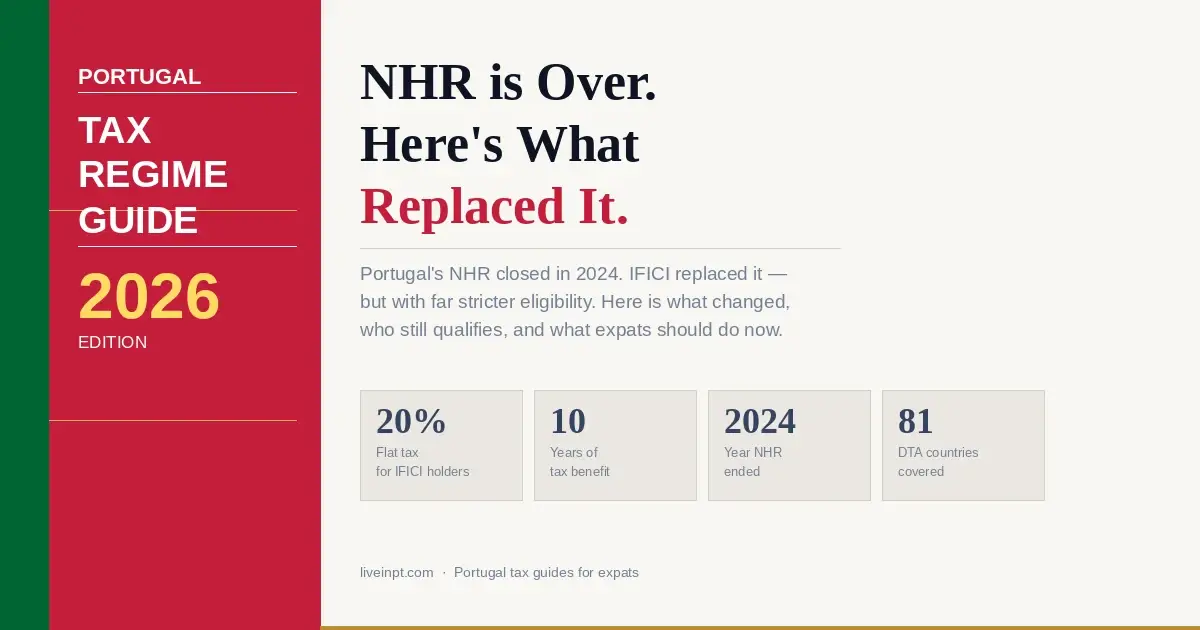
Quick answer: Portugal’s old NHR regime is no longer open in the same way for most new applicants. A replacement incentive, often discussed as IFICI, may apply only to specific eligible activities. This guide explains what changed and who may still have options in 2026.
The IFICI regime (also called NHR 2.0) is Portugal’s current tax incentive for new residents: a 20% flat income tax rate on qualifying Portuguese employment income, plus exemption on most foreign-sourced income, for up to 10 consecutive years.
What Was NHR and Why Did It End
Portugal launched the NHR (Regime Fiscal do Residente Não Habitual) in 2009 under Decree-Law 249/2009. The logic was simple: attract foreign talent and capital by offering preferential tax treatment to new residents for a fixed, non-renewable period of 10 years.
It worked. By 2019, the number of foreign citizens residing in Portugal had surpassed 500,000 (a record at the time), partly driven by NHR’s appeal to retirees from France, Italy, and Brazil, and later to tech workers and digital nomads. At its peak, tens of thousands of households were living under NHR status.
But the costs caught up with it. By 2024, the annual budgetary cost of NHR exemptions had exceeded €1.7 billion, the highest since the regime’s creation. Property prices in Lisbon, Porto, and the Algarve had risen sharply, and public pressure to end a scheme perceived as benefiting wealthy foreigners at the expense of local housing affordability became impossible to ignore. The EU also applied pressure to align Portuguese tax policy more closely with broader European principles.
In October 2023, the then-Prime Minister António Costa announced NHR would end. The 2024 State Budget (Lei n.º 82/2023, de 29 de dezembro) formally revoked it.
What Replaced NHR: The IFICI Regime Explained
IFICI stands for Incentivo Fiscal à Investigação Científica e Inovação (Tax Incentive for Scientific Research and Innovation). It came into force on 1 January 2024, regulated by Portaria n.º 352/2024/1, de 23 de dezembro.
Why you’ll see both 2024 and 2025 quoted as IFICI’s start date. Portaria n.º 352/2024/1 was only published on 23 December 2024, which is why a lot of guides describe IFICI as starting in 2025. But the regulation itself is explicit: it applies retroactively to anyone who became a Portuguese tax resident from 1 January 2024 onward. If you established tax residency during 2024, IFICI was already the applicable regime for you, even though the rulebook explaining how to register wasn’t published until that December.
The name is a mouthful, and it sounds narrower than it actually is. “Scientific research and innovation” suggests lab coats and PhDs. In practice, it covers a broader range of professional roles: engineers, IT specialists, company executives, doctors, university professors, and people working for qualifying export-oriented companies. But it does not cover everyone, and the eligibility criteria are genuinely strict in ways that the old NHR never was.
The fundamental shift in philosophy is this: NHR was designed to attract anyone who moved to Portugal (retirees, investors, remote workers) on the basis that bringing money and people to the country was inherently good. IFICI is designed to attract specific professional talent that contributes directly to Portugal’s economic output. If your move to Portugal doesn’t fit that framing, IFICI probably doesn’t apply to you.
| Old NHR | IFICI (NHR 2.0) | |
|---|---|---|
| Who qualifies | Broad: any profession in approved list, retirees, investors | Narrow: highly qualified professionals in specific sectors |
| Tax rate on Portuguese income | 20% flat on high-value activities | 20% flat on qualifying employment/self-employment |
| Foreign pension income | Exempt (later 10% flat from 2020) | Not covered: taxed at standard progressive rates |
| Foreign dividends/interest | Generally exempt under treaty rules | Exempt (except from blacklisted jurisdictions) |
| Foreign capital gains | Generally exempt | Exempt (except from blacklisted jurisdictions) |
| Education requirement | None | Bachelor’s + 3 years experience, or PhD |
| Employer requirement | None | Must be in qualifying sector or certified entity |
| Duration | 10 years | 10 years |
| Renewable | No | No |
| Application deadline | 31 March of the year following residency | 15 January of the year following residency |
Who Still Qualifies Under IFICI
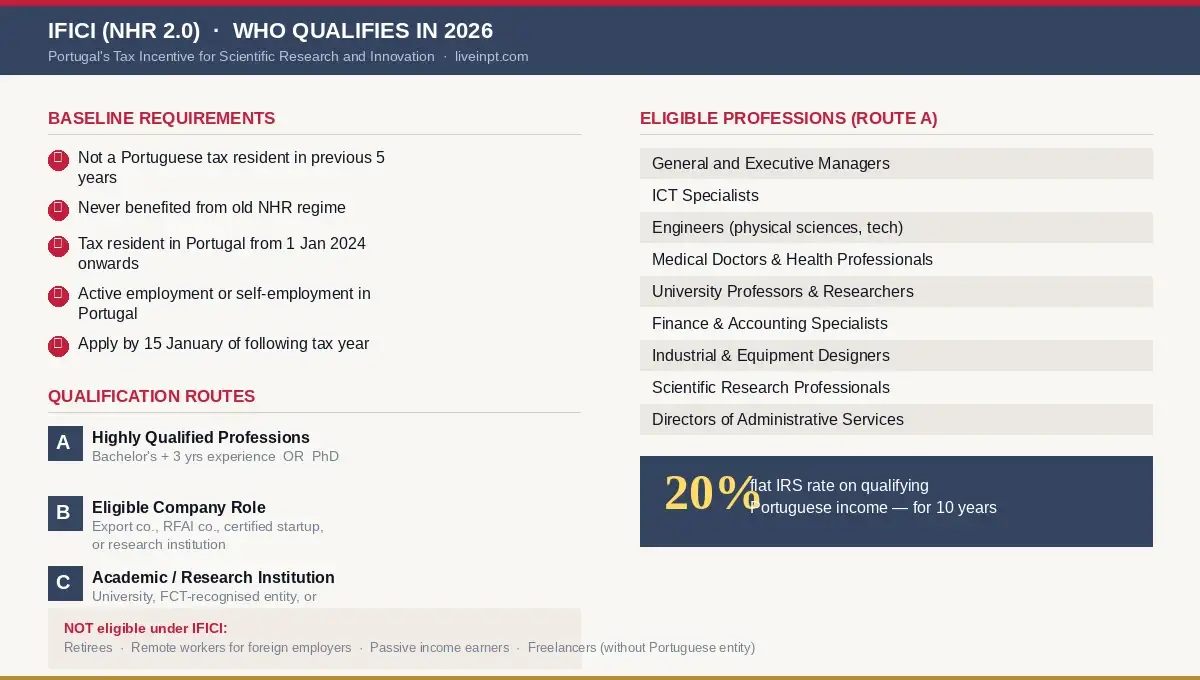
The baseline eligibility requirements are non-negotiable. You must meet all of them before anything else matters:
- Not been a Portuguese tax resident in the previous 5 years
- Never previously benefited from NHR or another Portuguese special tax regime
- Become a Portuguese tax resident from 1 January 2024 onwards
- Earn employment or self-employment income from a qualifying activity in Portugal (this is active, earned income, not passive income)
- Submit your application by 15 January of the year following your first year of tax residency
If you tick those boxes, you then need to satisfy the professional criteria. There are several routes.
Route A: Highly Qualified Professions
This is the most commonly used path. You must hold:
- EQF Level 6 (bachelor’s degree) plus at least 3 years of verified professional experience in your field, or
- EQF Level 8 (PhD or Doctorate), which waives the experience requirement
And your profession must fall on the approved list. Per Portaria n.º 352/2024/1, eligible professions include:
- General and executive managers
- Directors of administrative and commercial services
- Production and specialised services managers
- Specialists in physical sciences, mathematics, and engineering
- ICT (information and communications technology) specialists
- Medical doctors and other health professionals
- University and higher education professors and researchers
- Industrial and equipment designers
- Finance and accounting specialists
That’s a meaningful list, but it’s a list. If your profession isn’t on it, Route A doesn’t apply.
Route B: Highly Qualified Roles in Eligible Companies
Your profession doesn’t have to be on the approved list if you hold a qualifying position in the right type of company. Eligible employers under IFICI include:
Export companies: Businesses that generate at least 50% of their turnover from exports in the fiscal year of your employment, or in either of the two preceding years. They must operate in specific sectors defined by Portuguese CAE (Classificação Portuguesa de Atividades Económicas) codes, including manufacturing, information and communications, financial activities, consulting, and technical services.
RFAI companies: Companies that benefit from the Regime Fiscal de Apoio ao Investimento (RFAI), Portugal’s investment support tax regime. Board members and senior managers at these companies can qualify.
Certified startups: Entities officially certified under Portugal’s startup law (Lei das Startups). Employees, founders, and board members at certified startups can qualify regardless of their specific job title.
Technology and innovation centres: Research institutions and technology centres recognised by AICEP (Agência para o Investimento e Comércio Externo de Portugal) or IAPMEI (Instituto de Apoio às Pequenas e Médias Empresas e à Inovação).
Higher education and scientific research institutions: Universities, research institutes, and entities certified by the Fundação para a Ciência e a Tecnologia (FCT).
One critical restriction: IFICI does not apply to freelancers or employees of non-resident companies that lack economic substance in Portugal. The employer must have a genuine operating presence here. Working remotely for a foreign company with no Portuguese entity does not qualify, regardless of your profession.
IFICI for Entrepreneurs and Startup Founders
Founding your own company does not automatically qualify you for IFICI. A startup-certified company can support eligibility for qualifying employees or members of its corporate bodies, subject to the other statutory requirements. Under the export-company route, the specific qualifying role, the company’s eligible CAE activity and the 50% export test must all be met. Holding shares alone is not enough; a sole director or manager must still meet the applicable route and conditions.
The IFICI Tax Benefits in Practice
For those who do qualify, the benefits are real and worth having.
20% flat IRS rate on qualifying Portuguese income. Instead of Portugal’s progressive IRS (Imposto sobre o Rendimento de Pessoas Singulares) brackets (which run from 12.5% to 48% in 2026, with a solidarity surcharge of 2.5% to 5% on income above €80,000), qualifying employment and self-employment income (Category A and Category B) is taxed at a flat 20%. A senior engineer earning €80,000 in Portugal pays €16,000 in income tax under IFICI. Under standard progressive IRS, the same income produces a bill of approximately €27,000, before municipal surcharges. That’s an €11,000 annual difference, or over €100,000 across the 10-year period.
Exemption on most foreign-sourced income. Dividends, interest, rental income, capital gains, and employment income earned abroad are generally exempt from Portuguese taxation under IFICI. Unlike the old NHR, which relied on double tax treaty mechanics (which could produce inconsistent results depending on the treaty), IFICI sets out a direct domestic exemption. The income must be declared and is factored into rate progression calculations, but it isn’t taxed in Portugal.
The key exclusion: pensions. Foreign pension income is not exempt under IFICI. It is not subject to the 10% flat rate that old NHR holders who entered after 2020 enjoyed. It goes into the standard progressive IRS brackets along with everything else. For retirees, this is the most consequential change.
Blacklist rule. Income from countries that Portugal’s Finance Ministry designates as preferential tax regimes (paraísos fiscais), the so-called blacklist, does not qualify for the foreign income exemption under IFICI, unless the country in question has a Double Tax Agreement (DTA) with Portugal. Portugal currently has DTAs with 81 countries, which covers most of the places expats typically earn income from.
10-year duration, non-renewable. The clock starts from your first year of Portuguese tax residency. Year one is when you registered, even if you only lived in Portugal for part of that year.
Law vs Reality: What the Rules Say vs What Happens
| What the official rules say | What actually happens in practice |
|---|---|
| Application deadline is 15 January of the year following residency | Missing this deadline is common and costly. There is no formal grace period. Apply immediately after establishing residency. Don’t wait until January of the following year. |
| IFICI is open to any eligible professional | Processing is handled by the Autoridade Tributária e Aduaneira (AT). Applications that don’t clearly demonstrate employer eligibility or profession eligibility get rejected without much explanation. |
| The employer must export 50%+ of turnover | Proving this in your application requires specific documentation from the employer. Some employers don’t know they qualify, or don’t have the paperwork ready. |
| Freelancers cannot benefit unless working through a qualifying Portuguese entity | Many freelancers incorrectly assume their profession on the approved list is sufficient. Without an eligible employer or properly structured Portuguese company, the application will be rejected. |
| You can track your application on Portal das Finanças | Processing is typically fast, often a few weeks. But applications with documentation gaps can stall without notification. |
| IFICI covers any qualifying year during the 10-year period | If you lose qualifying employment for more than 6 months in a given year, you risk losing the benefit for that year. The continuity rule allows transitions between qualifying roles, but the gap cannot exceed 6 months. |
How to Apply for IFICI
The application is submitted through the Portal das Finanças (portaldasfinancas.gov.pt). Here’s the sequence:
Step 1: Get your NIF. You cannot do anything tax-related in Portugal without your NIF (Número de Identificação Fiscal). If you don’t have one yet, this is the first step. You can obtain it at a Finanças office or, for non-EU residents, through a fiscal representative. See our guide to getting your NIF in Portugal for the full process.
Step 2: Establish tax residency. Tax residency in Portugal is established by spending more than 183 days in Portugal in a 12-month period that starts or ends in the tax year, or by maintaining a habitual residence (habitação permanente) in Portugal at any point in the year. The year you establish tax residency is the year from which IFICI benefits are counted.
Step 3: Confirm employer eligibility. Before you apply, verify that your employer qualifies. Request written confirmation from your employer’s accounting or legal team. If they are unsure, the qualification depends on CAE code and export ratio, both of which the Autoridade Tributária can verify.
Step 4: Submit on Portal das Finanças. Log in to your account. Navigate to Aceda aos Serviços Tributários > Consultar Pedido > Inscrição Residente Não Habitual. Submit the application with supporting documents including proof of professional qualifications, employment contract, and employer documentation confirming eligibility.
Step 5: Watch the deadline. The general deadline is 15 January of the year after you became a tax resident. If you became a tax resident in 2025, you had until 15 January 2026. Miss it and you forfeit that year’s benefit, though the 10-year clock still starts from the year you became resident, meaning you lose one year of benefits rather than the start date shifting.
Processing time: Usually a few weeks, sometimes faster. The status can be tracked on Portal das Finanças under the same path as the submission.
What If You Don’t Qualify for IFICI
A lot of people who planned their move to Portugal around NHR now find themselves here without access to any special regime. That includes most retirees, most digital nomads, most remote workers employed by foreign companies, and most people with passive income portfolios.
The honest position for all of them is this: you pay standard Portuguese IRS.
For 2026, that means progressive IRS rates from 12.5% to 48% on worldwide income as a tax resident, with a solidarity surcharge of 2.5% on income between €80,000 and €250,000, and 5% above €250,000. Municipal surcharges (taxas municipais) add up to a further 1.5% depending on where you live.
That is not nothing. But it is also not catastrophically high by European standards, and Portugal’s cost of living, particularly outside Lisbon and Porto, means the overall financial picture can still work out positively.
IFICI and NHR Status for Retirees in 2026
Retirees are the group hit hardest by NHR’s closure: IFICI’s activity-based gates exclude passive pension income entirely, so there is no equivalent regime to fall back on. The picture depends heavily on which country your pension comes from and whether Portugal has a DTA with that country. Under the US-Portugal tax treaty, private pensions are taxable only in the country of residence, meaning US private pension income, 401(k) distributions, and IRA withdrawals are fully taxable in Portugal for US citizens who live there as tax residents. Social Security is taxable only in the US. UK state pension and most private UK pensions are taxable in Portugal under the UK-Portugal treaty.
For digital nomads and remote workers, the D8 Digital Nomad Visa provides a legal basis to live in Portugal, but it doesn’t provide any tax advantage. Once you’re resident, you’re in the standard IRS system. The 183-day rule is not negotiable: spend more than that and you’re a tax resident regardless of visa type. Budget for it.
Double Tax Agreements matter more now than they did under NHR. With NHR, the treaty mechanics were partly a formality: most foreign income was exempt anyway. Under standard IRS, the specific treaty provisions between Portugal and your home country determine what you actually owe and to whom. Know your treaty.
If you’re under 35, check IRS Jovem before assuming you’re stuck on full standard rates. It’s a separate regime from IFICI, with a much lower bar to entry, and it applies to ordinary employment income regardless of profession or employer type. It won’t replace what NHR offered, but it’s a real reduction that a lot of younger arrivals miss because all the coverage focuses on IFICI.
Existing NHR Holders: What You Need to Do Now
If you obtained NHR status before the regime closed, your benefits are protected for the full 10-year period. The law is explicit on this. Whether you entered NHR in 2013 or 2023, you keep the benefits until your decade is up, with the maximum possible end date being 31 December 2033 for anyone who entered under the transitional provisions and applied by the March 2025 deadline.
That’s the good news. The complication is what happens at the end.
When NHR expires, your tax position shifts immediately to standard Portuguese IRS. For some people, particularly those who relied heavily on the foreign income exemption, this is a substantial change. Foreign dividends that were previously exempt become taxable at the standard 28% flat rate (or progressive rates if you elect aggregation). Foreign pensions that were taxed at 10% under NHR become subject to the progressive bracket.
The practical implication: if you have five or more years left on your NHR clock, the time to start thinking about post-NHR structuring is now, not the year before it ends. Asset restructuring (moving holdings into tax-efficient vehicles, reviewing trust structures, considering your domicile for specific assets) takes time and often requires coordinating advisers in multiple countries. A year isn’t enough runway. Three to five years is more realistic for meaningful changes.
What you must still do while on NHR:
- File your annual IRS declaration (Modelo 3) every year between 1 April and 30 June. This is mandatory regardless of whether your income is exempt or taxed at a reduced rate
- Maintain your Portuguese tax residency. If you spend less than 183 days in Portugal in a given tax year, you risk losing residency status and with it, NHR protection
- Report all foreign income, even exempt income. The exemption doesn’t mean non-declaration
Common Mistakes
One thing that keeps tripping people up is treating IFICI as a scaled-up version of NHR’s old “high earner” logic. It isn’t. The gate is what you do and where, not how much you make, and that single misunderstanding sits behind most of the mistakes below.
Mistake: Assuming a high salary alone qualifies you for IFICI
IFICI has no income threshold. A €200,000 salary gets exactly the same 20% rate as an €45,000 salary, provided the underlying profession and employer both qualify. Earning a lot doesn’t substitute for meeting the activity and employer tests. This mirrors NHR’s old “high value-added” framing closely enough that people assume income level is still the deciding factor. It isn’t, and the confusion causes otherwise well-prepared applicants to skip verifying the actual eligibility gates because they assume their salary already clears the bar.
Mistake: Assuming your profession on the approved list is enough for IFICI
The profession list is one condition, not the whole test. Without a qualifying employer (a certified startup, a 50%+ export company, an RFAI company, or a recognised research institution), working in an eligible profession doesn’t get you IFICI. Many applications are rejected on exactly this basis. The employer’s eligibility has to be documented and confirmed, not assumed.
Mistake: Missing the 15 January application deadline and thinking it’s fixable
Applications are generally due by 15 January of the year following the first year of Portuguese tax residency. If registration is late, the benefit applies from the year of registration for the remaining statutory period. Do not assume a late application preserves the first year’s benefit, so file early.
Mistake: Believing remote work for a foreign employer qualifies under IFICI
It doesn’t. IFICI requires employment with a company that has genuine economic substance in Portugal. A foreign company with no Portuguese entity or operation does not satisfy this condition, regardless of your profession or qualifications. Remote workers employed abroad and simply living in Portugal are in the standard IRS system. This surprises a lot of people who moved here expecting NHR-style treatment.
Mistake: Planning a retirement around NHR tax rates that no longer exist
A significant number of people, particularly British and American retirees, made financial projections based on the old NHR pension rates. The 10% flat rate on foreign pensions that applied to NHR holders who entered after 2020 is not available under IFICI. Foreign pensions now go through the standard progressive IRS brackets. Run the numbers: a retiree with €60,000 in annual pension income paid roughly €6,000 a year under NHR’s 10% flat rate. Under 2026 standard IRS, the same income produces a bill of approximately €18,500. That’s a €12,500 annual gap: over €125,000 across a 10-year retirement horizon. If your retirement plan assumed NHR, rebuild the model with today’s rates.
Mistake: Assuming old NHR holders can switch to IFICI for a better deal
You cannot. The law (Article 58-A of the Tax Benefits Statute, EBF) explicitly bars people who benefited from the old NHR regime from also benefiting from IFICI, with narrow exceptions for those who registered under specific 2024 transitional provisions. There is no hybrid option. You’re either on NHR for the remainder of your 10 years, or you apply for IFICI if you never had NHR, not both.
Real Scenarios
Scenario 1: The software engineer who times it right
A software engineer from Germany takes a role at a Lisbon-based tech company that exports 65% of its revenue and holds an active CAE code in information and communication services. She moved to Portugal in March 2025, registered her NIF immediately, and her employer confirmed their export ratio in writing. She applied for IFICI through Portal das Finanças in December 2025, well ahead of the 15 January deadline. Application approved within three weeks.
Her Portuguese salary of €85,000 is taxed at 20%: €17,000. Without IFICI, the standard IRS calculation would produce a substantially higher bill, particularly with the solidarity surcharge kicking in above €80,000. Foreign investment income from German ETFs she’s held for years? Exempt from Portuguese tax under IFICI, subject to rate progression. She keeps her IFICI status as long as she remains employed at a qualifying company.
The lesson: the timing, the employer’s export profile, and the upfront documentation all mattered. Had she joined a Portuguese company that did most of its business domestically, she would not have qualified.
Scenario 2: The British retiree who needed a plan B
A retired NHS consultant from Manchester moved to the Algarve in 2023, expecting to apply for NHR. He met the 5-year non-residency condition. But the regime closed before he could lock it in, and he didn’t meet the transitional criteria: he had no Portuguese property contract or employment document dated before October 2023.
He’s now a Portuguese tax resident on standard IRS. His NHS pension is taxable in Portugal under the UK-Portugal DTA: private and occupational pensions are taxable in the country of residence. At €45,000 per year in pension income, his effective Portuguese IRS rate lands around 25-28% after deductions. His UK state pension has different treatment under the treaty. He worked with a Portuguese contabilista certificado and a UK cross-border adviser to review his pension drawdown strategy and ensure the right DTA provisions were being applied correctly. The tax bill is higher than he planned for, but manageable with proper structure.
The lesson: the absence of NHR doesn’t make Portugal unworkable for retirees, but the financial planning has to be done accurately, with today’s numbers, not 2022 marketing materials. From what I’ve seen over the years, retirees who accept this early and just rebuild their numbers tend to land somewhere workable. The ones who struggle are usually still comparing Portugal to a tax picture that stopped existing in 2024.
Scenario 3: The digital nomad who discovered residency applies to her
An American UX designer arrived in Portugal on a D8 Digital Nomad Visa in May 2025. She works remotely for a California-based startup. By November 2025, she had been in Portugal for more than 183 days and was, by Portuguese law, a tax resident, regardless of her visa type or the fact that she had no Portuguese employer.
She doesn’t qualify for IFICI: her employer has no Portuguese entity and her role, while listed in an approved profession category, doesn’t satisfy the employer eligibility requirement. She’s now subject to Portuguese IRS on her worldwide income, including the California salary. The US-Portugal DTA provides credits that prevent true double taxation (she doesn’t pay full tax twice), but the coordination between US and Portuguese obligations requires careful filing in both countries.
Had she planned for this before arrival and restructured her contract through a Portuguese employer-of-record arrangement, IFICI might have been accessible. She didn’t know to ask that question in time.
The lesson: the 183-day rule is automatic and not discretionary. Tax residency applies when you’re present that long. Plan for it.
Pro Tips
Check your employer’s CAE code before accepting a job offer. The CAE (Classificação Portuguesa de Atividades Económicas) code determines whether a company’s core activity falls within IFICI-eligible sectors. This is a piece of public information: it’s registered with the Registo Nacional de Pessoas Coletivas. If the CAE code doesn’t align with the eligible list, the export ratio alone may not be sufficient.
Don’t confuse the CAE code with the CPP code. The CAE tells you whether the company qualifies. The CPP (Classificação Portuguesa das Profissões) is the separate code that classifies your specific job role, and it’s the one the Autoridade Tributária checks against the approved profession list in Route A. My recommendation is to ask for both codes in writing from HR before signing anything: a qualifying employer with a non-qualifying job title still fails, and a qualifying job title at a non-qualifying employer fails just as fast.
Madeira and Azores operate their own qualifying lists. Under IFICI, Portugal’s autonomous regions, Madeira and the Azores, are permitted to define their own eligible jobs and activities under the regime’s framework. If you’re considering moving to either island, check the region-specific qualifying conditions rather than assuming mainland Portugal’s list applies identically.
The continuity rule gives you 6 months. If you leave a qualifying job, you have up to 6 months to find another qualifying role before losing IFICI eligibility for that year. This is more flexibility than most people realise: it doesn’t mean you’re immediately stripped of the status if you change jobs or take a short break.
Maintain records of your qualifying activity every year. IFICI requires ongoing eligibility, not just initial qualification. The Autoridade Tributária can request documentation of your qualifying activity at any point during the 10-year period. Keep annual records of your employment contracts, employer’s export verification, and your professional qualifications documentation. Don’t archive this at the end of year one and forget about it.
If you’re on standard IRS, use the e-Fatura system properly. Without a special regime, your deductible expenses matter more. Portugal’s e-Fatura system tracks consumer expenses linked to your NIF (health, education, housing costs) and converts them into IRS deductions automatically. Every time you make a relevant purchase, give your NIF. The annual impact of missing deductions can run to several hundred euros.
Frequently Asked Questions
Is NHR completely gone in Portugal?
Yes. The original NHR (Regime Fiscal do Residente Não Habitual) closed to new applicants when Portugal’s 2024 State Budget came into force. A transitional period allowed people who met specific criteria to apply until 31 March 2025, but that deadline has also passed. The replacement regime is IFICI, with stricter eligibility criteria.
What is Portugal’s 183-day tax residency rule?
You generally become a Portuguese tax resident if you spend more than 183 days in Portugal, consecutive or not, within a 12-month period that begins or ends in the relevant tax year. You can also become resident sooner if, at any time in that period, you have a home in Portugal in conditions suggesting an intention to keep and occupy it as your habitual residence. Tax residency can trigger worldwide-income reporting, independent of visa type or IFICI eligibility.
What is IFICI in Portugal?
IFICI (Incentivo Fiscal à Investigação Científica e Inovação) is Portugal’s current tax incentive for new residents. It offers a 20% flat tax rate on qualifying Portuguese employment and self-employment income, plus exemption on most foreign-sourced income, for 10 consecutive years. It targets highly qualified professionals in specific sectors and does not cover retirees or passive income earners.
Can retirees still get a tax break when moving to Portugal?
Not through IFICI. The regime excludes pension income, which is taxed under standard progressive IRS rates (12.5% to 48% in 2026). Retirees who secured NHR status before the regime closed continue to benefit from the 10% flat rate on foreign pensions for the remainder of their 10-year period. New retirees arriving in 2025 or 2026 are in the standard tax system.
What professions qualify for IFICI in Portugal?
The eligible professions include company directors and executives, ICT specialists, engineers, medical doctors, university professors, specialists in physical and mathematical sciences, finance and accounting professionals, industrial designers, and scientific researchers. A full and precise list appears in Portaria n.º 352/2024/1. Profession eligibility is necessary but not sufficient: your employer must also qualify.
Can digital nomads get IFICI in Portugal?
Generally, no. IFICI requires employment with a company that has economic substance in Portugal. Remote workers employed by foreign companies with no Portuguese entity do not satisfy this condition. Digital nomads who structure their work through a qualifying Portuguese employer-of-record, or who found or work for a certified Portuguese startup, may qualify, but this requires deliberate pre-arrival planning, not a standard remote work arrangement.
What happens to existing NHR holders in Portugal?
Nothing changes for the worse. Anyone already registered under NHR retains their benefits for the full 10-year period. The maximum possible end date under NHR is 31 December 2033. When NHR expires, standard Portuguese IRS applies. The recommendation is to begin post-NHR financial planning at least three to five years before the status ends.
What is the IFICI application deadline?
Applications are generally due by 15 January of the year following your first year of Portuguese tax residency. A late registration takes effect from the registration year for the remaining statutory period, so it may not preserve the first year’s benefit. If you became a tax resident in 2025, the standard deadline was 15 January 2026.
Can freelancers qualify for IFICI in Portugal?
It depends on the activity and route. A freelance or service contract is not automatically excluded, but it must fit one of the statutory IFICI activities and meet its specific requirements; for example, the Tax Authority confirms that higher-education teaching under a service contract can qualify. Generic foreign-client work through the Portuguese recibo verde system does not, by itself, establish IFICI eligibility. For a sociedade unipessoal, holding shares alone is insufficient; a sole manager may be eligible only if the applicable route and all other conditions are met.
Can I switch from NHR to IFICI if I prefer the new regime?
No. Former NHR beneficiaries are explicitly barred from applying for IFICI under Article 58-A of the EBF (Estatuto dos Benefícios Fiscais), subject to narrow transitional exceptions that applied only in 2024. You cannot hold both, and you cannot switch. NHR runs to its natural conclusion.
Is Portugal still worth moving to without NHR?
That depends entirely on your income type and level, which country you’re coming from, and how you compare Portugal’s overall cost of living against other options. For qualifying working professionals, IFICI is a genuine benefit. For retirees and passive-income earners, the financial case needs to be modelled accurately under current IRS rates. Portugal’s quality of life, healthcare, and cost of living outside major cities remain compelling, but the tax advantage that drove a lot of marketing content before 2024 no longer exists.
Does IFICI cover capital gains from selling property abroad?
Foreign-sourced capital gains are generally exempt under IFICI, provided the income is not sourced from a jurisdiction on Portugal’s blacklisted tax havens list. This includes gains from selling shares, securities, crypto assets, and other investments held abroad. Gains from selling Portuguese property are taxed under standard Portuguese rules regardless of IFICI status.
Does Portugal still tax crypto gains in 2026?
Yes, but the rule that matters most is unrelated to IFICI or NHR: it applies to every Portuguese tax resident. Gains from crypto assets held for less than 365 days are taxed at a flat 28%. Gains from crypto assets held for 365 days or longer are exempt from capital gains tax entirely, under the same Category G rules that apply to other investments. This holding-period exemption exists regardless of whether you qualify for IFICI, so it’s worth knowing even if the rest of this guide doesn’t apply to you.
Does Portugal have an exit tax?
Not a general one. Portugal doesn’t tax unrealised gains on property or securities just because you stop being a tax resident, unlike some EU countries. Two narrow exceptions exist: unrealised crypto gains can face a 28% exit tax when a resident departs (unless the asset was held over 365 days, which stays exempt), and individuals who benefited from a tax-neutral corporate restructuring, such as a merger or share exchange, must include the related gain in their final year of residency. For most people leaving Portugal, neither exception applies.
How long does the IFICI application take to process?
Processing is typically fast: most applications are decided within a few weeks, sometimes in a few days when documentation is complete and the NIF has been recently activated. Applications with gaps in employer documentation or professional qualification evidence can stall. Track your application status on Portal das Finanças under Aceda aos Serviços Tributários > Consultar Pedido > Inscrição Residente Não Habitual.
Conclusion
NHR is over for new arrivals. IFICI replaced it with something more targeted: genuinely useful for the right professional in the right job, genuinely irrelevant for most retirees and remote workers.
The single most important thing to do if you’re considering moving to Portugal is to model your actual tax position under the regime that applies to you, not the one you read about two years ago. For working professionals whose employers might qualify, get the employer eligibility confirmed before you relocate, not after. For existing NHR holders, start post-NHR planning now, not in the final year of your status.
Portugal’s appeal wasn’t built on one tax regime and it doesn’t disappear without it. But the financial case has to be made accurately, with 2026 numbers, not 2022 assumptions.
Before your first Portuguese tax filing, my honnest advice is to consult a contabilista certificado (certified accountant registered with the Ordem dos Contabilistas Certificados) who works regularly with expats. The interaction between your home country’s tax system and Portugal’s IRS, particularly under double tax treaty provisions, is not something to work out from guides alone.
For the practical steps (getting your NIF, registering with Finanças, and understanding the annual IRS filing process), see our guide to Portugal’s Portal das Finanças and our IRS Portugal guide for foreigners.