

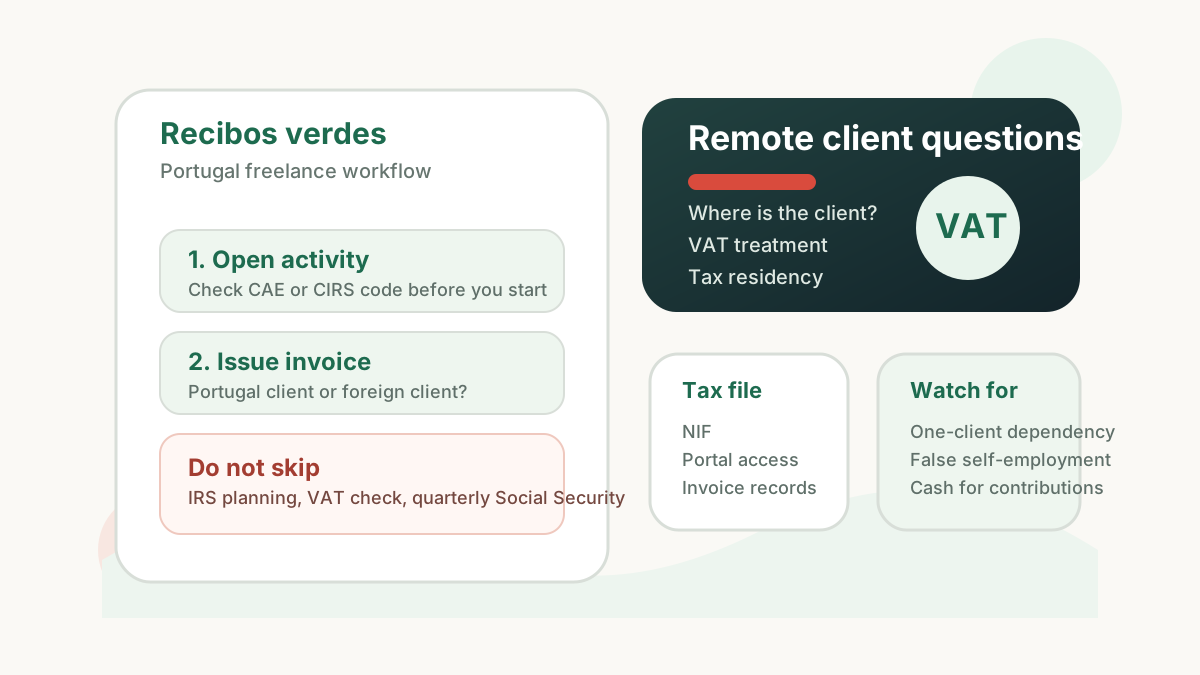
If you freelance from Portugal, recibos verdes are the tax documents used to invoice and record self-employed income through Portal das Finanças. In English they are usually called green receipts, but the Portuguese term is the one you will see around the tax system.
The portal is not the hard part. The mistakes usually happen in the choices around it: Fatura vs Fatura-Recibo, the IVA reason, IRS withholding, foreign-client details, your activity code and Social Security.
Quick Answer
Quick Answer: Recibos verdes are the electronic tax documents used by self-employed workers in Portugal. For a typical freelancer living and working from Portugal in 2026, the correct invoice, IVA, IRS and Social Security treatment depends on the client, payment status and type of work.
For a typical freelancer living and working from Portugal in 2026:
- open activity with Finanças before starting regular self-employed work
- use Fatura-Recibo if the client has already paid
- use Fatura if the client will pay later, then issue a Recibo when payment arrives
- check whether you qualify for the €15,000 Article 53 IVA exemption
- do not assume a foreign client means you can ignore Portuguese tax or Social Security
- if the client is an EU business, VAT is commonly handled by reverse charge
- if the client is a UK, US or other non-EU business, the general B2B rule normally places the service outside Portuguese VAT, subject to exceptions
- Portuguese IRS withholding is a separate question from IVA
- qualifying first-time self-employed workers can have a delayed start to mandatory Social Security contributions, but the first year is not tax-free
- self-employed workers also need work-accident insurance, even if they already have another job
Start with the client, payment status and type of work; the portal choices follow from those facts.
Who this guide is for
This guide is for foreigners who:
- freelance while living in Portugal
- invoice a UK, US, Canadian or other non-EU company
- invoice businesses elsewhere in the EU
- have a D8 or another residence status and work as an independent contractor
- have a job plus occasional freelance income
- have been told by one company to work on recibos verdes instead of an employment contract
If you are actually an employee of a foreign company rather than a contractor, do not assume recibos verdes are automatically the right solution. The legal and Social Security setup can be different.
EU/EEA/Swiss citizens can work independently in Portugal without a work visa. Third-country nationals need a visa or residence status that allows independent activity; opening activity at Finanças does not, by itself, create a right to work.
What are recibos verdes?
Recibos verdes literally means “green receipts”. The name survived from the old paper system; today the documents are electronic.
When someone says “I work on recibos verdes”, they normally mean they work as a trabalhador independente — a self-employed worker — and declare their professional income through the Portuguese tax system.
The important distinction is between the three documents you will see on Portal das Finanças.
Fatura vs Fatura-Recibo vs Recibo
| Document | Use it when |
|---|---|
| Fatura | You are billing the client but have not been paid yet |
| Fatura-Recibo | You invoice and receive payment at the same time or payment has already arrived |
| Recibo | You previously issued a Fatura and now need to record that it was paid |
A Fatura-Recibo says both “I billed this” and “I received the money”. If a UK company needs an invoice before accounts payable can release the money, issue a Fatura first. Issuing a Fatura-Recibo before payment records a payment that has not happened.
Abrir atividade explained
Abrir atividade means registering the start of your self-employed activity with Finanças.
For regular freelance work, you should do this before starting the activity, or at the latest on the start date you declare.
When you open activity, the choices that matter later include:
- your CAE or CIRS activity code
- expected annual turnover
- your IVA regime
- simplified regime or organised accounting
- the type of work you actually provide
My rule here is simple: do not choose an activity code because it gives a nicer-looking tax result. Choose the one that describes the work. The code can affect the IRS coefficient and what appears when you issue receipts.
If this is genuinely a single, occasional job with no expectation of repeating it, check whether an ato isolado is more appropriate. A recurring client relationship is not what an ato isolado is designed for.
CAE vs CIRS: do not choose by the lower tax coefficient
The activity-opening flow can show CAE and CIRS codes, which is why foreign freelancers often end up comparing codes that look similar.
Pick the code or codes that describe the work you actually do. Under the simplified IRS regime, the classification can affect whether a service falls under the 0.75 or 0.35 coefficient, so choosing an “other services” code only because it appears cheaper can create a problem later.
Do recibos verdes workers need work-accident insurance?
Yes. Portugal’s current self-employed guidance says seguro de acidentes de trabalho is mandatory for independent workers, including people who also have an employment contract.
This is easy to miss because it is not a field you complete when issuing the receipt.
If your NIF is not ready yet, start with the NIF guide. For the portal itself, see the Portal das Finanças guide.
Documents usually needed
Opening activity itself is mostly an online tax-registration process rather than a large document application.
Have these basics ready:
- NIF
- Portal das Finanças access
- Portuguese tax address
- description of your activity
- expected annual turnover
- IBAN/banking details where requested
- the CAE or CIRS code that matches your work
Finanças communicates the start of self-employed activity to Social Security. If you do not already have a NISS or are unsure how your Social Security record is set up, use the NISS guide.
How to issue a recibo verde step by step
On Portal das Finanças, go to Faturas e Recibos → Emitir. The wording can change slightly as the portal is updated, but the decision sequence is more important than memorising clicks.
- Choose Fatura or Fatura-Recibo.
- Select the activity that generated the income.
- Enter the transaction/service date.
- Add the client as the Adquirente.
- Describe the service and enter the value before tax.
- Choose the correct IVA treatment or exemption reason.
- If you are issuing a Fatura-Recibo, choose the applicable IRS withholding treatment.
- Review the document before issuing it.
- Save the PDF for your own records and send the client the document they need.
If you issued only a Fatura, return when the payment arrives and issue the matching Recibo. That is when the Portal asks for the withholding treatment connected to the payment.
Can you issue a recibo verde in English?
The Portal-issued document is in Portuguese and may not contain every commercial detail a foreign accounts team expects, such as your preferred bank wording or purchase-order reference.
Keep the Portuguese document as the fiscal record. If the client needs an English commercial invoice or payment note, make sure the client name, service, amount, dates and invoice reference match rather than creating two documents that appear to describe different transactions.
Made a mistake? Correct the original document
Do not fix a wrong IVA rate, value or client by simply issuing another receipt and ignoring the first one.
Where the Portal offers Anular, use the document’s correction route before replacing it. If the error changes the taxable value or IVA after the document has already affected a return, Portuguese VAT rules can require a rectifying document such as a credit or debit note and, where necessary, correction of the declaration.
For a material VAT error covering several months, this is accountant territory rather than trial-and-error in the portal.
How foreign clients change the situation
Foreign clients are where recibos verdes stop being a simple “invoice tutorial”.
Before choosing IVA, identify two things:
- Is the client a business/taxable person or a private consumer?
- Is the client in Portugal, elsewhere in the EU, or outside the EU?
For ordinary B2B professional services, the client location often determines where VAT is due. There are exceptions for specific services, so do not copy a reverse-charge option from someone in a completely different profession.
EU business client
For a business in another EU country, the standard B2B workflow is usually:
- choose cliente estrangeiro
- enter the country
- use the client’s VAT number and validate it through VIES
- choose the Intra-UE nature of operation where appropriate
- do not charge Portuguese IVA under the general B2B rule
- show IVA – autoliquidação / reverse charge
If you are required to file IVA returns, the transaction still needs to be reported. EU B2B services can also trigger the declaração recapitulativa, even where you are using the Article 53 small-business exemption.
How to issue recibos verdes to a UK client
The UK is outside the EU for VAT purposes.
For an ordinary service supplied from Portugal to a UK business, the general B2B rule normally means the service is located where the business customer is established. In that common situation you do not add Portuguese IVA.
For a typical UK/US/non-EU business client, the current government workflow points to:
- cliente estrangeiro
- the client’s country
- Fora do território nacional
- the applicable Article 6 / IVA – autoliquidação reason
- if the client has no Portuguese NIF, the government guide says a generic NIF such as 999999990 can be used where appropriate
A UK company without a Portuguese permanent establishment also normally does not perform Portuguese IRS withholding for you. That is different from saying the income is tax-free: you still declare the Category B income in Portugal if you are Portuguese tax resident.
This same broad logic is commonly relevant to business clients in the US, Canada, Switzerland and other non-EU countries, subject to the type of service and any special VAT place-of-supply rule.
What if the foreign client is a private person?
Do not use the B2B rule automatically.
For B2C services, the general rule is different and Portuguese IVA can apply, with important exceptions for certain electronic, property-related, event, transport and other services.
If you are unsure whether the customer counts as a taxable business, solve that before choosing the IVA field.
IVA/VAT basics
There are two questions that often get mixed together:
1. Are you in an IVA exemption regime? 2. Is this particular service even located in Portugal for VAT purposes?
They are not the same test.
Article 53 exemption: the €15,000 rule
In 2026, Article 53 can exempt qualifying Portugal-based small businesses from charging IVA where the relevant annual turnover in the previous calendar year did not exceed €15,000, subject to the other statutory conditions.
Do not read that as “under €15,000 means no tax”. Article 53 is an IVA exemption, not an IRS exemption and not a Social Security exemption.
It also does not replace the foreign-client location rules. A B2B service to a UK company may be outside Portuguese IVA because of Article 6, while a small domestic freelancer may be exempt under Article 53. Those are different reasons for not adding IVA.
If you are not exempt from IVA
For ordinary taxable services in mainland Portugal, the standard rate is generally 23%. Madeira and the Azores have different regional rates, and some activities use reduced/intermediate rates or Article 9 exemptions.
If you are in the normal IVA regime, periodic IVA declarations can remain mandatory even in a period where you collected no Portuguese VAT. If I were checking a foreign-client setup, IVA treatment is the first field I would verify before copying an old receipt.
Withholding tax basics
Retenção na fonte is an advance payment toward IRS. It is not the final tax calculation.
For many professional activities in the Article 151 table, the standard Category B withholding rate is 23% when the Portuguese payer is an entity required to withhold. Other Category B activities can have different rates.
There is a useful small-income rule: if you expect annual Category B income below €15,000 and meet the conditions, you can generally use the withholding exemption under Article 101.º-B. The exemption is optional and stops after the statutory limit is reached.
Foreign client: do they withhold Portuguese IRS?
Usually not, if the foreign company is a non-resident without a permanent establishment in Portugal.
That is why a foreign-business receipt may use wording such as “Sem retenção – não residente sem estabelecimento” rather than the €15,000 small-income exemption.
Do not confuse no Portuguese withholding on the invoice with no Portuguese IRS due at year-end. The income can still be taxable Category B income in Portugal.
Social Security basics
Self-employed Social Security is separate from IRS and IVA.
For a standard self-employed service provider outside organised accounting, Segurança Social calculates relevant income using 70% of service revenue from the previous quarter. The contribution rate for self-employed workers is 21.4%, applied to the monthly contribution base.
A simple illustration, before any permitted adjustments or exemptions:
| Example | Amount |
|---|---|
| Services invoiced over 3 months | €9,000 |
| Relevant income at 70% | €6,300 |
| Monthly base (€6,300 ÷ 3) | €2,100 |
| 21.4% contribution | €449.40/month |
The quarterly declaration is normally submitted by the end of January, April, July and October, covering the previous three months. Contributions themselves are paid monthly, generally between the 10th and 20th of the following month.
In the quarterly system, you can generally choose to move the calculated relevant income up or down by as much as 25%, in 5% steps. Where there is no income or the calculated contribution is very low, a €20 minimum contribution can apply.
For the full calculation, exemptions and declaration cycle, use the dedicated Social Security contributions for recibos verdes guide.
Is the first year of recibos verdes tax-free?
No.
I would never describe the first year as “tax-free”. Two different rules are often collapsed into that phrase.
On a first-ever Social Security enrolment as an independent worker, the mandatory regime generally starts on the first day of the 12th month after activity begins. You can opt to start contributing earlier. A restart of previous independent activity is different and does not automatically recreate that first-start delay.
Separately, under the IRS simplified regime, the 0.75/0.35/0.10 coefficients can be reduced by 50% in the tax year activity starts and 25% in the following tax year if the statutory conditions are met — notably, you do not receive Category A employment income or Category H pension income in those periods, and the activity was not restarted within the previous five years.
So if someone tells you “you pay no tax in year one”, ask which tax they mean.
Does paying only €20 to Social Security make AIMA reject your residence permit?
There is no general official rule saying a €20 Social Security contribution automatically causes an AIMA refusal.
The €20 amount can be a lawful minimum under the quarterly Social Security rules when income is zero or the calculated contribution is very low. Separately, AIMA can require a self-employed applicant to prove genuine means of subsistence, registration with Finanças and Social Security, and evidence such as a service contract or recent receipts.
So the problem is not the number €20 by itself. The problem is relying on self-employment as proof of livelihood while your contracts, receipts and declared income do not support that story. Do not inflate income or contributions just to make an immigration file look stronger.
How IRS works on recibos verdes
Recibos verdes income is normally Category B income.
Many freelancers use the regime simplificado rather than organised accounting. Under the simplified regime, the taxable base is not simply “gross invoices minus whatever expenses I choose”. Statutory coefficients apply.
Common service coefficients include:
- 0.75 for many professional activities specifically covered by the Article 151 table
- 0.35 for other service income not covered by the specified categories
That coefficient is not your tax rate. After the taxable income is calculated, it feeds into the annual IRS calculation alongside your other income and applicable deductions/rates.
For the 0.75 and 0.35 service coefficients, part of the deduction also depends on having enough qualifying business expenses properly recorded. Keep e-Fatura classifications and business expenses organised rather than discovering this during the IRS filing window.
See the IRS guide for foreigners for the annual-return side.
False self-employment warning
One client is not automatically illegal. The problem is when a supposed freelance relationship works like employment.
Warning signs include a company that:
- fixes your daily schedule
- controls where and how you work
- gives you the tools and systems as if you were staff
- expects ongoing exclusivity
- places you inside its management structure
- pays a fixed recurring amount while you carry little genuine business independence
Social Security also tracks economic dependence on contracting entities. A client receiving more than 50% of a contributing freelancer’s annual service activity can fall within the contracting-entity regime; the client’s contribution rate is higher where dependence exceeds 80%.
That Social Security test is not, by itself, the legal test for whether you should have an employment contract. But it is another reason not to treat “just invoice us every month” as neutral paperwork.
If the relationship looks like employment, compare the terms with the employment contract guide before accepting the arrangement.
Remote work and foreign client warnings
The most common real-world setup is now something like this:
You live in Portugal, work online from Portugal, and invoice one company in the UK or US every month.
That can be a legitimate self-employed arrangement. But the client being abroad does not move your Portuguese activity abroad with it.
If Portugal is where you live and perform the work, you still need to consider:
- Portuguese Category B income
- Social Security
- your IVA place-of-supply rule
- double-tax treaty questions if foreign tax is withheld
- whether the working relationship is genuinely independent
If your residence route is the D8, keep immigration and tax concepts separate: the visa may explain why you can live in Portugal, but it does not choose the correct tax treatment for each invoice. See the D8 visa guide for the residence side.
Common mistakes
These are the mistakes I would actively check before the first few invoices:
- issuing Fatura-Recibo before the client has actually paid
- choosing Article 53 just because income is below €15,000 without checking whether the exemption conditions apply
- charging 23% Portuguese IVA to a foreign B2B client when the general place-of-supply rule puts the service abroad
- doing the opposite and assuming every foreign customer means “no IVA”
- using the €15,000 withholding exemption when the real reason for no withholding is that the foreign payer has no Portuguese establishment
- assuming the first Social Security year is also IRS-free
- forgetting quarterly Social Security declarations after the exemption period
- opening the wrong activity code
- working like an employee for one company while carrying all the freelancer risk yourself
The VAT error is particularly expensive because it can sit unnoticed for several quarters. If you realise past invoices used the wrong IVA treatment, do not simply change the next invoice and hope the old ones disappear; get the earlier declarations checked and corrected where necessary.
Practical checklist before opening activity
- Confirm self-employment is the right legal setup and your residence status permits it.
- Get NIF/Portal access and choose the CAE/CIRS code that matches the work.
- Estimate turnover and check Article 53, IVA and IRS withholding separately.
- Classify each client: Portugal, EU B2B, non-EU B2B or consumer.
- Know whether the next document is Fatura, Fatura-Recibo or Recibo.
- Arrange work-accident insurance and check when Social Security contributions start.
- Keep contracts, issued documents and payment evidence together.
When to hire an accountant
You do not need an accountant merely because the words on Portal das Finanças are in Portuguese.
I would get help early if:
- you invoice both businesses and private clients in different countries
- you have already charged the wrong IVA
- a foreign country is withholding tax from your payments
- you are unsure whether 0.75 or 0.35 applies to your IRS activity
- you have employment income and freelance income at the same time
- your annual Category B income is approaching €200,000, above which organised accounting becomes mandatory
- one client controls your work so closely that you are unsure whether the relationship is really freelance
For a straightforward Portugal-based consultant invoicing one verified UK or EU business, the system can become routine once the first invoice is set up correctly. The expensive part is usually not issuing the receipt; it is fixing months of receipts that all used the wrong tax option.
Summary
For recibos verdes, most costly errors happen before you press Emitir: the wrong activity code, document type, IVA reason or withholding option.
For a foreign client, identify whether it is a business, where it is established and whether the payment has already arrived. Once those three facts are clear, the Portal becomes much easier to use.