

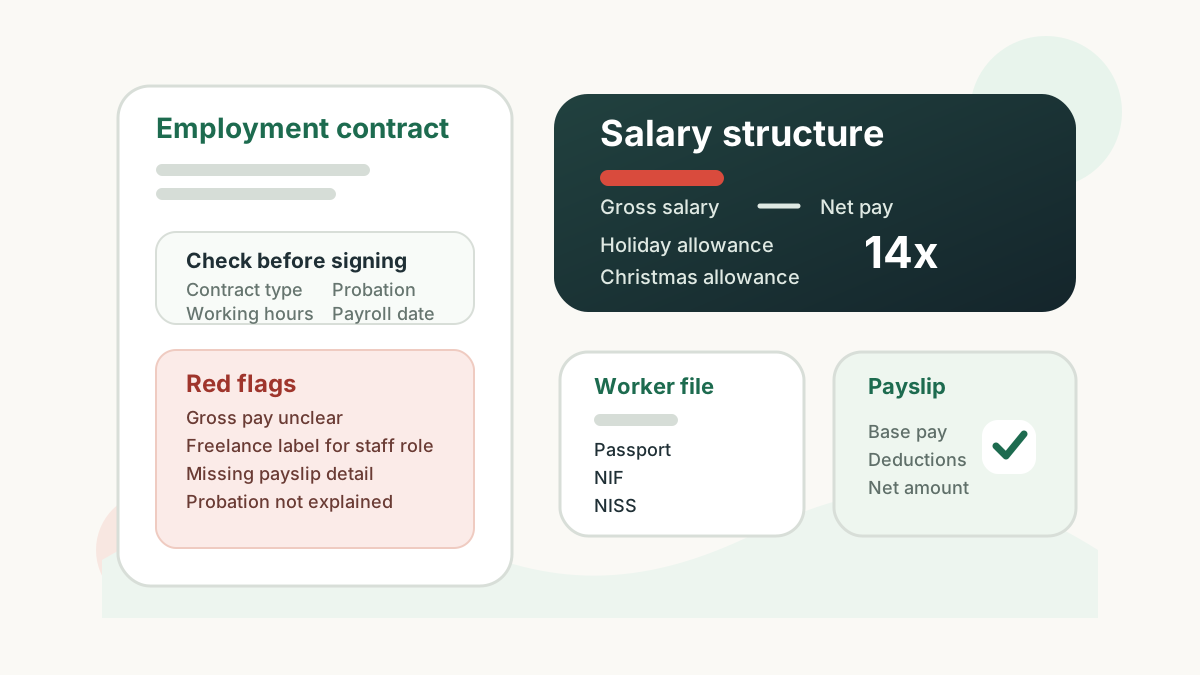
If you have just received a job offer in Portugal, the most important line is not always the salary. You need to know what type of contract you are signing, when it starts, how long it lasts, how probation works, and whether the salary is quoted over 12 or 14 payments.
Those details matter even more when your rent, residence paperwork or move to Portugal depends on the job.
This guide focuses on the clauses foreign workers most often misunderstand in a Portuguese employment contract and the questions worth asking before you sign.
Important: This article covers private-sector employment under the Portuguese Labour Code. Public-sector contracts have separate rules.
Quick Answer: A Portuguese employment contract can be permanent (contrato sem termo), fixed-term (contrato a termo certo) or uncertain-term (contrato a termo incerto).
For the private sector, the current rules include:
| Issue | Current rule to know |
|---|---|
| General probation on a permanent contract | 90 days for most workers |
| Certain qualified / trust / first-job cases | Up to 180 days |
| Directors / senior management | Up to 240 days |
| Fixed-term contract ≥ 6 months | 30-day probation |
| Fixed-term contract < 6 months | 15-day probation |
| Maximum fixed-term duration | 2 years under the Labour Code currently in force |
| Maximum uncertain-term duration | 4 years |
| Fixed-term renewals | Up to 3, subject to legal limits |
| Annual holiday | Normally at least 22 working days after the first-year rules |
| Holiday allowance | Yes |
| Christmas allowance | Yes |
Portugal’s Government announced a labour-law reform proposal in May 2026 that would increase some fixed-term limits. Those proposed limits are not the current rule unless and until the Labour Code is amended.
Portuguese Employment Contract Terms in English
Foreign workers often search the Portuguese wording copied directly from a contract or payslip. These are the terms worth recognising:
| Portuguese term | Plain-English meaning |
|---|---|
| contrato de trabalho | employment contract |
| contrato sem termo | permanent / open-ended contract |
| contrato efetivo | common informal way of referring to permanent employment; the legal wording is usually contrato sem termo |
| contrato a termo certo | fixed-term contract with a stated end date |
| contrato a termo incerto | temporary contract whose exact end date is not known at the start |
| período experimental | probation / trial period |
| data de início do trabalho | employment start / commencement date |
| retribuição base | base salary |
| salário bruto / ilíquido | gross salary |
| salário líquido | net salary |
| subsídio de alimentação / refeição | meal allowance |
| subsídio de férias | holiday allowance |
| subsídio de Natal | Christmas allowance |
| duodécimos | paying an allowance proportionally across the year instead of as one lump sum |
| recibo de vencimento | payslip / pay stub |
| aviso prévio | notice period |
| certificado de trabalho | employment certificate issued when employment ends |
| CCT / IRCT | collective labour agreement / collective regulation that may add rules to the statutory minimum |
If your contract uses one of these Portuguese terms, search the exact phrase rather than relying on an automatic translation of the whole document.
What is an employment contract in Portugal?
A contrato de trabalho is the legal relationship under which a worker performs work for an employer under the employer’s organisation and authority in return for pay.
A good contract should let you answer, without guessing:
- Who is employing me?
- What job am I being hired to do?
- Where will I work?
- What is my start date?
- What is my normal schedule?
- What is my base salary?
- Is the contract permanent or temporary?
- If temporary, why and when does it end?
- Is there a probation period?
- Which collective agreement, if any, applies?
For a fixed-term contract, Portuguese law requires a written document containing specific information including the parties, job, pay, workplace, normal working period, start date, term and the reason justifying the temporary contract.
That last point is important. A fixed-term contract is not supposed to be used merely because an employer prefers temporary workers.
Permanent Contract in Portugal — Contrato sem Termo / Contrato Efetivo
The legal wording is usually contrato de trabalho sem termo. In everyday Portuguese you may also hear contrato efetivo or someone saying they have become efetivo.
There is no predetermined end date.
That does not mean the employer can never terminate the employment. It means the relationship is not built around an expiry date in the way a fixed-term contract is.
For long-term planning, the practical advantage is simple: there is no agreed expiry date.
Fixed-Term Contract in Portugal — Contrato a Termo Certo
A fixed-term contract is:
contrato de trabalho a termo certo
It has a stated end date and must be based on a legally permitted temporary need.
How many years can a fixed-term work contract last in Portugal?
Under the Labour Code currently in force, a fixed-term employment contract generally cannot exceed 2 years, including the applicable duration rules.
A fixed-term contract can be renewed up to three times, but the combined duration of the renewals cannot exceed the duration of the initial contract.
For example, an initial 12-month contract cannot simply be followed by three additional 12-month renewals. The renewal rules and overall statutory duration limit still apply.
Portugal’s Government announced a 2026 proposal to raise those maximums to three years and five years. The consolidated Labour Code still states 2 years and 4 years at the time this guide was verified.
You may also find government summary pages that describe the renewal count differently. For the legal limit, I would use the current consolidated Labour Code: Article 149 states up to three renewals, with the total duration of the renewals capped by the initial contract period.
Does a contrato a termo certo become permanent after three renewals?
Not simply because the third renewal has happened.
The current Labour Code allows a fixed-term contract to be renewed up to three times, and the total duration of those renewals cannot exceed the duration of the initial contract. A renewal made in breach of Article 149 can cause the relationship to be treated as a contrato sem termo.
The question to ask is:
Has the employer exceeded a legal renewal or duration limit while I continue working?
A lawful fixed-term contract can also simply expire instead of being renewed again.
Does a fixed-term contract automatically renew?
It can, depending on the contract and the law.
The parties may agree that the contract will not renew. Where renewal has not been excluded, a fixed-term contract may renew at the end of its term if the legal conditions remain satisfied and neither side validly brings it to an end.
Do not read only the expiry date. Look for wording about:
- automatic renewal;
- non-renewal;
- renewal periods;
- notice required to stop renewal.
ACT’s current fixed-term simulator notes that, where a worker wants a fixed-term contract to end at its stated term, the worker normally communicates that in writing 8 days before expiry; the employer’s corresponding notice is generally 15 days.
Contrato a Termo Incerto — What Is an Uncertain-Term Contract?
A contrato a termo incerto is different from a fixed-term contract because the exact end date is not known at the start.
It may be used where the temporary need will end when a particular event occurs, such as the return of an absent employee or completion of a temporary project, where the precise date cannot initially be fixed.
The current private-sector maximum is 4 years.
If your contract says termo incerto, check:
- what event ends the contract;
- why that event creates a temporary need;
- what notice you should receive when the employer expects the term to occur.
Portugal Probation Period — Período Experimental
The Portuguese term is:
período experimental
It is the initial period in which both sides assess whether the employment should continue.
The standard private-sector periods currently in the Labour Code are:
| Contract / worker | Probation |
|---|---|
| Permanent contract — most workers | 90 days |
| Certain technically complex, high-responsibility, trust, first-job or long-term unemployed cases | 180 days |
| Director / senior management | 240 days |
| Fixed/uncertain-term contract expected to last at least 6 months | 30 days |
| Fixed-term under 6 months / uncertain-term expected under 6 months | 15 days |
The period can sometimes be reduced or excluded because of previous work, temporary work, service provision or a professional internship involving the same activity, depending on the statutory conditions. It can also be reduced by collective regulation or written agreement.
I would never assume the probation period from the job advert. Read the clause in the contract and match it to the category you actually fall into.
Can the employer end the contract during probation?
Probation has special termination rules, which is exactly why the number of days matters.
A permanent contract can still begin with a valid probation period, so factor that period into any move, lease or immigration timing that depends on the job.
Commencement Date — Data de Início do Trabalho
The commencement date is the date your employment actually begins — in Portuguese contracts you may see wording such as:
data de início do trabalho
For a fixed-term contract, the written contract must identify the start date. It also normally identifies the date of signing and, for a fixed term, the end date.
Check that the commencement date matches:
- the day you were told to start;
- the payroll period;
- the date the employer will register your employment;
- any visa or residence timing that depends on the job.
If you started working before the date shown in the paperwork, do not quietly assume it makes no difference. Ask HR to explain the discrepancy in writing.
13th and 14th Month Pay — Subsídio de Férias and Subsídio de Natal
The Labour Code provides for:
- subsídio de férias — holiday allowance;
- subsídio de Natal — Christmas allowance.
That is why Portuguese job offers are often described as having 14 payments.
The phrase can be misleading if you come from a country where salary is always discussed as 12 monthly payments. It does not necessarily mean the employer suddenly adds two extra months on top of the annual salary you were quoted.
How to compare a 12-month and 14-month salary offer
Suppose an employer says:
€1,500 gross per month × 14
The straightforward annual gross reference is:
€21,000 gross per year
If another employer quotes:
€1,750 gross × 12
that also equals:
€21,000 gross per year
So compare annual gross compensation, not only the monthly headline.
What does duodécimos mean on a Portuguese salary?
If your offer or payslip says duodécimos, part or all of an allowance is being spread across regular payroll instead of being paid as one larger amount at the traditional time.
That changes cash flow, not the basic reason the allowance exists.
Before signing, ask payroll to show you:
- annual gross salary;
- normal monthly base salary;
- how much of the holiday allowance is paid in duodécimos;
- how much of the Christmas allowance is paid in duodécimos; and
- whether any balance is paid separately later.
Do not compare one offer quoted “with duodécimos” against another quoted as base monthly salary without converting both to annual gross.
Are the 13th and 14th payments mandatory?
The existence of holiday and Christmas allowances is protected by Portuguese employment law.
Portuguese courts have also repeatedly held that these protections can remain mandatory where a worker habitually performs their employment in Portugal even if the contract chooses the law of another country.
The timing or distribution of the payments can vary depending on the applicable arrangement. Some workers receive allowances at the traditional times; others may see amounts paid proportionally during the year where that arrangement is validly used.
Before signing, ask HR for the annual gross figure and how these two allowances appear on the payslip.
Retribuição Base, Salário Bruto and Salário Líquido
Three figures are often mixed together in job discussions:
Base salary (retribuição base): the contractual base remuneration.
Gross salary (salário bruto / ilíquido): remuneration before employee deductions.
Net salary (salário líquido): what actually reaches you after applicable deductions.
If a recruiter tells you:
“You will earn €1,400.”
ask whether that is:
- base gross salary;
- estimated net salary;
- a figure including meal allowance;
- a figure including variable bonus;
- multiplied by 12 or 14.
A net estimate can change with your personal tax circumstances. Make sure the written offer clearly shows the gross structure.
Meal Allowance — Subsídio de Alimentação / Refeição
You will often see subsídio de alimentação or subsídio de refeição in Portuguese job offers.
In the private sector, the Labour Code does not create one universal meal-allowance entitlement for every worker. The payment may come from the individual contract, company policy or an applicable collective agreement.
Do not automatically add it to base salary when comparing two contracts.
Ask:
- Is it paid in cash or meal card?
- What is the amount per working day?
- Is it paid for every working day or subject to attendance rules?
- Is it included in the recruiter’s headline compensation figure?
For a clean comparison, use:
base annual gross + holiday/Christmas structure + contractual fixed allowances + clearly defined variable compensation
rather than one recruiter-created monthly total.
What does CCT or IRCT mean in a Portuguese contract?
Your contract may refer to a CCT (Contrato Coletivo de Trabalho) or another IRCT (Instrumento de Regulamentação Coletiva de Trabalho).
That matters because the collective rules applying to your sector or employer can affect issues such as salary scales, allowances, working time, job categories or other conditions.
If the contract names a CCT/IRCT, note the exact title. Do not assume the Labour Code table in a general guide is the only rule that applies to you.
Documents a Foreign Worker May Be Asked For
The contract can support an immigration process, but signing it does not itself grant a visa or residence permit.
An employer may ask for documents such as:
- passport or accepted ID;
- Portuguese NIF;
- NISS;
- address/contact details;
- Portuguese bank details for payroll;
- evidence of the right to work or residence status where relevant;
- professional qualifications where the job requires them.
If you do not yet have a NISS, see How to Get a NISS in Portugal.
ACT also has specific rules for foreign workers. Its guidance says the employment contract for a foreign worker should be prepared in duplicate, with a copy delivered to the worker. The employer also has reporting obligations connected with employing a foreign worker.
Do not let an employer turn its own reporting obligations into an unexplained “fee” you have to pay to obtain a contract.
Can You Get a Portugal Work Contract While Abroad?
Yes. A Portuguese company can recruit someone who is still abroad and issue a genuine employment contract or promise of employment where appropriate.
But getting the contract is not the same as getting a visa or residence permit.
For a non-EU applicant, the contract may then be used as part of the relevant immigration route. The correct route depends on the job and the applicant’s circumstances. For ordinary employed-worker residence, see Article 88 Portugal. Highly qualified workers should check the separate Article 90 guide.
Portugal Work Contract From India, Pakistan or Another Non-EU Country
A genuine Portuguese contract does not get a different Labour Code because the worker is applying from India, Pakistan, Nigeria or another non-EU country.
What changes is the immigration and consular process around the job.
If an agent tells you that you must pay them for a guaranteed Portuguese employment contract, treat that as a major warning sign. Community discussions repeatedly raise concerns about fake recruitment, fabricated contracts and visa/job packages.
Before sending money:
- verify the employer exists;
- independently find the company’s official website/contact information;
- contact HR using details you found yourself;
- confirm the person named in the offer works for the company;
- check that the salary, job and workplace make sense;
- never treat a PDF contract alone as proof that a visa is guaranteed.
Be especially cautious where the “employer” refuses a direct video call or all communication goes through an immigration agent rather than the company.
Can you live in Portugal with a Spanish or other foreign employment contract?
Yes, potentially — but the contract alone does not answer the tax, payroll or Social Security questions.
The key issue is where you habitually perform the work, because that can affect employment-law protections, payroll, tax and social-security obligations.
A recent Portuguese court decision reiterated that where work is actually performed in Portugal, mandatory Portuguese protections such as holiday and Christmas allowances can apply even where the contract selects another country’s law.
That does not mean every Spanish, French, UK or US employment contract automatically becomes a normal Portuguese payroll contract.
If you permanently work from Portugal for a foreign company, the employer may need a compliant cross-border employment setup. Community discussions frequently mention employer-of-record arrangements precisely because payroll and Social Security cannot be solved merely by writing “remote work from Portugal” into a foreign contract.
If you will work permanently from Portugal, confirm the payroll and Social Security setup before assuming the foreign contract can continue unchanged.
Employment Certificate — Certificado de Trabalho
An employment contract and an employment certificate are different documents.
When employment ends, Article 341 of the Labour Code requires the employer to give the worker a certificado de trabalho stating:
- the admission/start date;
- the termination date; and
- the position or positions held.
The certificate should contain other references only if the worker requests them.
So if a new employer or authority asks for your Portuguese employment certificate, they may be asking for proof of previous employment — not a copy of your current contract. If the employment has ended and you are checking benefit eligibility as well, see Unemployment Benefit in Portugal.
Portuguese Payslip — Recibo de Vencimento
Your recibo de vencimento is where the contract turns into actual payroll.
Check the first one rather than assuming payroll got everything right.
You should be able to reconcile:
- base salary;
- allowances;
- holiday or Christmas allowance when applicable;
- deductions;
- net pay;
- the amount that entered your bank account.
If your payslip does not match the written offer, ask payroll to explain the line item rather than relying on a verbal “it is normal in Portugal.”
For the tax side, see IRS Portugal for Foreigners.
Employee or recibos verdes?
A genuine employee normally works under the employer’s organisation and authority. A self-employed worker carries on independent activity and typically invoices through recibos verdes.
A company cannot turn an employment relationship into genuine self-employment simply by writing “freelancer” on the agreement.
Warning signs include a setup where the company:
- fixes your schedule like an employee;
- directs your daily work;
- integrates you into the normal staff structure;
- requires employee-like exclusivity;
- still asks you to invoice rather than putting you on payroll.
If that is what you are being offered, compare it with the Recibos Verdes guide before signing.
Contract Clauses I Would Check Before Signing
I would pause on any of these:
- the fixed-term contract does not clearly explain why the term exists;
- the start date is different from the date you are actually expected to begin;
- HR cannot tell you whether the salary is 12 or 14 payments;
- the probation clause seems longer than the legal category you fall into;
- a “permanent” offer is actually a succession of short fixed-term arrangements;
- the employer will not give you your own signed copy;
- the job advert and contract show different salary or hours;
- an agent asks you to pay for the employment contract itself;
- you are called a freelancer but managed exactly like an employee;
- a foreign employer says you can permanently work from Portugal without discussing payroll or Social Security.
One unclear clause is not automatically illegal. Several vague clauses around pay, term, hours or termination are a reason to stop and ask for written clarification.
Before you sign
Use this final check:
- Employer’s legal name matches the company that interviewed me.
- My job/function is described correctly.
- Start date is correct.
- Workplace or remote-work arrangement is clear.
- Normal working hours are clear.
- Base and annual gross salary are clear.
- I know how holiday and Christmas allowances are paid.
- I know whether meal allowance/bonus is separate.
- Contract is permanent, fixed-term or uncertain-term — and I know which.
- If fixed-term, the reason and end date are written clearly.
- I checked the probation period.
- I understand renewal/non-renewal wording.
- I have my own signed copy.
- Nobody has asked me to pay for a “guaranteed” job contract.
If those points are clear — employer, role, start date, contract type, pay, probation and termination rules — you should be able to explain your own contract without relying on what a recruiter said verbally.