

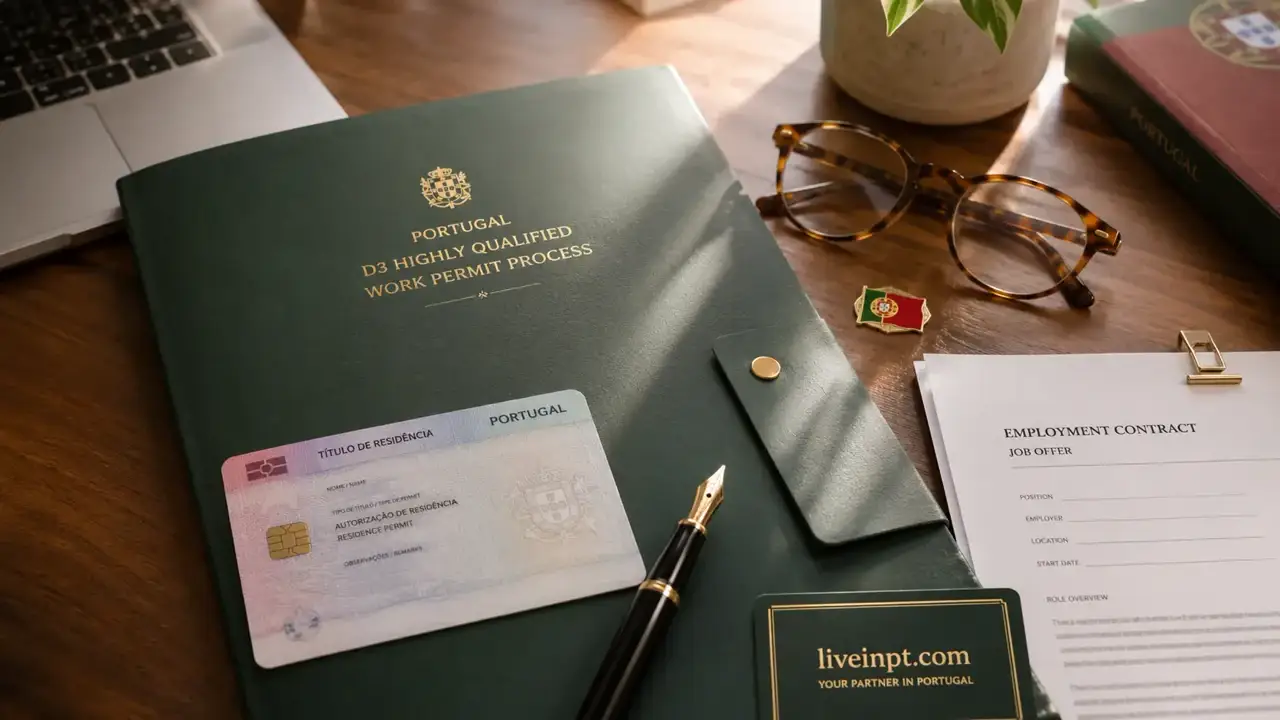
Article 90 is the Portugal residence permit route for people carrying out a highly qualified activity in Portugal. In everyday language, many people call the full route the D3 visa, but the two are not exactly the same thing.
The direct answer: D3 is usually the visa stage before you enter Portugal; Article 90 is the AIMA residence permit stage after you are in Portugal. If you are a non-EU citizen with a genuine highly qualified job, teaching role, research-linked role, cultural activity or qualifying service contract in Portugal, this route may fit. If you only have a normal job offer, remote work for a foreign employer, or freelance clients outside Portugal, another route may be safer.
In my opinion, this is one of Portugal’s most misunderstood immigration routes. People focus on the job title — “engineer”, “manager”, “consultant”, “specialist” — but the file is judged as a whole. The role, salary, contract, qualifications, employer evidence, address proof and Portuguese setup all need to tell the same story: this is genuinely highly qualified work in Portugal.
The D3 and Article 90 distinction
| Term people use | What it usually means | Where it happens |
|---|---|---|
| D3 visa | Residence visa for highly qualified, teaching, research or cultural activity | Portuguese consulate or VFS before travel |
| Article 90 | Residence permit for highly qualified, teaching or cultural activity | AIMA in Portugal |
| Article 90(2) | Direct residence permit request in Portugal with visa exemption in specific cases | AIMA, if legal entry/stay and requirements are met |
| Tech Visa | Employer certification pathway that can support some highly qualified cases | Do not treat it as a self-application route |
| EU Blue Card | Separate EU-level residence title for highly qualified employment | Best handled in its own comparison |
A simple way to think about it:
- Outside Portugal: most applicants apply for a D3 residence visa.
- Inside Portugal: they use that visa to attend AIMA and request the Article 90 residence permit.
- After approval: AIMA states that the temporary residence permit is valid for two years and renewable for successive three-year periods.
The visa is not the residence card. It is the bridge into Portugal so you can request the card.
Who Article 90 is really for
Article 90 is not a “better normal work visa”. It is for work or professional activity requiring strong qualifications, specialised technical knowledge, or exceptional skill.
Portuguese law defines highly qualified activity as activity requiring specialised technical skills of an exceptional nature or an adequate qualification for the activity. That wording matters because it gives AIMA and consulates room to judge the quality of the file, not just the salary line.
This route can fit, for example:
- senior software engineers and ICT specialists;
- data, AI, cybersecurity, cloud or infrastructure professionals;
- engineers in technical or regulated fields;
- doctors, nurses, architects and other regulated professionals, if recognition rules are handled;
- university teachers, researchers and qualified trainers;
- senior managers or specialists where the role is genuinely technical or strategic;
- cultural professionals where the activity is recognised in the way required by law;
- highly qualified service providers where the contract and qualifications support Article 90.
What I have seen in weak files is the opposite: the applicant has a real job offer, but the role is described too generically. If the contract only says “operations assistant”, “sales representative”, “customer support” or “business developer” with no high-level explanation, the file may look more like ordinary employment than Article 90.
That does not mean those jobs are bad. It means they may belong under another route.
Salary thresholds in 2026 without false certainty
The salary requirement is important, but it is not as simple as copying one number from a blog.
For highly qualified subordinate work, the official guidance refers to a contract or promise of contract with remuneration linked to 1.5 times the national average gross annual salary or three times the IAS. For certain shortage occupations in ISCO/CITP major groups 1 and 2, the lower threshold may be 1.2 times the national average gross annual salary or two times the IAS.
For 2026, the IAS is €537.13, so the IAS-based monthly references are:
| Formula based on IAS | 2026 monthly reference |
|---|---|
| 2 x IAS | €1,074.26 |
| 2.5 x IAS | €1,342.83 |
| 3 x IAS | €1,611.39 |
For the normal D3 / Article 90 route, I would not build the file around the lowest possible interpretation. AIMA’s own Article 90 page still displays reference examples based on older national average salary and IAS values, while the law and visa guidance use formulas. Some consulates and VFS checklists also phrase the contract and salary requirements differently.
My practical view: if the salary is only barely arguable, the rest of the file needs to be very strong. A high salary alone is not enough, but a low or borderline salary can make the file harder to defend.
Contract duration and signature details matter more than people think
For the residence visa stage, current official gov.pt guidance for highly qualified subordinate activity refers to a contract or promise of contract valid for at least one year. Some consular checklists and older materials may phrase timing differently. Use your local consulate or VFS checklist first.
The contract should ideally show:
- job title;
- contract duration;
- salary and payment structure;
- job location in Portugal;
- working basis and start date;
- duties that show specialised or high-level work;
- employer identification details;
- whether the profession is regulated;
- signatures that the consulate will actually accept.
That last point is not theoretical. In expat forums, I have seen people report problems because a contract was considered too informal, digitally signed in a way the reviewer did not accept, or not clearly supported by the employer. I would not assume that a short DocuSign-style offer letter is enough for every consulate.
If your contract is brief, I suggest asking the employer for a separate supporting declaration. It should explain why the role is highly qualified, how your profile matches the role, how the salary threshold is met, and why the company is hiring you in Portugal.
Before signing anything, read our employment contract in Portugal guide. For immigration, a vague contract can create avoidable delays even when the employer is genuine.
Regulated professions need extra caution
This is a major exception competitors often rush through.
For a regulated profession, such as certain healthcare, engineering, architecture or legal roles, you may need proof that you are allowed to practise that profession in Portugal. A foreign degree alone may not be enough if Portuguese law requires recognition or professional registration.
For a non-regulated profession, the focus is usually whether you have high professional qualifications suitable for the activity or sector in the contract. That can include degrees, certificates, professional experience, seniority, portfolio evidence or specialised technical background.
In my opinion, regulated professions are where people should be most cautious. You can have a strong job offer and still hit a recognition problem if the Portuguese professional body or competent authority has not accepted your qualification.
For non-regulated tech and business roles, the mistake is different: people submit a degree but do not connect it clearly to the job. If the role is cloud security architect, the file should show why you are qualified for cloud security architecture, not just that you have a random bachelor’s degree.
Employee, service provider or employer-certified tech case
Article 90 can appear in different practical situations. I would not judge the route only by the job title; I would look at how the work is documented.
If you are an employee
This is the clearest route. You usually rely on an employment contract or promise of employment with a Portuguese employer, salary evidence, qualifications, criminal record, accommodation, NIF, NISS and the other visa/residence documents.
Once in Portugal, normal setup matters too. That usually means a NIF, a NISS, address evidence and later the AIMA residence card process.
If you are a service provider
AIMA’s Article 90 page also refers to service contracts, tax and social security activity, company documents and receipts in some cases. This is where the line between Article 90 and self-employment routes becomes sensitive.
If you are genuinely providing a highly qualified service in Portugal, Article 90 may be possible. If you are simply freelancing for foreign clients, the D8 digital nomad visa may fit better. If you are starting a business or working independently in a more ordinary way, look at the Article 89 self-employed residence permit instead.
If your employer mentions Tech Visa
Tech Visa can be relevant when the Portuguese employer is certified and is recruiting highly qualified workers, but I would keep it in perspective. It is mainly an employer-backed pathway connected to the highly qualified route, not a separate lifestyle visa that an applicant casually chooses alone.
For this Article 90 guide, the practical point is simple: if the employer says the case is Tech Visa-backed, ask for proof that the certification is current and ask exactly what responsibility document they will provide. The employer-side file matters as much as your own documents.
I would save deeper questions — certification rules, employer obligations, and whether the company can really use Tech Visa for your profile — for a dedicated Tech Visa guide rather than mixing everything into the Article 90 article.
Article 90(2) direct applications in Portugal
Some competitor pages push the direct Article 90(2) route very strongly: enter Portugal legally, get a qualifying highly qualified contract, then apply directly in Portugal without first getting the D3 visa abroad.
This route exists in the law, and AIMA’s Tech Visa page refers to residence permits issued with visa exemption under Article 90(2), requiring all documents plus proof of legal entry and stay in Portugal.
But I would be careful. Legal possibility is not the same as practical ease. A direct in-country route can run into appointment availability, proof-of-legal-stay timing, document authentication issues, and uncertainty about how AIMA will handle the case in practice.
My suggestion: if you are outside Portugal and already know you need this route, the normal D3 visa path is usually cleaner. If you are already legally in Portugal and a genuine Article 90 opportunity appears, get proper advice before relying on Article 90(2) as your plan.
D3 versus EU Blue Card
The EU Blue Card is another route for highly qualified employees, but it should not be treated as simply a better version of D3. It has its own eligibility logic, salary test, document requirements and EU mobility purpose.
For this article, the main distinction is enough:
- Article 90 / D3 is the Portuguese highly qualified activity route this guide focuses on.
- EU Blue Card is a separate EU-level residence title that deserves its own guide, especially for people comparing long-term EU mobility options.
In my opinion, many applicants should first identify whether their Portuguese employer is actually preparing a D3 / Article 90 file or a Blue Card file. Mixing the two in emails, contracts or checklists can create confusion. If the employer or lawyer says “Blue Card”, ask them to confirm that they are not simply using that phrase casually to mean “highly qualified worker”.
Documents you should expect
The exact checklist depends on your consulate, country of residence, VFS location and whether the case is employment, service contract, Tech Visa, teaching, research or cultural activity.
For the visa stage, expect documents such as:
- valid passport;
- national visa application form;
- passport photos;
- criminal record certificate from the country of nationality or where you lived for more than one year;
- travel insurance for the visa stage, unless the checklist allows an exemption because insurance is covered in the contract;
- proof of accommodation in Portugal;
- employment contract, promise of contract, service contract or invitation letter;
- evidence of qualifications or professional experience;
- proof of means of subsistence, often supported by the contract;
- permission for Portuguese criminal record consultation, where applicable.
For the AIMA Article 90 residence permit stage, AIMA lists documents such as passport, valid residence visa for highly qualified activity, authenticated criminal record, address declaration or proof, NIF, social security registration, proof of highly qualified activity, qualification documents and employer or activity evidence.
A practical note: your documents should not fight each other. If your visa form says one address, your lease says another, your contract start date has passed, and your employer letter uses a different job title, the case becomes harder than it needs to be.
For accommodation, your proof does not always need to be a long lease, but it must be credible for the checklist you are using. If you are still arranging housing, our proof of address guide and renting in Portugal guide are useful companion reads.
The process from job offer to residence card
First, secure the Portuguese job, service contract or invitation. This should happen before the visa application, not after.
Second, prepare the visa file in your country of residence. For many applicants, this is done through VFS or the Portuguese consulate responsible for their jurisdiction. Do not rely on a checklist from another country if your local post uses a different one.
Third, after the D3 residence visa is approved, enter Portugal. A residence visa normally allows entry for the purpose of applying for a residence permit. Portuguese residence visas are generally issued for a limited period and normally allow two entries.
Fourth, attend AIMA for the Article 90 residence permit. Appointment availability and platform changes can matter as much as the legal rule. AIMA’s Article 90 page says the request is made by appointment, with an electronic platform in implementation for holders of residence visas.
Fifth, after approval, receive the residence card. AIMA states the temporary residence permit for highly qualified activity is valid for two years and renewable for successive three-year periods.
For this stage, read the AIMA appointment guide and AIMA residence card guide. Those are the practical parts people often underestimate.
If you receive a project to refuse
This is a community pain point that many polished guides skip.
A “project to refuse” or pre-refusal notice is not always the final answer. It usually means the authority has concerns and is giving you a short window to respond before a final decision. In D3 discussions, people commonly report concerns around contract formality, doubts about the purpose of stay, unclear employer evidence, inconsistent travel history or documents that do not prove the highly qualified activity strongly enough.
If this happens, do not panic and do not send a casual one-line reply. Read the reasons carefully, answer each point, attach the missing or corrected documents, and if possible get the employer to support the response. This is one of the situations where I would strongly consider a lawyer, especially if the issue is legal classification, contract validity or intention to reside in Portugal.
Family members
A D3 / Article 90 route can support family planning, but family members are not automatically approved just because the main applicant has a good job. They still need the correct visa or family reunification process, documents, relationship proof, accommodation and means of support.
Some consulates allow accompanying-family visa applications alongside the main D3 file. Others are more procedural. Once the main applicant is resident in Portugal, family reunification through AIMA may also be relevant.
If you are moving with a spouse or children, do not leave this to the end. Marriage certificates, birth certificates, apostilles/legalisation and translations can take longer than expected. Start with our family reunification Portugal guide if your family will join you.
When Article 90 is probably not the right route
I would be careful with Article 90 if any of these are true:
- your employer is outside Portugal and you will work remotely from Portugal;
- your Portuguese job is ordinary employment and not clearly highly qualified;
- the salary is too low or only barely arguable;
- the contract is vague, unsigned, informal or inconsistent;
- your regulated profession is not recognised in Portugal;
- you are really starting your own business rather than joining a highly qualified role;
- the employer wants you to work as a freelancer to avoid employment obligations;
- your documents show different job titles, dates, addresses or salary figures.
For remote work with a foreign employer or foreign clients, the D8 digital nomad visa may be more relevant. For passive income, see the D7 visa guide. For a standard job search, see the Portugal job seeker visa guide.
Common mistakes I would avoid
The first mistake is treating D3 as a magic fast-track visa. It may have priority language at the visa stage, but that does not mean weak documents are forgiven.
The second mistake is relying only on salary. Salary helps, but the work must still look highly qualified.
The third mistake is using a generic contract. If the contract could describe almost any office job, it may not support Article 90 well.
The fourth mistake is ignoring regulated profession rules. Doctors, nurses, architects, engineers and other regulated professionals should check recognition before assuming the job offer solves everything.
The fifth mistake is ignoring NIF and NISS timing. You may be able to start the visa process before every Portuguese setup step is finished, but by the residence stage these numbers often become important.
The sixth mistake is copying a checklist from another country. VFS India, VFS UK, a Portuguese consulate in the US and another consular post may phrase requirements differently. Use your local checklist first.
The seventh mistake is not preparing for a pre-refusal response. If the file has any weak point, keep backup evidence ready: employer explanation, notarised or properly signed contract, qualification proof, travel history explanation, address proof and updated documents.
My practical checklist before applying
Before submitting, I would want to answer yes to these questions:
- Is the Portuguese role genuinely highly qualified?
- Does the contract or employer letter explain that clearly?
- Does the salary meet the relevant threshold or formula?
- Is the contract duration strong enough for the checklist I am using?
- Are my qualifications or experience directly connected to the role?
- If the profession is regulated, have I checked recognition or licensing rules?
- Is the employer real, identifiable and prepared to support the file?
- Do my dates, addresses, job title and salary match across documents?
- Do I have a realistic plan for accommodation, NIF, NISS and AIMA follow-up?
- If my family is moving, are their documents being prepared at the same time?
If any answer is weak, fix it before filing. In immigration files, small inconsistencies can create big delays and with AIMA expect even longer delays.
FAQs
Is Article 90 the same as the D3 visa?
Not exactly. The D3 visa is usually the residence visa issued before you enter Portugal. Article 90 is the legal basis for the residence permit for highly qualified, teaching or cultural activity after you are in Portugal.
Can I apply for Article 90 without a D3 visa?
Sometimes Article 90(2) may allow a direct residence permit request in Portugal with visa exemption, if you entered and stay legally and meet the requirements. I would not treat this as the default plan from abroad. The normal D3 route is usually cleaner if you are still outside Portugal.
Is a university degree mandatory?
Not always in exactly the same way for every profession, but you must prove suitable high qualifications or specialised professional competence. For regulated professions, formal recognition or professional certification may be required. For non-regulated professions, strong experience and relevant qualifications may support the case.
Can freelancers use Article 90?
Possibly, if the service activity is genuinely highly qualified and the documents support Article 90. Ordinary freelancing, remote work for foreign clients, or starting a small business may fit another route better, such as D8 or Article 89.
Is Tech Visa the same as D3?
No. Tech Visa is connected to certified employers and can support some highly qualified worker cases, but it is not simply a normal D3 with a different label. For this Article 90 guide, the key point is to confirm whether the employer is actually certified and what responsibility document they will provide. The detailed employer-certification rules should be treated as a separate Tech Visa topic.
Does D3 lead to permanent residence or citizenship?
A D3 / Article 90 residence permit is legal residence in Portugal. Time under a valid residence permit may count toward later permanent residence or citizenship, subject to the law in force and your continuity of residence. Check the latest Portugal citizenship residence requirement guide before relying on long-term timelines.
Is the EU Blue Card better than Article 90?
Not automatically. The EU Blue Card is a separate route with its own salary, qualification and mobility logic. I would compare it carefully if your long-term plan involves moving within the EU, but I would not let that comparison distract from this article’s focus: the Portuguese D3 / Article 90 route.
Bottom line
Article 90 is a strong route when the facts are strong: a real Portuguese role, real high qualifications, a salary that fits the rules, and documents that clearly support the story.
It is not the best route for everyone with a job offer. In my opinion, the winning Article 90 file is not the one with the most documents. It is the one where every document points to the same conclusion: this person is coming to Portugal to carry out a genuinely highly qualified activity, and the employer, salary, qualifications and residence plan all make sense.