

Immigration

AIMA Article 89 Self-Employed Residence Permit Portugal 2026

Portugal Article 89 guide for freelancers, consultants, and entrepreneurs in 2026: D2 route, AIMA documents, income proof, taxes, and renewals.

Important note: This guide explains Portuguese processes in simple terms based on official sources. It is not legal or professional advice.

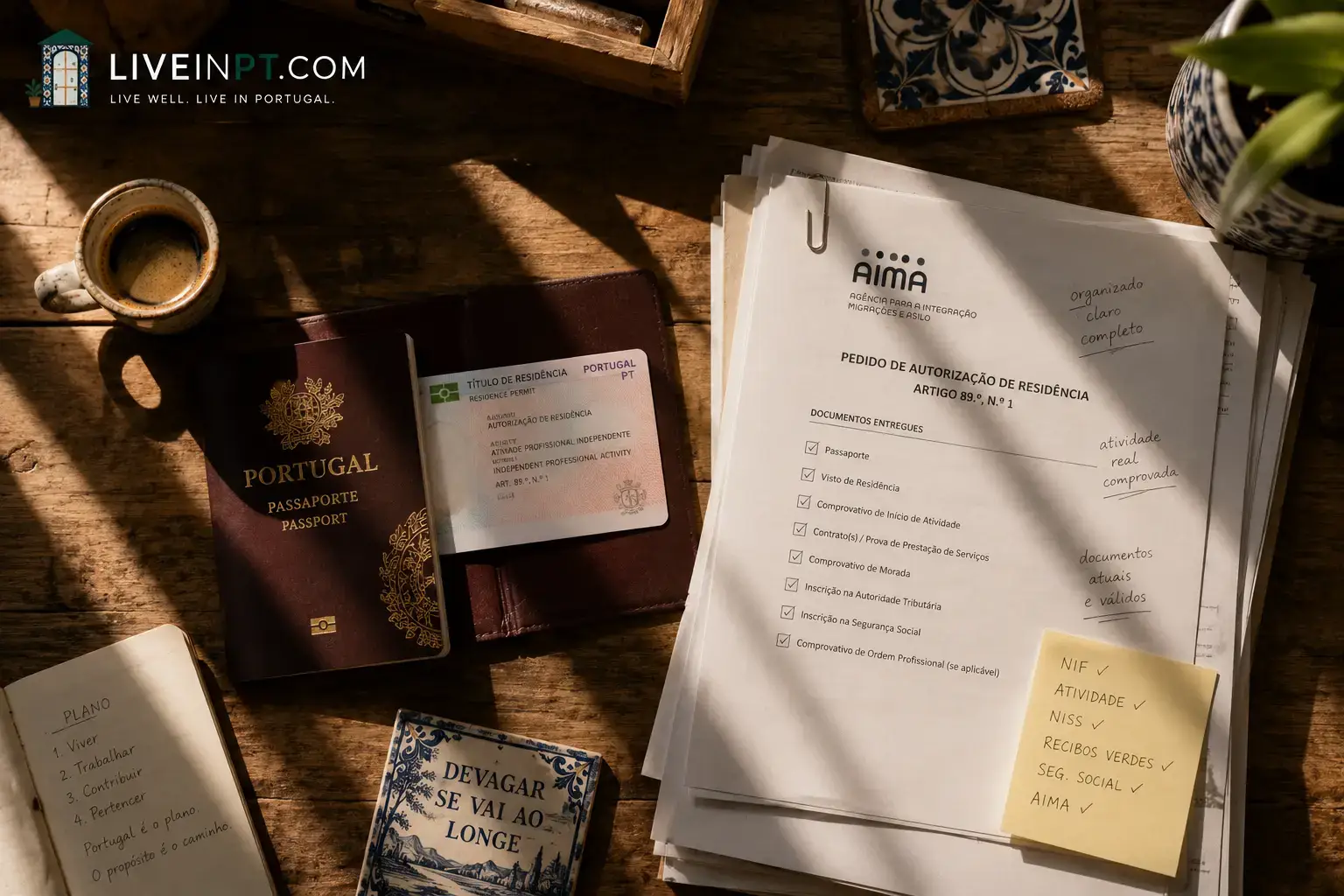
A self-employed worker reviewing Portuguese residence documents and invoices at a sunlit desk in Portugal
Author
Veer Lakhani
Published
Updated
Last verified
  • AIMA
  • Immigration
  • Residence Permit
  • Portugal Visa
  • NIF
  • NISS

Article 89 is Portugal’s residence permit route for non-EU citizens who work independently: freelancers, consultants, sole traders, service providers, and some entrepreneurs. In 2026, the safest way to understand it is simple: for most people outside Portugal, the normal path is D2 visa first, then Article 89(1) residence permit in Portugal.

That matters because older forum advice still says you can enter Portugal as a tourist, open activity at Finanças, issue recibos verdes, and then regularise through a manifestation of interest. That old general route is no longer the rule for new applicants. Article 89(2), the self-employed manifestation-of-interest route, was revoked from 4 June 2024. There are transitional cases and a separate Article 89(4) route for certain entrepreneur/incubator projects, but ordinary freelancers should not plan a move around the old inside-Portugal route.

From the Portugal side, the key is not only whether you have clients. The key is whether your file proves a real independent activity on paper: tax registration, social security registration, invoices, matching bank payments, accommodation, and a route that still exists under the current law.

Quick Answer

If you are a freelancer or self-employed worker planning to move to Portugal in 2026, the normal route is:

  1. Apply for the D2 visa at a Portuguese consulate before moving.
  2. Enter Portugal with the D2 visa.
  3. Register your tax and social security setup if it has not already been completed.
  4. Attend your AIMA appointment.
  5. Receive an Article 89(1) temporary residence permit.

If you are building a startup through a certified incubator, Article 89(4) may be relevant. If you are already in Portugal and relying on the old Article 89(2) route, treat that as a legal-risk situation and get advice before assuming you can still apply.

Your situationBetter route to investigateMain warning
Freelancer outside PortugalD2 visa, then Article 89(1)Do not rely on old manifestation-of-interest advice
Consultant with foreign clientsD2 or D8, depending on income and work structureD8 is not the same as self-employment in Portugal
Startup founder in a certified incubatorArticle 89(4) / Startup Visa routeThis is not for ordinary freelancing
Passive-income applicantD7Article 89 requires active work
Already in Portugal without a residence visaLegal advice firstArticle 89(2) was revoked for new cases from 4 June 2024

What Article 89 Actually Is

Article 89 sits inside Portugal’s immigration law, Lei 23/2007. It is not a visa by itself. It is the legal basis for a temporary residence permit for independent professional activity in Portugal.

That distinction is important:

  • The D2 visa is usually the consular-stage permission that lets you enter Portugal for independent work, entrepreneurship, or business activity.
  • Article 89(1) is the AIMA-stage residence permit you apply for after entering Portugal with that residence visa.
  • Article 89(4) is a newer entrepreneur route for third-country nationals developing an entrepreneurial project, including an innovative company, integrated into a certified incubator.
  • Article 89(2) was the old self-employed manifestation-of-interest route without a residence visa. It was revoked from 4 June 2024 for new cases.

So when people say, “I am applying for Article 89,” they may mean very different things. A D2 holder converting the visa into a residence card is not in the same position as someone who entered as a tourist and wants to regularise from inside Portugal.

The 2026 Route Map: Which Article 89 Path Applies?

Article 89(1): the normal route for most freelancers

Article 89(1) is the route for a person who already has a valid residence visa for independent professional activity. In practice, this usually means you applied for a D2 visa abroad, entered Portugal with that visa, and then attend AIMA to obtain the residence permit card.

AIMA’s Article 89(1) checklist is built around that reality. It asks for a valid passport, a valid residence visa for independent professional activity, proof of start of activity with the tax authority and Social Security, recent invoices or a service contract/company proof, accommodation proof, tax registration, Social Security registration, and professional-order proof when the profession is regulated.

This is the route I would treat as the default if you are still outside Portugal and planning properly.

Article 89(2): the old manifestation-of-interest route

Article 89(2) used to allow self-employed workers to apply from inside Portugal without first obtaining a residence visa. That general route was revoked from 4 June 2024 by Decreto-Lei n.º 37-A/2024.

The important practical point is this: do not read an old 2022 or 2023 blog post and assume you can still arrive as a tourist, open activity, and regularise through Article 89(2).

AIMA still has information connected to Article 89(2) because older and transitional cases exist. For example, AIMA opened a transitional service for people who had not submitted a manifestation of interest but had registered and contributed to Social Security before 4 June 2024, with the goal of completing at least 12 months of contributions. That is a narrow transitional situation. It is not a general route for someone starting now.

Article 89(4): entrepreneur/incubator route

Lei n.º 61/2025 introduced a specific Article 89(4) route for third-country nationals developing an entrepreneurial project, including the creation of an innovative company, integrated into a certified incubator and meeting the general residence requirements.

This is useful, but it should not be confused with ordinary freelancing. A designer, marketing consultant, developer, copywriter, or coach with clients usually belongs in the D2-to-Article-89(1) discussion, not the incubator route, unless there is a genuine startup/incubation file.

Who Article 89 Is For

Article 89 is for non-EU, non-EEA, non-Swiss citizens who will carry out independent professional activity in Portugal.

It can fit:

  • Freelancers issuing recibos verdes
  • Consultants with Portuguese or foreign clients
  • Designers, developers, marketers, writers, translators, analysts, and other service providers
  • Sole traders registered with Finanças
  • Entrepreneurs establishing a business in Portugal
  • Startup founders with a certified incubator route, where Article 89(4) applies
  • Regulated professionals, if they can prove the required professional authorisation or order registration

It does not usually fit someone whose income is mainly passive. If your income comes from pensions, dividends, savings, rental income, or investments, look at the D7 passive income visa instead.

It also does not automatically fit someone who is really an employee in substance. If you have one company controlling your schedule, work tools, workplace, and day-to-day instructions, the issue may be disguised employment rather than self-employment.

D2 Visa vs Article 89: Do Not Confuse the Two

The D2 visa and Article 89 are connected, but they are not the same thing.

The D2 visa is requested before you move to Portugal. The official national-visa documentation for independent work and entrepreneurs asks for evidence connected to the purpose of stay, such as a service provider contract or written proposal for liberal professions, professional competence proof where applicable, executed investment operations, proof of financial means available in Portugal, intention to invest, or an IAPMEI-certified incubation contract for Startup Visa cases.

Article 89 comes later, when you are dealing with AIMA in Portugal.

The practical sequence normally looks like this:

  1. Prepare your business, self-employment, or service-provider file.
  2. Apply for the D2 visa through the consulate/VFS route that serves your country.
  3. Enter Portugal with the visa.
  4. Complete the Portuguese setup: NIF, address, Portuguese bank account, activity registration, NISS, invoices, and Social Security.
  5. Attend AIMA and convert the visa basis into the Article 89 residence permit.

This is why the D2 application cannot be treated casually. A weak business plan, vague client proof, or unclear income story can create problems before you even reach the AIMA stage.

The Practical Setup Order in Portugal

For Article 89, order matters. If one piece is missing, the next piece can slow down.

StepWhat you needWhy it matters
1NIFNeeded for tax registration, bank account, contracts, invoices, and most admin
2Portuguese addressNeeded for AIMA, banks, Finanças, Social Security, and card delivery
3Portuguese bank accountHelps prove income received and pay local obligations
4Start of activity at FinançasProves you are formally self-employed
5NISS / Social Security registrationNeeded for contributions and AIMA’s Article 89 file
6Recibos verdes and payment trailShows the activity is real, not just registered
7AIMA appointmentConverts the visa/legal basis into the residence card

Start with the NIF, because almost every Portuguese admin step connects to it. Then make sure your address proof is realistic, because AIMA and other entities will rely on where you say you live. If you are renting, your lease and landlord documents need to support your file, not just your daily life. For the payment trail, you will usually want a Portuguese account too; the bank-account guide for foreigners explains what banks commonly ask for.

This guide explains the kinds of proof of address commonly used in Portugal.

Once the tax side is ready, you open activity on Portal das Finanças and issue invoices through the recibos verdes system. If that part is new to you, read the detailed guide to recibos verdes in Portugal before your first invoice. For Social Security setup, the separate NISS guide explains how the number fits into work, AIMA, and contributions.

What AIMA Wants to See

AIMA is not trying to judge whether your freelance career is impressive. It is trying to decide whether your residence file meets the legal requirements and whether your independent activity is genuine.

A strong file usually tells one consistent story:

  • You have a lawful route into the Article 89 process.
  • You have a valid passport and the correct visa or legal basis.
  • You registered your activity with Finanças.
  • You registered with Social Security.
  • You have invoices, a service contract, company proof, or another credible activity document.
  • Money shown in your bank statements matches the work you say you performed.
  • You have a real address in Portugal.
  • You have no obvious tax or Social Security compliance problem.
  • If your profession is regulated, you have the necessary professional proof.

In practice, people who struggle are often not the ones with weak businesses. They are the ones with weak paperwork: invoices that do not match deposits, expired certificates, a vague address situation, or activity registered under a code that does not match what they actually do.

Working Checklist for the AIMA Appointment

Use AIMA’s current Article 89 page for the official list for your exact route. The checklist below is a practical preparation list, not a promise that every AIMA counter will ask for every item in every case.

Core Article 89(1) documents

For the D2-to-Article-89(1) route, prepare:

  • Valid passport
  • Valid residence visa for independent professional activity
  • Completed AIMA application form
  • Two recent passport-style photos if your appointment location requires them, such as AIMA shops where photos are not captured digitally
  • Proof of start of activity with the Portuguese tax authority
  • Proof of Social Security registration
  • Service contract, written service-provider proposal, recent recibos verdes, or company proof such as a permanent certificate
  • Accommodation declaration and supporting housing document
  • Proof of tax registration
  • Proof of Social Security registration
  • Professional-order declaration or competence proof if your profession is regulated in Portugal

Practical supporting documents worth bringing

These may not appear in the same way on every official checklist, but they can make your file easier to understand:

  • Three to six months of bank statements
  • Client contracts or project scopes
  • Recent invoices and matching payment receipts
  • Proof of savings, especially if income is irregular
  • Portuguese IRS filing if you have already completed a tax year in Portugal
  • Social Security contribution history if you have already started contributing
  • Health insurance or SNS proof, depending on your stage
  • Copies of everything in a clean folder, ordered by category

My view is simple: prepare the file as if the officer has no time to guess what you mean. If your invoice says one thing, your bank statement says another, and your activity code says something else, the file becomes harder than it needs to be.

Accommodation Proof: A Common Weak Point

AIMA’s Article 89(1) list includes an accommodation declaration explaining where and under what terms you live in the property. If you own or have usufruct rights, you may need property-registry proof or an access code. If you rent, sublet, stay with a host, or have another use arrangement, the landlord or hosting entity should support the legal basis of your stay.

This is where many files become messy. A short informal message from a friend is not the same as a clear housing document. A lease that is not registered, a host who will not provide ID, or an address that does not match your other documents can slow everything down.

For AIMA purposes, focus on whether your address can be proven cleanly, not only whether you can sleep there.

Income: What “Enough” Means in Practice

Article 89 does not publish a special income threshold like the D8 digital nomad visa. The standard concept is adequate means of subsistence.

In practice, the national minimum wage is the reference point people use because it is the baseline Portugal applies across many immigration and subsistence contexts. In 2026, the mainland Portuguese minimum wage is €920 per month.

That does not mean €920 is a magic approval number. A stronger Article 89 file shows:

  • regular income, not only one isolated payment;
  • bank deposits that match invoices;
  • enough savings to cover irregular months;
  • housing costs that make sense for the income shown;
  • no unpaid tax or Social Security problems.

If you live in Lisbon, Porto, Cascais, or parts of the Algarve, a bare-minimum income file may look less convincing because rent and daily costs are higher. If your income fluctuates, show the pattern over several months instead of relying on one good invoice.

One Client: Is It a Problem?

Having one client does not automatically disqualify you. Article 89 does not say you need three clients, five clients, or clients in Portugal.

The real question is whether your relationship is genuinely independent. A single-client file is stronger if you can show that you:

  • issue invoices rather than receive payslips;
  • control how and when you perform the work;
  • use your own equipment;
  • can work for other clients;
  • have a service agreement rather than an employment contract pretending to be freelance;
  • are not integrated into the client company like a normal employee.

If your client controls your schedule, tools, workplace, and day-to-day instructions, Portuguese labour law may view the relationship as falso recibo verde — self-employment in form, employment in substance.

That matters for the client, for labour compliance, and potentially for the credibility of your renewal file. If the facts look like employment, Article 88 or a real work contract may be the more stable route.

Taxes and Social Security: What Changes After You Start

Once you live in Portugal and work independently, you are not only an immigration applicant. You are also inside the Portuguese tax and Social Security system.

For tax, self-employed income is Category B income. Many freelancers are under the simplified regime if annual gross Category B income does not exceed €200,000 and they have not opted for organised accounting. Under this regime, taxable income is calculated by applying coefficients to gross income. For many Article 151 professional services, the coefficient is 0.75; for other services not specifically listed, it can be 0.35. Expenses registered through e-Fatura can still matter, especially where the law requires proof of part of the presumed expense amount.

For yearly deadlines, keep the Portugal tax calendar open too, because missed dates can create avoidable compliance problems before renewal.

For Social Security, self-employed workers pay their own contributions. gov.pt states that self-employed contributions are paid monthly, normally between the 10th and 20th, for the previous month. Your exact contribution base and rate depend on your category and activity situation, so do not rely on a simple internet calculator for a residence-permit file.

This guide explains Segurança Social contributions for recibos verdes workers.

An accountant is not legally required for everyone, but for a foreign freelancer in Portugal, it is often one of the best practical investments. Your immigration renewal depends partly on your tax and Social Security history. A cheap mistake in Finanças can become an expensive immigration problem later.

If You Are American, Add a Second Compliance Layer

Article 89 solves Portuguese residence. It does not remove US tax obligations.

US citizens and green-card holders generally continue to file with the IRS even while living in Portugal. Foreign bank accounts may create FBAR and FATCA reporting obligations, and Portuguese self-employment/tax residence can interact with US foreign tax credit planning.

This is not a reason to avoid Article 89. It is a reason to plan the paperwork before the first Portuguese tax year closes.

Travel While Waiting: Be Careful

AIMA’s own FAQ is clear that a receipt proving a residence-permit application is not a travel document and cannot be used by itself to travel to other Schengen areas.

This is one of the most important practical warnings in the whole process. A Portuguese pending receipt may help prove your status inside Portugal, but it does not guarantee that an airline, border officer, or another Schengen country will accept your situation.

If your visa has expired and your card has not arrived, do not assume you can travel normally. Before leaving Portugal, check your specific documents and, if the trip matters, get professional advice. Missing a family emergency, being denied boarding, or being stuck outside Portugal is much worse than delaying a trip.

Booking and Attending AIMA

If you enter on a D2 visa, do not treat the visa validity period as free time. The AIMA appointment is the bridge between your visa and your residence card, and appointment availability can be uneven.

After arrival, your priorities should be:

  • confirm your address;
  • finish any missing tax/Social Security steps;
  • organise your self-employment evidence;
  • check your AIMA appointment status;
  • avoid letting key documents expire.

This guide explains how AIMA appointments work and what to watch for when dealing with the appointment process.

Since 2025, incomplete temporary residence applications have become much riskier because the previous grace period for missing documents was eliminated. Treat the appointment as a complete-file appointment, not a first conversation.

Documents That Expire Faster Than You Expect

Foreign criminal record certificates, apostilles, translations, and some consular documents can become stale before AIMA sees them. This is especially frustrating if you prepared everything early and then waited months for an appointment.

A practical approach is:

  • prepare slow documents early enough to avoid panic;
  • delay short-validity certificates until the appointment is realistic;
  • keep digital scans of every document;
  • carry originals plus copies;
  • check whether translations or apostilles are required for your country;
  • do not assume a document used for the visa stage will still be valid for AIMA.

If your document comes from outside the EU, the apostille/legalisation step is often the delay. Build that into your timeline.

Renewing the Article 89 Permit

AIMA states that the temporary residence permit for independent professional activity is valid for two years from issue and renewable for successive three-year periods.

At renewal, the issue is not only whether you still live in Portugal. You need to show that your life and activity remain compliant:

  • continued independent activity;
  • invoices or company/self-employment proof;
  • tax filings submitted;
  • Social Security contributions paid where due;
  • accommodation proof;
  • clean criminal-record position;
  • no serious absence problem.

Portugal’s absence rules for temporary residence normally mean you should not be away for more than six consecutive months or eight non-consecutive months during the permit validity period, unless an accepted exception applies.

The practical advice is to treat renewals as a two-year audit trail. Do not wait until the last month to discover unpaid Social Security, missing IRS filings, expired address proof, or inconsistent invoices.

Segurança Social Direta is where many contribution and declaration tasks are managed online. For residence-card renewal steps, also check the AIMA online portal guide before your expiry date is close.

What Article 89 Gives You

An Article 89 residence permit gives you legal residence in Portugal and the right to carry out independent professional activity. It also becomes the basis for several longer-term steps:

  • registering for public healthcare once the normal requirements are met;
  • building Social Security history;
  • applying for family reunification when eligible;
  • renewing residence;
  • applying for permanent residence after the required residence period;
  • eventually counting residence time toward nationality, if you meet the law in force at that time.

For healthcare, you will usually want a número de utente once you are eligible and registered correctly.

For family, note that Portugal changed family-reunification rules in 2025. Do not assume older timelines still apply.

Permanent Residence and Citizenship

Article 89 is usually a temporary residence route at first. The medium-term goal for many people is permanent residence.

After five years of legal residence, many foreign residents can apply for permanent residence if they meet the conditions. Some residents may also compare this with EU long-term residence in Portugal, which has its own requirements. Permanent residence is different from citizenship: it gives stronger residence stability, but it does not make you Portuguese.

Citizenship is now a longer conversation for many non-EU applicants. Lei Orgânica n.º 1/2026 changed Portugal’s nationality timeline, and the practical starting point is the residence permit, not merely the day you arrived. If nationality is part of your long-term plan, read the current law carefully before assuming old five-year advice still applies.

Article 89 vs Other Portuguese Routes

Article 89 vs D8 digital nomad visa

The D8 digital nomad visa is for remote workers with foreign employment or foreign clients who meet a higher income threshold. In 2026, the benchmark is four times the Portuguese minimum wage, so €3,680 per month using the mainland €920 minimum wage.

If all your income is foreign and you easily meet the D8 threshold, compare D8 carefully. If you are building a Portuguese self-employed activity, taking Portuguese clients, or setting up a local business, Article 89/D2 may fit better.

Article 89 vs D7 passive income visa

The D7 is for passive or stable income such as pensions, rental income, dividends, or other non-work income. If your money comes mainly from assets rather than active work, D7 is normally the cleaner discussion.

Article 89 vs Article 88 employed worker

Article 88 is for subordinate employment. If a Portuguese employer is hiring you under a real employment contract, Article 88 is usually more natural than pretending to be self-employed.

Article 89 vs Golden Visa

The Golden Visa is an investment residence route, not a work route. If your goal is investment-based residence with limited stay requirements, compare it separately.

Common Mistakes That Weaken Article 89 Files

1. Relying on old manifestation-of-interest advice

This is the biggest 2026 mistake. The old Article 89(2) route is not the standard route for new applicants. Start from the current AIMA route, not old comments online.

2. Registering activity but not issuing invoices

Opening activity at Finanças is not enough. AIMA wants to see that the activity exists in practice.

3. Showing invoices without matching bank payments

If your invoice says you earned €3,000 but the bank statement does not show the money arriving, the file is weaker. Bring both.

4. Ignoring Social Security

Self-employed workers are responsible for their own contributions. Missed payments can affect benefits, renewals, and the overall credibility of the file.

5. Treating the AIMA receipt like a residence card

The receipt is not a Schengen travel document. Plan international travel carefully until the card is issued.

6. Using the wrong route for the wrong income type

Active freelance work, passive income, remote employment, local employment, and investment are not the same immigration story. Choose the route that matches the facts.

This broader guide covers common mistakes foreigners make when moving to Portugal.

A Practical Pre-Appointment File Structure

A clean Article 89 file should be boring to review. Use separators or folders like this:

  1. Passport and visa/legal-entry documents
  2. AIMA form and appointment confirmation
  3. Tax registration and start of activity
  4. Social Security registration and contribution proof
  5. Contracts, proposals, company documents, or client proof
  6. Recibos verdes and matching bank payments
  7. Accommodation proof
  8. Professional-order documents, if applicable
  9. Health/SNS/insurance documents, if relevant
  10. Criminal-record documents, translations, and apostilles if requested for your route
  11. Copies of everything

The goal is not to impress AIMA with volume. The goal is to make the decision easy: your route is correct, your activity is real, your documents match, and you are compliant.

Final Take

Article 89 is one of Portugal’s most useful residence routes because it recognises a modern reality: many people work for themselves. You do not always need an employer sponsor, a huge investment, or a passive pension to build a legal life in Portugal.

But in 2026, Article 89 is not the casual inside-Portugal workaround many people remember from the manifestation-of-interest era. For most new self-employed applicants, the strong route is to prepare properly, apply through the D2 visa route when required, build a clean Portuguese paper trail, and treat AIMA as a complete-document appointment.

If I were preparing this file today, I would focus less on finding a shortcut and more on making every part of the story line up: visa route, NIF, address, activity registration, NISS, invoices, bank deposits, taxes, and Social Security. That is what turns Article 89 from a confusing immigration article into a workable residence plan.

Helpful guide? Share it with someone living in Portugal or planning to move here.

Newsletter

Don’t miss what matters in Portugal

Related guides