

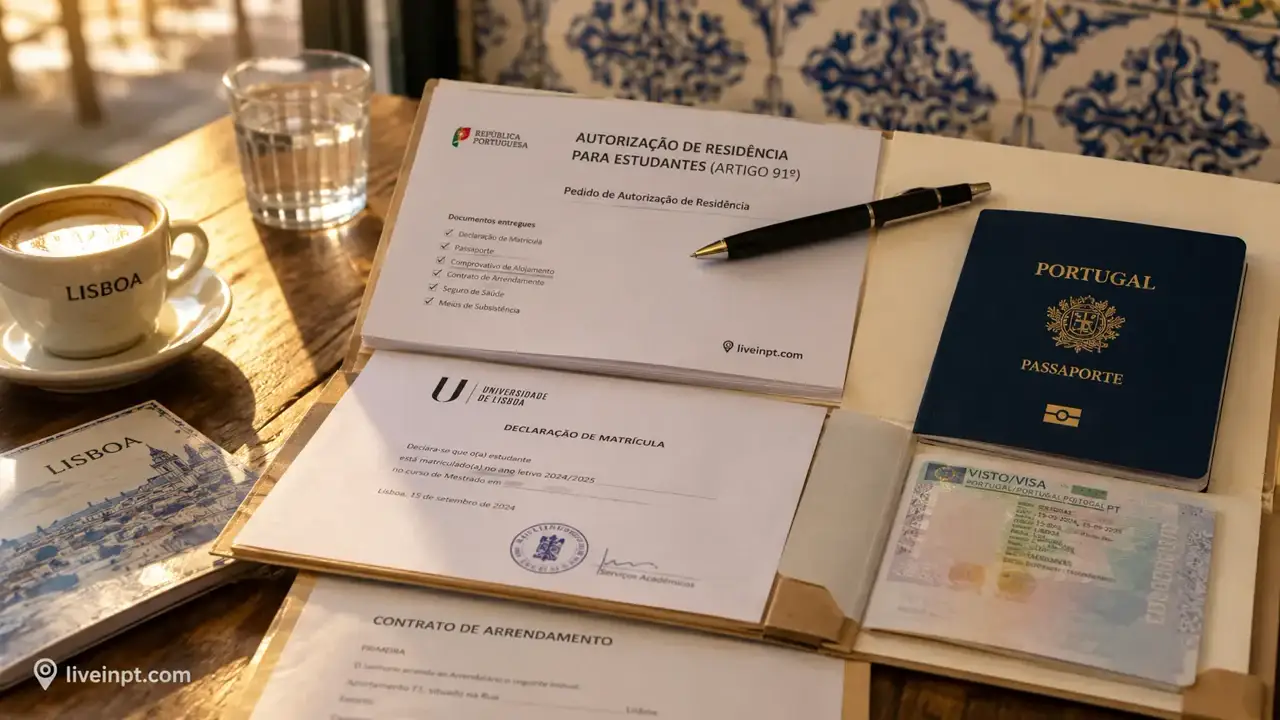
Getting an acceptance letter from a Portuguese university resolves one question and immediately raises another: what exactly do you do at AIMA, and in what order? The visa gets you through the border; Article 91 of Lei n.º 23/2007 is what authorises you to actually live here while you study.
Article 91 covers the residence permit for higher education students who are third-country nationals — people who are not EU, EEA, or Swiss citizens, and therefore need a formal immigration document to stay in Portugal for longer than a short visit. EU and EEA citizens follow a completely different registration process and are not affected by this article at all.
The sequence is not complicated, but the details matter: study visa first at a Portuguese consulate, then travel to Portugal, then AIMA appointment, then permit. What goes wrong in practice is almost always document preparation or poor timing — two problems that are entirely avoidable if you know what to expect.
Quick Answer: Article 91 of Lei n.º 23/2007 grants a three-year residence permit to third-country nationals enrolled in higher education in Portugal. You apply in person at an AIMA shop after arriving on a valid study visa. The permit is renewable, allows complementary part-time work, and can transition into an extended stay under Article 122 once you graduate.
Changed 11 September 2026: Lei n.º 62/2026 repealed Article 91(4). For new Article 91 cases, do not rely on the old legal-entry exemption to convert a tourist or visa-free stay into this student residence permit. If you applied under Article 91(4) before 11 September and your case is still pending, the new law does not set out a blanket Article 91 transitional rule, so confirm the treatment of your specific case with AIMA or qualified immigration counsel.
Who Article 91 Is For
This article applies to any non-EU national who has been accepted onto a degree programme, postgraduate course, or recognised study cycle at a higher education institution in Portugal. That includes universities, polytechnics, and other accredited institutions.
If you are an EU citizen, you do not need this permit. If you are a non-EU student already holding a residence permit from another EU member state and coming to Portugal on a formal student exchange, a different provision applies — Article 91-A covers that mobility scenario separately.
A note for citizens of CPLP countries, including Brazil, Angola, Mozambique, Cape Verde, and Guinea-Bissau. Following Lei n.º 61/2025, which came into effect in October 2025, CPLP nationals can no longer apply for a residence permit from inside Portugal on the basis of a tourist visa or Schengen entry. A proper residence visa from a Portuguese consulate is now required first, the same as for other third-country nationals. If I were advising a Brazilian student today, I would make the consular residence visa the first step, before booking flights or accepting accommodation, not something to figure out after arriving.
What Article 91 Actually Grants
A residence permit under Article 91 authorises you to live in Portugal for the duration of your studies. It is not a general residence permit and does not grant you free rein to switch to work-based status without a separate process. The permit is tied to your enrolled student status.
One update worth knowing: the current permit validity is three years, or the length of the study programme if it is shorter than three years. This is different from older versions of the law, which provided one-year permits renewable annually. If you are reading older guides or archived SEF information that still references annual renewals, that information is outdated.
There is one important exception to the three-year rule. Students who are covered by a European Union or multilateral programme that includes mobility measures, Erasmus+ for example, or by an agreement between two higher education institutions, receive a two-year permit rather than three. This applies where the EU programme framework itself has brought you to Portugal for a full degree. If the conditions of Article 62(4) were not satisfied at the time of granting, the permit may be reduced to one year. For most students enrolled in a standard Portuguese degree with no EU programme framework, three years remains the default.
Holders of a student residence permit may engage in professional activity complementary to the study activity that led to the visa. This is written to mean student-compatible, part-time, or related work — not full-time employment in an unrelated field running alongside nominal enrolment.
Documents for the AIMA Appointment
Since April 2025, AIMA no longer accepts incomplete applications. If your file is missing a document when you arrive at the counter, the appointment ends without processing. Prepare this file thoroughly before booking the appointment.
The required documents under Article 91:
Passport or valid travel document — valid for the full period you expect to remain in Portugal, ideally with validity beyond your programme end date.
Valid residence visa — your D4 study visa, issued at a Portuguese consulate in your country of residence before you travelled. The former Article 91(4) legal-entry exemption was repealed on 11 September 2026.
Proof of enrollment — a current, signed declaration from your higher education institution confirming your programme and enrolled status. Universities issue these at the start of each academic year; make sure yours is dated recently.
Proof of tuition payment — if your institution charges fees, a declaration confirming payment. Students on scholarships or fully funded grants should ask their institution for a letter confirming that status.
Proof of accommodation — a signed rental contract, university housing letter, or formal accommodation agreement showing your address in Portugal. If you are still finalising where you will live when you arrive, sort this before booking the AIMA appointment, not after. The guide to renting in Portugal as a foreigner covers what a valid Portuguese tenancy agreement needs to include.
Means of subsistence — bank statements, grant letters, or scholarship documentation showing you have sufficient funds for your stay, as defined by Ministerial Order 1563/2007. The exact threshold should be verified against current AIMA guidance before your appointment, since the amounts are updated periodically.
Criminal record certificate — from your country of nationality, and from any country where you have lived for more than one year before Portugal. This needs to be apostilled or legalised, and translated by a sworn translator if it is not already in Portuguese or English. This document has a short shelf life — do not order it too far in advance. If you are coming from the United States, the FBI background check and apostille guide covers the process step by step.
Health insurance or SNS proof — valid private health insurance covering treatment in Portugal, or evidence of National Health Service registration. For most students arriving from outside the EU, private insurance is the practical option at arrival.
What I would emphasise about this document list: bring originals and copies of everything. AIMA officers may retain copies of some documents, and having duplicates with you avoids scrambling on the day.
The AIMA Application Process
After arriving in Portugal on your study visa, you book an appointment at an AIMA shop — either through the AIMA online portal or by telephone. The AIMA appointment guide explains the current booking routes, what to expect from appointment wait times, and which AIMA shops service which areas of the country.
At the appointment, biometric data (fingerprints and photograph) is collected alongside your documents. You leave with a receipt confirming submission. The residence card itself is issued and printed separately — it typically takes several weeks. The AIMA residence card guide explains how to track the card and what documents to carry while you wait.
Before the appointment, sorting your NIF (Número de Identificação Fiscal) should be a priority. The NIF is not a formal AIMA requirement for the permit application, but you need it immediately for banking, rental contracts, utilities, and any employment. The guide to getting a NIF in Portugal covers the current process, including how to apply through a consulate before you travel if you want to arrive with your NIF already active.
Working While You Study
Professional activity is permitted under Article 91, as long as it is complementary to the study that led to your visa. For practical purposes, this means you can work part-time or freelance in a field connected to your programme.
If you take up an employment contract, you will need a NISS (Número de Identificação da Segurança Social) to be registered with the Portuguese social security system. The NISS guide covers registration through Segurança Social Direta. For freelance income, recibos verdes, Portugal’s system of self-employment invoices, require an active NIF and a registration with the tax authority (Finanças).
At renewal, AIMA will cross-check your tax and social security records if you have declared any professional activity. Keep both registrations clean from the start rather than trying to correct them at renewal.
Renewing the Article 91 Permit
The renewal application should be submitted between 90 and 30 days before your current permit expires. AIMA checks at renewal that you continue to meet the original Article 91 conditions: active enrollment, sufficient means of subsistence, and compliance with the general conditions of Article 77.
The renewal file requires an updated enrollment certificate, updated bank statements or subsistence proof, and updated accommodation evidence if your address has changed. Proof of study progress, such as transcripts, grade certificates, or a letter from your supervisor for postgraduate students, may also be requested.
The most common renewal complication, in my experience reviewing how these cases go wrong, is a gap in enrollment documentation. If you took a leave of absence, deferred a semester, or changed institutions without formally notifying AIMA at the time, the renewal process becomes substantially harder. Document any changes as they happen, not retrospectively.
One thing I would add: if you are nearing the end of a three-year permit and still have study time remaining, do not confuse your permit expiry date with your programme end date. They are often different, and AIMA expects the renewal to be initiated within the 90-to-30-day window before the card expires — regardless of how much study time remains.
FDUL Students: The AIMA Fast-Track Renewal Pilot
If you’re at the Faculdade de Direito da Universidade de Lisboa and renewing your first residence permit, a separate process may now apply to you. In July 2026, AIMA signed a pilot cooperation agreement with FDUL to issue the required documents within 30 days — a sharp contrast to AIMA’s standard processing times, which can run up to four years.
The pilot currently covers only first residence permit renewals, not initial applications or later renewals. FDUL was chosen partly because international students make up roughly a quarter of its enrollment, and the stated goal is to have eligible students regularised before the academic year starts in September.
This is a pilot, not a settled process yet. Coverage is expected to widen to other study cycles at FDUL, and a similar agreement is reportedly being developed with NOVA University Lisbon. A related model already runs in Coimbra, where AIMA operates a service point inside the university itself, handling everything from renewals to permanent residence through the Inforestudante academic platform.
What I’d suggest if you think you qualify: confirm directly with FDUL’s international student office how the two offices are coordinating documents on their end, since the mechanics haven’t been published in AIMA’s own guidance yet — this is agency-to-institution coordination, not a new public application route.
After Graduation: The Article 122 Route
Article 122 of Lei n.º 23/2007 allows graduates to remain in Portugal after completing their studies to look for work or establish a business, without needing to leave the country and reapply from abroad. The specific sub-paragraphs are (o) and (p): paragraph (o) covers staying to seek employment or start a business after completing higher education; paragraph (p) covers the equivalent for researchers after completing a research project. The Article 122 stay after graduation guide covers this transition in full detail.
The practical process is not what most graduates expect. The transition from student to employment status under Article 122 is treated by AIMA as a new authorisation, Dispensa de Visto, Art. 122, not as a standard renewal. This means the AIMA online renewal portal will not accept it. The correct route is through the AIMA contact form at aima.gov.pt under “Contactos”, selecting the subject “Concessão de Autorização” and then “Dispensa de Visto – Art. 122”, attaching your employment contract (or promissory contract), NIF certificate, passport, and the expired or expiring student permit card. What I have found is that graduates who go straight to the renewal portal and hit a dead end assume something is wrong with their application. In fact, they are using the wrong door entirely.
Processing times for this transition are currently running at six to eighteen months. The receipt AIMA issues on submission of the request serves as legal proof of your authorised status while the decision is pending. You can work, remain in Portugal, and present the receipt to employers and banks. The key condition is that you must request the Article 122 stay before your current student permit expires — do not wait until the card has lapsed.
From there, if you secure employment in a highly qualified field, Article 90 is the relevant residence permit framework. If you go into independent work or start a business, Article 89 is the equivalent for self-employed and entrepreneur routes.
If you are earning income in Portugal after graduation, the IRS Jovem tax regime is worth understanding — it provides a partial income tax exemption for young graduates working in Portugal, with graduated rates that are significantly lower than the standard IRS scale.
Frequently Asked Questions
What is the Article 91 residence permit in Portugal?
Article 91 of Lei n.º 23/2007 grants a residence permit to third-country nationals enrolled in higher education in Portugal. It allows you to live and study in Portugal for up to three years, renewable, and permits complementary professional activity alongside your studies.
Do I need a visa before applying?
Yes. For new Article 91 applications, a D4 student visa issued at a Portuguese consulate before travel is the standard route. Article 91(4), which previously allowed a legal-entry exemption, was repealed with effect from 11 September 2026.
How long is the permit valid?
Three years, or the duration of the programme if shorter, under the current legislation. Older guides that say one year are referencing an outdated version of the law.
Can I work with this permit?
Yes — professional activity complementary to your study programme. If you take up employment, register for NISS and keep your tax situation current.
What happens after I finish my degree?
Article 122 allows you to remain in Portugal to look for work or start a business after graduation, without leaving. You must request this before your student permit expires.
Do I need a NIF before the AIMA appointment?
Not as a formal requirement for the permit application, but you will need it for essentially everything else. Sorting the NIF early — before or immediately after arrival — avoids delays on banking, accommodation, and work.
Is there a faster AIMA process for FDUL students?
Yes, for first residence permit renewals. Since July 2026, a pilot agreement between AIMA and FDUL sets a 30-day document turnaround, against the standard wait of up to four years. It doesn’t yet apply to new applications or subsequent renewals.
Portugal’s student route is one of the more straightforward immigration pathways in the country. A three-year permit, the ability to work part-time alongside your studies, and a direct bridge to Article 122 after graduation give you real continuity. The process is not difficult if your documents are in order — and that preparation is entirely within your control.
If you are still in the planning phase and want a broader picture of what arriving as an international student involves from first steps through to settled life, the international student Portugal checklist covers the full sequence in one place.