


Renting a house in Portugal as a foreigner is not just about finding a place you like. The rental contract can become part of your proof of address, your tax address, your bank paperwork, and sometimes your immigration file.
That is why the safest question is not only “Can I afford this rent?” It is also: “Will this rental create a clear document trail I can use later?”
If your long-term plan includes ownership, compare this with buying property instead of renting before you sign a multi-year lease.
This guide explains renting in Portugal for foreigners in practical English: documents, NIF, deposits, contracts, rent receipts, proof of address, red flags, and what to check before signing.
Last verified: October 26, 2026. Housing, tax, and immigration-related requirements can change. Always check official sources and get qualified legal advice before signing if the contract or payment request is unclear.
Quick Answer
Quick Answer: Foreigners, EU and non-EU alike, can rent homes in Portugal without needing a residence permit first. You will typically be asked for a passport or ID, a Portuguese NIF, proof of income, and sometimes a guarantor (fiador) or extra advance rent. A written rental contract should name the landlord, tenant, property, rent, deposit, and advance rent amounts. By law, a landlord can currently ask for at most two months’ rent as a deposit and two months’ rent paid in advance, though many landlords informally ask for more from tenants without a Portuguese guarantor. Never pay before confirming the property, the landlord’s identity, and the payment destination.
Who This Guide Is For
This guide is for:
- Foreigners renting in Portugal for the first time
- People moving for work, study, family, retirement, or remote work
- Tenants who need proof of address for AIMA, banks, Finanças, or healthcare
- People without Portuguese payslips yet
- Non-residents arranging housing before arrival
- Anyone worried about rental scams or unclear deposits
Renting in Portugal: What Foreigners Should Expect
A quick note on vocabulary: in Portuguese, the landlord is the senhorio and the tenant is the arrendatário or inquilino. You will see both terms used interchangeably in contracts and on Finanças forms.
The rental market can move quickly in popular cities. Landlords may receive many applications, and foreigners can be asked for extra reassurance because they may not have Portuguese payslips, a local guarantor, or a long local history.
Common practical challenges include:
- You need a NIF before many landlords will prepare a contract
- You may not yet have Portuguese proof of income
- Some landlords ask for a fiador (guarantor)
- Some properties are advertised before all paperwork is clear
- Some landlords prefer tenants who can move fast
- Some scams pressure foreigners to pay before seeing the property
- AIMA, banks, or Finanças may later ask for address evidence
None of this means you should slow down. It means the documents above are worth assembling before you start touring properties, not after you find one you want.
Where to Find a Rental Listing in Portugal
There is no single national listings site the way MLS works in the US. Most tenants end up checking several sites in parallel: Idealista, Imovirtual, and Supercasa cover the broadest range of listings, while agency-specific sites like Remax, Century 21, and ERA sometimes list properties that never appear on the portals at all.
A few recurring frustrations expats report:
- The same apartment is often listed by two or three different agents, sometimes with different prices, sizes, or availability dates for the identical unit
- The map pin on a listing is not always accurate to the actual building
- Photos can be old; always ask when the listing was last updated
- The landlord usually contracts and pays the listing agency. A tenant should only accept an agency or relocation fee after receiving a written explanation of the service, the amount, VAT, and who contracted the agency. Do not assume you must pay part of the landlord’s commission merely because more than one agency is involved
Facebook expat groups and local WhatsApp groups can surface off-market listings faster than the portals, but they carry a higher scam risk since there is no agency identity behind the post. Treat a private Facebook listing with the same caution as any other unverified source, and apply the same red-flag checklist below.
Affordable Rent in Portugal: New 2026 RSAA Limits
Important distinction (verified 26 October 2026): Portugal now has a regulated Regime Simplificado de Arrendamento Acessível (RSAA) for qualifying affordable-rental contracts. This is not a nationwide price cap on ordinary private-market rentals. An ordinary landlord advertising a flat on Idealista is not automatically bound by the RSAA ceiling simply because the apartment is in Lisbon or Porto. Check whether the specific contract is being offered under the scheme.
Portaria n.º 454/2026/1, published 13 October 2026 and effective 14 October 2026, sets the RSAA’s monthly maximum rents by municipality (concelho) and apartment size (tipologia). The underlying regime is in Decreto-Lei n.º 97/2026. These are examples directly from the Portaria’s annex, before any permitted increases:
| Municipality | T0 studio | T1 one-bedroom | T2 two-bedroom |
|---|---|---|---|
| Lisbon (Lisboa) | €785 | €1,006 | €1,309 |
| Porto | €652 | €866 | €1,118 |
| Almada | €612 | €784 | €1,021 |
| Braga | €391 | €531 | €671 |
The Portaria includes all municipalities and T0–T5 limits, plus an extra-room rule above T5. For a room or part of a home, Article 2 uses a formula based on the room’s usable area as a share of all bedrooms’ usable area, with a 25% uplift to the room area if it has a private bathroom. The ceiling can also increase by 10% for private parking and 10% for an energy rating of A or higher supported by a valid certificate; these increases are cumulative. Do not treat the table above as a final quote for every eligible property.
How to use this when house-hunting: ask the owner or agent, in writing, “Is this tenancy offered under the Regime Simplificado de Arrendamento Acessível (RSAA), or is it an ordinary private-market lease?” If RSAA, check the municipality, T-number, any parking/energy adjustments, and the contract’s eligibility. If ordinary, the RSAA table does not by itself make a higher advertised rent illegal. Keep the contract and Finanças rent receipts in either case.
The RSAA began on 1 September 2026, but the new ceilings entered into force on 14 October. For the intervening 1 September–13 October period, Article 7 of the Portaria specifies transitional use of the earlier Portaria n.º 176/2019 limits. Its revocation of the 2019 affordable-rent Portarias is effective as specified in Article 7; do not apply the new table retroactively to that transitional period.
This enacted affordable-rent regime is separate from the broader proposed changes to eviction procedures, deposits and advance rent discussed below. The latter had not become general tenancy law as of this verification.
Documents Landlords Usually Ask For
Requirements vary by landlord, agency, city, property type, and your profile.
Common documents include:
| Document | Why it may be requested |
|---|---|
| Passport or ID card | To identify the tenant |
| NIF | To prepare the contract and receipts |
| Proof of income | To show you can pay rent |
| Employment contract or payslips | To support your application |
| Bank statements or savings proof | Common if you do not have Portuguese payslips |
| Residence permit, visa, or appointment evidence | Sometimes requested from foreign tenants |
| Guarantor details | Used when the landlord wants extra security |
| Previous landlord or employer reference | Sometimes requested, especially by agencies |
If you do not yet have Portuguese payslips, prepare a simple explanation and alternative proof: foreign payslips, employment contract, remote-work contract, pension proof, savings statement, scholarship letter, or company documents.
EU Citizens vs. Non-EU Citizens: What Changes When Renting
There is no nationality restriction on renting a home in Portugal. What changes between an EU citizen and a non-EU citizen is not your right to rent, it is the paperwork a landlord will expect to see alongside your NIF, and how the lease fits into your wider immigration timeline.
What documents do I need to rent in Portugal as an EU citizen?
An EU citizen typically needs a valid passport or national ID card, a Portuguese NIF, and proof of income. You do not need a visa or a residence permit to sign a lease, since EU, EEA, and Swiss citizens can live and work in Portugal under free movement rules. Landlords sometimes still ask EU tenants for the same guarantor or advance-rent security as anyone without a Portuguese income history.
What documents do I need to rent in Portugal as a non-EU citizen?
A non-EU citizen needs the same core documents, passport, NIF, and proof of income, but often signs the lease before any residence permit exists, because the lease itself is submitted as accommodation evidence for a visa or AIMA appointment. In that situation, be ready to explain to the landlord that a signed rental contract, not a residence card, is the normal order of events for a newly arriving non-EU tenant.
I’ve seen non-EU tenants lose weeks by assuming they need residency paperwork in hand before a landlord will even talk to them. In practice, most Portuguese landlords care far more about proof you can pay than about your immigration status on day one.
NIF and Proof of Address
A NIF is commonly needed for renting in Portugal because it helps identify the tenant for contracts, receipts, and tax-related records. If you do not have one yet, start with our guide to getting a NIF in Portugal.
Proof of address is more circular. You may need an address to deal with banks or public services, but you may also need documents to get the rental contract that proves the address. The next section covers exactly what a stronger proof-of-address file looks like once you have signed.
Renting in Portugal as an American
Renting in Portugal as an American follows the same core process as for any non-EU citizen: NIF, proof of income, and usually a guarantor or other financial security (see the FAQ below on why a foreign-based guarantor may not be accepted). The one thing worth flagging separately: a Social Security Number means nothing to a Portuguese landlord. What matters is your NIF, which a fiscal representative can obtain for you before you arrive.
If you are signing from the US before you relocate, wiring a deposit internationally, or lining up a lease to support a D7 or D8 visa application, our dedicated guide on renting an apartment in Portugal from the US walks through the remote-signing and cross-border payment side of it in more depth.
Rental Contract Explained
A rental contract is the written agreement between landlord and tenant. In Portuguese, it is usually called a contrato de arrendamento, or more formally a contrato de arrendamento habitacional for a residential lease.
Before signing, make sure the contract clearly states:
- Full names and identification details of landlord and tenant
- NIFs where applicable
- Full property address
- Start date and contract duration
- Monthly rent
- Payment method and due date
- Deposit amount and return conditions
- Any advance rent
- Who pays utilities, condominium (condomínio) charges, and repairs
- Inventory (inventário) or condition notes, if furnished
- Notice periods and renewal terms, including how either side can oppose automatic renewal (oposição à renovação)
- Signatures of the parties
Do not rely on verbal promises for important points. If the landlord says something matters, ask for it in the contract or written messages.
Deposit, Advance Rent, and Guarantor
Foreigners often hear different words used loosely: deposit, caução, advance rent, guarantee, first month, last month, and fiador.
They are not the same.
| Term | Practical meaning |
|---|---|
| Deposit / caução | Money held as security for damage, unpaid rent, or contract obligations |
| Advance rent | Rent paid before the month it relates to |
| First month rent | The first normal rent payment |
| Guarantor / fiador | A person who may be responsible if the tenant does not pay |
How much deposit can a landlord legally ask for in Portugal?
Under Civil Code Article 1076, amended by the 2023 State Budget law (Lei 24-D/2022) and in force since January 1, 2023, a landlord can ask for at most two months’ rent as a deposit (caução) and two months’ rent paid in advance, and only if there is a written agreement. Added to the first month’s normal rent, that puts a legally compliant maximum upfront payment at around five months’ rent.
Legislative status checked 26 October 2026: the Government announced a wider rental-market reform on 9 July 2026. Its Proposta de Lei n.º 103/XVII/1 passed only the first parliamentary vote (na generalidade) on 30 September 2026 and was sent to committee for detailed consideration. Proposed changes include potentially allowing three months of advance rent and revising deposit rules, but the final text may change. A first-reading vote does not make these proposals law. The current Civil Code Article 1076 still states a maximum of two months of advance rent by written agreement and security up to the value of two rents. Do not confuse this pending general reform with the already enacted, separate RSAA affordable-rent scheme described above.
Official guidance vs. What actually happens
| Situation | Official guidance | What actually happens |
|---|---|---|
| Deposit (caução) | Capped at two months’ rent | Usually two months’ rent asked, in line with the cap |
| Advance rent | Capped at two months’ rent, with written agreement | Some landlords ask for three, six, or even twelve months from tenants without a Portuguese guarantor, framing it as “advance rent” even though this exceeds the legal cap |
| Guarantor (fiador) | Not legally required | Commonly requested from foreign tenants; landlords often prefer a Portuguese NIF, locally verifiable income, and assets or earnings that can be enforced in Portugal |
| Total upfront on signing | First month + up to 2 months deposit + up to 2 months advance = around 5 months | Ranges anywhere from 1 month (no deposit, no advance) to 12+ months in guarantor-substitution cases |
If a landlord or agency asks for more than the legal caps in the name of “advance rent” or “deposit,” the request may exceed Civil Code Article 1076 and should be reviewed before you agree or make a payment.
As a practical rule, never treat a large payment request as “normal” just because the market is competitive. Ask for a written breakdown:
- How much is rent?
- How much is deposit?
- How much is advance rent?
- What is refundable?
- When is it refundable?
- Which bank account receives the money?
- Does the account holder match the landlord or agency?
Rent Receipts and Finanças
Rent receipts matter because they help prove payments and may connect the tenancy to tax records. In Portuguese, electronic rent receipts are often called recibos de renda eletrónicos.
Do I need a rent receipt for AIMA, Finanças, or my bank in Portugal?
The tenant is not responsible for issuing the receipt, but should ensure that each rent payment is supported by an electronic rent receipt or another valid document. In practice, a stack of matching rent receipts is one of the strongest, cheapest pieces of proof you can hand any institution later. Portal das Finanças has services for rental matters, including rent receipt and contract-related services; if you have not used the portal before, our Portal das Finanças guide walks through account setup and navigation. Tenants should keep:
- Signed contract
- Proof of bank transfers
- Receipts or invoices
- Messages about payment instructions
- Any Portal das Finanças records visible to them
If a landlord refuses to issue receipts or avoids written records, be cautious. That can create problems later when you need proof for tax, address, immigration, or dispute purposes. The recurring complaint I hear from tenants is not that receipts were wrong, it is that they never asked for them in the first place and only realized the gap when AIMA or a bank pushed back.
Can a Rental Contract Prove Your Address?
Often, yes, a rental contract can help prove address. But do not assume one document will be accepted everywhere. Our full guide to proof of address in Portugal covers what each institution accepts in more detail.
Different institutions may ask for different evidence. Portuguese tax authority guidance for foreign citizens lists a residential rental agreement as one possible tax-address document, a bank may ask for a different form of proof, and AIMA’s own accommodation-evidence guidance can point to the rental contract and a recent rent receipt.
A stronger proof-of-address package may include:
- Rental contract in your name
- Recent rent receipt
- Utility bill if available
- Tax address confirmation
- Junta de Freguesia residence certificate, if obtained
- Declaration or form requested by the specific institution
The important point is consistency. Your name, NIF, address, dates, and supporting documents should tell the same story.
Common Rental Scams and Red Flags
Foreigners are vulnerable because they may be under time pressure, applying from abroad, or unfamiliar with Portuguese paperwork.
Be careful if:
- You are asked to pay before seeing the property or verifying the landlord
- The rent is far below market level
- The advertiser refuses video calls, visits, or agency verification
- The payment account name does not match the landlord, agency, or contract
- You are rushed because “many people are waiting”
- The landlord refuses a written contract
- The contract has missing property details
- The landlord will not provide receipts or written payment confirmation
- You are asked to send documents through insecure channels without explanation
- You are told not to worry about registration, receipts, or official records
If something feels wrong, pause. Losing a good apartment is better than losing several months of rent to a scam. I’ve had readers tell me they felt embarrassed asking a landlord for a video call before wiring money. Don’t be. A landlord who refuses a five-minute video walkthrough is telling you something.
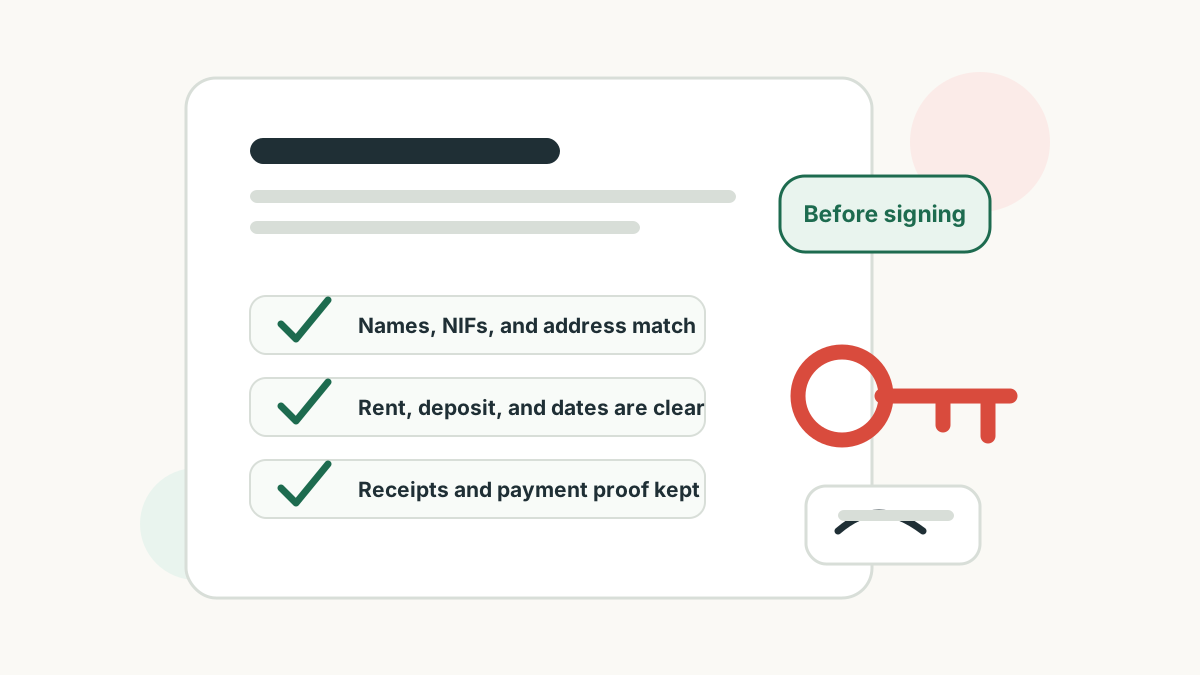
Checklist Before Signing
Before you sign a lease agreement in Portugal, check:
- You have seen the property in person or through a trusted representative
- The landlord or agency identity is clear
- The property address matches the contract
- Your name and NIF are written correctly
- Rent, deposit, and advance rent are separated clearly
- Refund rules for the deposit are written
- Utilities and condominium costs are explained
- Furniture and condition are documented with photos
- Payment account details are confirmed in writing
- You understand renewal and notice rules
- You have time to ask a professional if the contract is unclear
Checklist Before Moving In
Before you move in, keep a record of:
- Signed contract
- Payment proof
- Deposit receipt or written confirmation
- Keys received
- Meter readings for electricity, gas, and water
- Photos or video of property condition, ideally as a signed move-in inspection report (vistoria or auto de vistoria)
- Inventory of furniture and appliances
- Existing damage
- Landlord or agency contact details
- Rules for repairs and emergencies
Send important move-in notes in writing. A simple email with dated photos can prevent arguments later. If the property is not yet set up under your name for electricity, gas, water, and internet, see our guide to setting up utilities in Portugal. For paying rent itself, most landlords expect a bank transfer or MB Way; our MB Way and Multibanco guide explains how both work for foreigners.
What If You Do Not Have Portuguese Payslips Yet?
Many foreigners rent before they have a Portuguese salary history.
You can strengthen your application by preparing:
- Foreign employment contract
- Remote-work contract
- Recent payslips from another country
- Savings statement
- Pension or scholarship proof
- Company ownership or freelance activity documents
- Portuguese NIF
- Portuguese bank account or proof you can pay rent
- Reference letter, if useful
Some landlords may still ask for a guarantor or more security. If the requested upfront amount is high, get advice before paying. I generally tell people to lead with a short cover note summarizing their income sources before the landlord even asks; it tends to shortcut a lot of back-and-forth with agencies that default to asking for local payslips first.
Common Mistakes
- Assuming a listing’s price or size is accurate without cross-checking, since the same unit is often relisted by multiple agents with different details
- Not confirming upfront who pays the agency commission before scheduling viewings
- Signing a contract with missing names, NIFs, dates, or address
- Treating cash payments as safe without written proof
- Not keeping payment records
- Assuming a contract will be accepted everywhere as proof of address
- Not photographing the property condition at move-in
- Ignoring unclear deposit wording
- Accepting pressure because of visa or AIMA deadlines
- Not getting help when the contract is difficult to understand
- Assuming a friend or family member abroad can act as your fiador
- Paying more than two months’ deposit or two months’ advance rent without questioning it
What If Something Goes Wrong With Your Landlord?
A clean contract, receipts, and payment trail matter most when something goes wrong: a deposit that is not returned, a landlord who enters without notice, an eviction (despejo) threat, or a dispute over repairs. Portuguese tenancy law gives tenants specific protections in these situations, including notice periods a landlord must respect and limits on when a lease can be ended early (resolução do contrato). The Balcão do Arrendatário e do Senhorio (BAS) handles the Procedimento Especial de Despejo and the Procedimento de Injunção em Matéria de Arrendamento. It replaced the former Balcão Nacional do Arrendamento (BNA) and Sistema de Injunção em Matéria de Arrendamento (SIMA) in 2024. Depending on the dispute, a tenant may also need a lawyer, a Julgado de Paz, an arbitration centre, or the courts.
This guide focuses on getting into a rental safely. For what happens after you have signed, including deposit disputes, notice periods, illegal lockouts, and where to file a complaint, read the full breakdown in tenant rights and landlord limits in Portugal.
Frequently Asked Questions
Can I rent an apartment in Portugal without a NIF?
In practice, no. Almost every Portuguese landlord and agency asks for a NIF before preparing a rental contract, because the NIF identifies the tenant on the contract and on any rent receipts. If you do not have one yet, a fiscal representative can obtain a NIF for you remotely before you arrive in Portugal.
Can I rent in Portugal before getting my visa or residence permit?
Yes. A signed lease is usually a requirement for the visa or AIMA appointment, not something you get after it. Non-EU tenants routinely sign a rental contract while still abroad or newly arrived, then use that same contract as accommodation evidence in their D7 or D8 visa or residence-permit file.
How much money do I need upfront to rent an apartment in Portugal?
Under the current legal caps, a landlord can ask for the first month’s rent plus up to two months’ deposit and up to two months’ advance rent, roughly five months’ rent in total. Some landlords informally ask for more from tenants without a Portuguese guarantor, which exceeds the legal caps under Civil Code Article 1076.
Can someone in the US be my guarantor for a Portugal rental?
A guarantor living in the US or another country is not automatically legally invalid. However, Portuguese landlords frequently prefer a fiador with a Portuguese NIF, income declared in Portugal, and assets or earnings that can be verified and enforced locally. Many landlords therefore decline foreign-based guarantors and instead ask for other security within the applicable legal limits.
Is a fiador legally required to rent in Portugal?
No. A guarantor is not a legal requirement to sign a valid lease in Portugal. Depending on the landlord, a fiador may be replaced by advance rent and a deposit within the applicable legal limits, a bank guarantee, rental-guarantee insurance, or stronger evidence of income and savings.
What happens if my landlord refuses to give me a rent receipt?
Check e-arrendamento and e-Fatura first. If the landlord is exempt from issuing electronic receipts, the rent may only appear after the landlord’s annual declaration to the Tax Authority. If you possess valid manual receipts that are missing, you may be able to register and validate them for IRS purposes. A landlord’s refusal to issue the legally required document can be reported to the Tax Authority.
Summary
Renting a house in Portugal as a foreigner is easier when you treat the rental file as an official document trail, not just a place to sleep. Prepare your ID, NIF, income evidence, and banking details before applying.
Before signing, check the landlord, property, rent, deposit, payment method, and contract wording. Keep receipts, transfer proof, photos, and written messages. A clean rental contract and payment trail can help later with proof of address, AIMA, banks, Finanças, and daily life in Portugal.
If a payment request or contract clause feels unclear, pause and get qualified advice before sending money.