

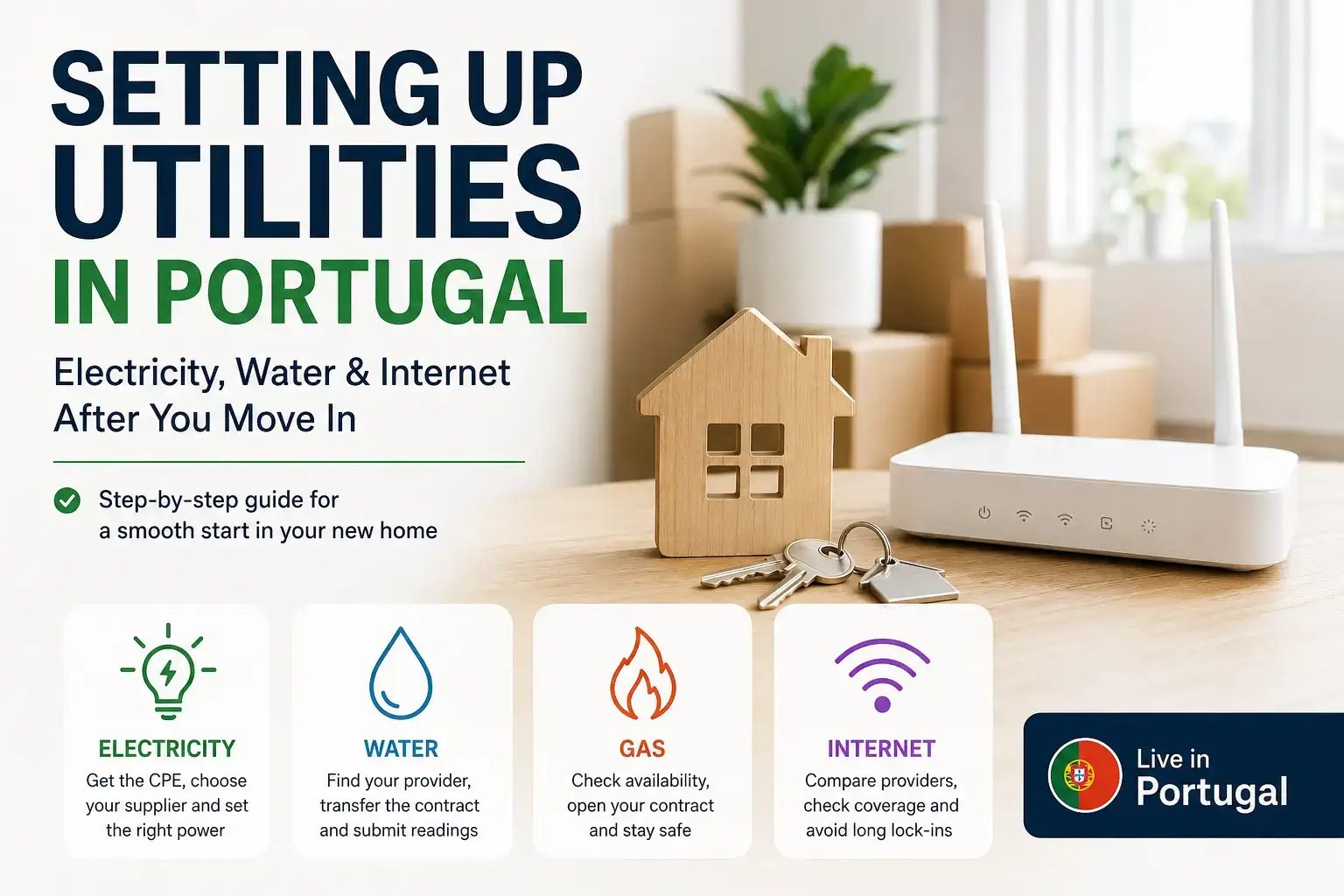
If you have just got the keys to a home in Portugal, deal with electricity and water first. Internet comes next; gas only matters if the property actually uses it.
The first mistake is treating every utility as the same job. Electricity has a supplier and a separate network operator. Water is local. Internet has its own installation and cancellation rules.
One move-in habit is worth doing before you unpack anything: photograph every meter. Those photos are much easier to find later than an argument over where the first bill should have started.
Quick Answer: Have your ID, NIF, rental contract or property deed, address and payment details ready. For electricity, get the CPE and the opening meter reading. For water, identify the provider serving your municipality. For internet, check fibre at the exact apartment before accepting a long commitment period.
Get these details before the landlord or agent leaves
Ask for:
- the latest electricity bill or the property’s CPE;
- the latest water bill or the water provider’s name;
- the gas CUI, if the property uses piped natural gas;
- current electricity, water and gas meter readings;
- confirmation of which supplies are active;
- the current contract holder;
- whether fibre has already been installed in the apartment;
- any router, TV box or other operator equipment left at the property.
If the previous tenant owes an electricity or gas bill, that debt does not normally become yours just because you move into the same property. ERSE’s commercial rules prevent a supplier from refusing a genuinely new customer’s contract solely because another former customer at that address owes money, except where the title change is clearly being used to avoid the debt.
Documents usually needed for utilities
The exact list varies, but this covers most setup requests:
| Document or detail | Electricity | Water | Internet | Gas |
|---|---|---|---|---|
| Passport / ID | Yes | Usually | Yes | Yes |
| NIF | Usually | Usually | Usually | Usually |
| Lease or property deed | Usually | Usually | Sometimes | Usually |
| Portuguese address | Yes | Yes | Yes | Yes |
| IBAN / payment method | Usually | Usually | Usually | Usually |
| Opening meter reading | Strongly recommended | Strongly recommended | No | Strongly recommended |
| Property identifier | CPE | Local account/meter reference | Installation address | CUI |
If you still need a Portuguese tax number, use the NIF guide. If you want a local account, see how to open a bank account in Portugal.
Do you need a Portuguese bank account for utilities?
Not necessarily.
A provider may ask for an IBAN for direct debit, but Banco de Portugal describes refusal of an EEA IBAN solely because it comes from another EEA country as IBAN discrimination.
The practical side can still be messier than the legal rule. Some signup forms are easier with a Portuguese IBAN, and some customer-service agents may default to asking for one.
This is one of those Portugal setup questions with two answers: the rule says an eligible EEA IBAN should not be rejected just for being foreign; the smoothest signup may still be a Portuguese account.
Do not open a bank account solely because a blog says every utility legally requires PT50. Ask the actual provider first.
How do you pay utility bills in Portugal?
Direct debit is common, but it is not the only method for many energy contracts. Electricity bills can also include a Multibanco entity/reference for payment, and suppliers may offer bank transfer or in-person payment channels depending on the contract.
If Entidade, Referência and Montante on a Portuguese bill mean nothing to you yet, the Multibanco and MB WAY guide explains how those references work.
The important move is not to assume that cancelling a direct debit cancels the underlying contract. End or transfer the service through the provider’s proper process.
Can you set up utilities before you arrive in Portugal?
Sometimes, but it depends on what has to happen at the property.
If the supply is active and the provider accepts remote contracting, electricity paperwork can often be started before move-in. Internet or a disconnected supply may require access for a technician. Water procedures vary by municipality.
If someone else will be at the property, ask the provider whether they can receive the technician or whether you need a formal authorisation.
For a remote move, the useful distinction is:
- paperwork can often start early;
- physical access cannot be done remotely.
How to set up electricity in Portugal
Electricity is the part most newcomers overcomplicate because three different names may appear in the same conversation: the supplier, E-REDES, and sometimes the previous supplier.
E-REDES vs EDP — what is the difference?
They are not the same role.
E-REDES operates the electricity distribution network on mainland Portugal for most household customers. It deals with the physical grid, meters, readings, CPE information and technical network matters.
Your supplier sells you electricity and issues the bill. EDP Comercial is one supplier, but you can choose others.
So:
- billing/tariff/contract question → usually your supplier;
- CPE/meter/network fault/technical reading question → usually E-REDES.
That single distinction explains a surprising amount of electricity-admin confusion.
Find the CPE before choosing a supplier
The CPE — Código de Ponto de Entrega — identifies the electricity supply point.
Look for it on an old bill first. If you have no bill, E-REDES allows customers to request the installation’s CPE through its Digital Service. Its contact menus also include the wording “Quero fazer novo contrato e preciso de saber o meu CPE.”
Do not confuse the CPE with the serial number printed on the meter.
If the electricity is already on
Tell the supplier that you are the new occupant and want the contract in your name.
You do not have to keep the previous occupant’s supplier. If you later switch suppliers as the same customer, ERSE says the new supplier handles the old supply contract, the switch itself is free and the supply should not be interrupted merely because you changed supplier.
Take the opening meter reading even if the meter is smart. It gives the new contract a clean reference point.
If the electricity is disconnected
Ask whether the supply is simply inactive or whether a network/technical intervention is needed.
A disconnected property is not the moment to rely on a generic “same-day activation” promise from a relocation blog. The timing depends on why the supply is off and whether access or technical work is needed.
If you work from home, resolve this before the day you expect to open the laptop.
What is potência contratada and which kVA should you choose?
Potência contratada is the contracted power available for appliances running at the same time. It also affects the fixed part of the bill.
Too little can make the supply trip when high-power appliances overlap. Common combinations include:
- induction hob + oven;
- water heater + kettle;
- heater + washing machine;
- hair dryer + dishwasher.
More kVA is not automatically better because higher contracted power costs more.
ERSE has a contracted-power simulator for homes up to 10.35 kVA. Use the appliances you actually run together rather than copying the kVA from somebody else’s apartment.
A small flat can still need more power than a larger one if its cooking, hot water and heating are all electric. Floor area alone is a poor shortcut.
Changing contracted power is generally free, so an initial setting can be adjusted if it proves wrong.
Simples or bi-horário electricity tariff?
You may also be asked to choose the tariff timing structure.
- Simples: the energy price does not depend on the time period.
- Bi-horário: consumption is split into off-peak and other periods.
- Tri-horário: three time periods.
Bi-horário is not automatically cheaper. It becomes more interesting when you can genuinely shift substantial use—such as water heating, EV charging, laundry or dishwashing—into off-peak periods.
If most of your cooking, heating and appliance use happens at normal evening hours, compare the full bill rather than choosing bi-horário because the off-peak €/kWh number looks attractive.
How to compare electricity suppliers
Compare more than the headline kWh price:
- energy price;
- fixed charge for contracted power;
- tariff timing;
- any commitment period;
- discounts tied to direct debit or electronic billing;
- paid add-on services;
- whether an electricity + gas bundle is actually cheaper.
Use ERSE’s official tools rather than treating the previous tenant’s supplier as the default best option.
Why is your electricity bill estimated with a smart meter?
A smart meter does not guarantee that remote readings are already active.
E-REDES says the automatic-reading functionality becomes available when it is active and that customers are notified. Until then, it advises customers to continue submitting readings. Communication faults can also prevent a smart meter from sending data.
ERSE explains that when the supplier does not have a real meter reading, billing can be based on estimated consumption.
So if a bill says estimativa:
- compare the bill reading with the meter;
- check E-REDES’ Digital Service for the reading history;
- submit a current reading if remote readings are not active;
- ask the supplier to explain any adjustment that does not reconcile.
This is more useful than assuming the physical presence of a digital meter means every bill must already be based on live data.
How to set up water in Portugal
Water is local rather than a national supplier market.
Depending on the concelho, the service may be run by:
- the municipality;
- a municipal company;
- a concessionaire;
- another local water entity.
The fastest route is usually the previous water bill. If you cannot get one, search the municipality’s official website for abastecimento de água, serviços de água or contrato de água.
You will normally need ID, NIF and evidence that you occupy the property. Online setup, deposits and document requirements vary by provider.
Why a water bill can be higher than the water you used
A water invoice may also contain wastewater, sanitation or municipal-waste related charges.
That is why comparing only the cubic metres consumed can give a misleading picture of the total bill.
Photograph the water meter when you receive the keys and check the first invoice against that reading.
Are utilities included in rent in Portugal?
For ordinary long-term rentals, do not assume they are.
Some furnished, short-term or shared rentals keep electricity, water or internet in the landlord’s name and bill the tenant separately. If that is the arrangement, make the calculation method part of the written lease or agreement.
Ask for:
- copies of the real supplier bills;
- the readings covering your tenancy;
- how shared consumption is divided;
- whether fixed charges are included;
- any monthly allowance or cap;
- how the final reconciliation works.
A shared building meter is where vague “utility share” arrangements become difficult to audit.
If the bill in your own name is important for another administrative process, see proof of address in Portugal. For wider rental issues, see renting a house in Portugal and tenant rights in Portugal.
How to set up gas
First check whether the property needs a gas contract at all.
Homes may use:
- piped natural gas;
- bottled butane/propane;
- no gas because cooking and hot water are electric.
A piped-gas installation has a CUI — Código Universal da Instalação, normally shown on the gas bill.
Suppliers may bundle electricity and gas, but compare the total offer rather than assuming a dual-fuel discount wins automatically.
A new gas contract or holder change can also raise inspection questions depending on the installation. If an inspection is required, ask exactly what triggered it and which authorised inspection route applies.
How to set up internet in Portugal
Check fibre at the exact apartment, not just the street or neighbourhood.
Before signing, ask:
- Is fibre available to this exact unit?
- Is a technician visit needed?
- Is new cabling required?
- Does that cabling need landlord or condominium approval?
- What equipment is supplied?
- What is the minimum commitment period?
- What is the early-cancellation cost?
- What happens if I move?
The expensive mistake here is not choosing the “wrong” logo. It is signing a long contract before checking the exact address and the exit terms.
If installation will take time, a mobile hotspot or 4G/5G connection can bridge the gap. See SIM cards and mobile internet in Portugal.
What happens to internet when you move?
Ask the operator whether equivalent service is available at the new address before accepting a transfer or new installation.
Gov.pt advises customers who are moving to check whether the provider can continue the service at the new address and what happens to the existing contract if it cannot.
Do not stop the direct debit and assume that ends the telecom contract. Request the transfer/cancellation formally and keep proof.
How long does utility setup take?
There is no useful Portugal-wide promise for every service.
| Situation | What controls the timing |
|---|---|
| Electricity already active | Contract/admin processing |
| Electricity disconnected | Reason for disconnection and any E-REDES intervention |
| Water | Local provider’s process |
| Internet | Coverage plus technician availability |
| Piped gas | Contract plus any inspection/technical requirement |
Internet and disconnected energy supplies deserve the most planning because they may require somebody to attend the property.
How much do utilities cost in Portugal?
There is no single monthly figure that is useful across Portugal.
Electricity depends heavily on contracted power, tariff, heating/cooling and appliance use. Water pricing and associated charges vary locally. Internet depends on the package and commitment terms.
If you are budgeting for the move rather than setting up the contracts, use the broader Portugal cost-of-living guide instead of copying one household’s Reddit bill.
The setup order after you get the keys
If services are already working:
- Photograph every meter.
- Get the CPE and put electricity in the correct name.
- Identify the water provider and open/transfer the water account.
- Confirm the gas type and only contract piped gas if the home uses it.
- Check fibre at the exact unit and book any technician visit.
- Save the contract PDFs, account numbers and cancellation terms together.
If electricity or water is off, move that service to the top because physical intervention may be needed.
Moving out and cancelling utilities
Before handing back the keys:
- photograph the final electricity, water and gas readings;
- notify each provider using the required contract channel;
- request the final bill;
- keep the cancellation or transfer confirmation;
- return router, TV box and other telecom equipment;
- keep proof of the equipment return;
- leave the direct debit in place until the final amount is settled;
- tell the landlord which contracts have ended.
The folder that felt unnecessary on move-in earns its keep here. Final readings, cancellation confirmations and equipment-return receipts are exactly the records that are annoying to reconstruct six months later.
Problems worth challenging
The supplier says you must pay the previous tenant’s electricity debt
Ask for that requirement in writing. A genuinely new occupant should not normally be refused an energy contract because a different former customer at that property owes money.
The power trips whenever several appliances run
Check potência contratada before assuming the wiring or meter is faulty.
The landlord’s utility charge looks too high
Ask for the original bills, meter readings and allocation method. A utility bill includes more than raw consumption, but the amount charged to you should still be explainable.
The first bill includes consumption from before your tenancy
Send the dated move-in meter photo and ask for the opening reading to be corrected.
Your smart-meter bill is still estimated
Check whether remote readings are active and compare E-REDES’ reading history with the supplier’s invoice.
The internet salesperson promised something missing from the contract
Use the written order and contract as the reference. If the operator does not resolve the discrepancy, use the formal complaint route.
Where to complain
Start with the company and keep the complaint number or written response.
If the issue remains unresolved:
- electricity or natural gas: ERSE;
- water: the relevant water provider / water-sector consumer route;
- internet, mobile or TV: the communications consumer route;
- formal complaint: Livro de Reclamações, including the electronic version where available.
Keep the bill, contract, meter photos and written correspondence together. They are usually more useful than screenshots of a chat-group answer.
Move-in utilities checklist
- Electricity CPE obtained
- Opening electricity meter photographed
- Correct electricity contract holder confirmed
- Potência contratada checked
- Tariff timing understood
- Supplier offer compared
- Water provider identified
- Opening water meter photographed
- Gas type confirmed
- CUI obtained if piped gas is used
- Internet coverage checked for the exact unit
- Internet commitment/cancellation terms understood
- Technician dates booked where needed
- Landlord-billed utility method documented, if applicable
- Contracts, readings and account numbers saved