

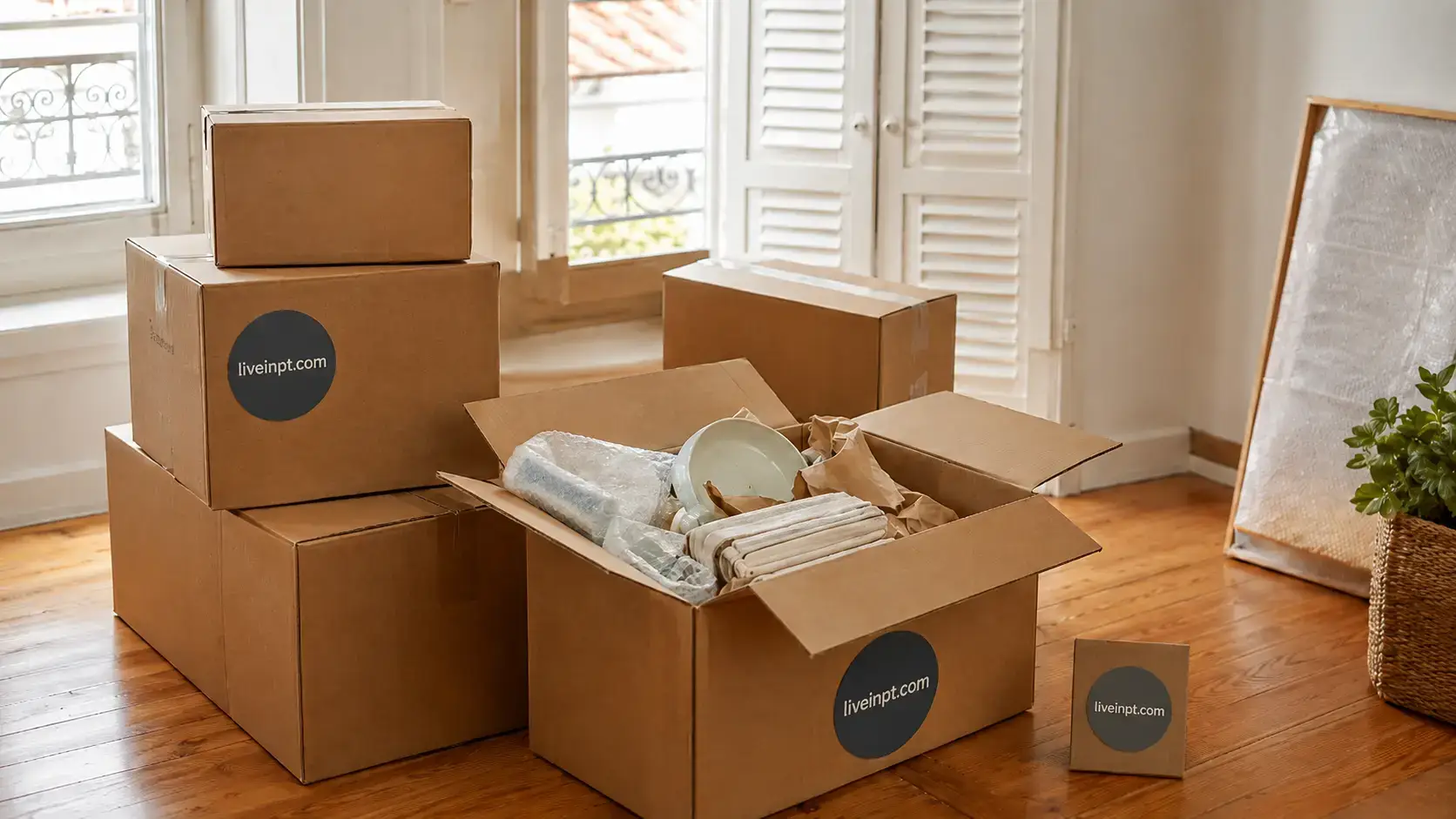
Shipping household goods from the US to Portugal is less about finding the cheapest ocean quote and more about getting the transfer-of-residence paperwork in the right order. If the shipment arrives while your customs file is incomplete, storage and port charges can turn a reasonable move into an expensive one.
Quick Answer: Used personal belongings can qualify for relief from import duty and Portuguese IVA when you transfer your normal residence from the US to Portugal. The core rules are usually: at least 12 consecutive months of normal residence outside the EU, ownership and use of the goods for at least 6 months, and import within 12 months after establishing normal residence in Portugal. For US moves, the Certificado de Bagagem is a key part of the practical customs file.
If you are still planning the wider relocation, use the separate moving to Portugal from the US guide. This page is specifically about personal belongings, household goods and the customs sequence.
The rules at a glance
| Rule | What it means for a US-to-Portugal move |
|---|---|
| Previous residence | Normally at least 12 consecutive months outside the EU customs territory |
| Prior ownership/use | Non-consumable goods generally must have been owned and used for at least 6 months before leaving the previous residence |
| Same purpose | The goods should continue to be used for the same personal or household purpose in Portugal |
| Import deadline | Normally within 12 months after establishing normal residence |
| Multiple shipments | The goods can be imported in more than one consignment within that 12-month window |
| Excluded from the relief | Alcohol, tobacco, commercial means of transport and most professional equipment |
| Selling or giving goods away | Special restrictions continue after duty-free/IVA-free import |
The relief is tied to transfer of normal residence, not US citizenship. A non-US citizen moving from the United States can still fall within the same rules if the residence conditions are met.
The reverse is also important. If you already moved your normal residence from the US into another EU country and only later move to Portugal, do not assume you can start a new US-to-Portugal duty-free window. The relief is based on the transfer from a country outside the EU customs territory.
What the duty-free and IVA-free relief covers
Council Regulation (EC) No 1186/2009 covers personal property imported by a person transferring normal residence from a third country into the EU customs territory. Portugal’s Decreto-Lei n.º 31/89 contains the parallel IVA exemption rules.
Typical household goods can include:
- furniture and normal household equipment;
- clothing, books and personal effects;
- personal electronics;
- bicycles and motorcycles;
- household pets and saddle animals;
- portable professional instruments in the limited categories allowed by the rules.
The 6-month rule matters. Except in special justified cases, non-consumable goods must have been in your possession and used by you at your previous normal residence for at least six months before you stopped living there.
That is why newly purchased furniture, unopened electronics or multiple identical high-value items can create questions. The relief is for a genuine household move, not for bringing new commercial stock into Portugal.
Alcohol and tobacco are specifically excluded from the normal transfer-of-residence relief. Do not list a wine or spirits collection as if it were ordinary exempt household furniture.
The 12-month rule has two different meanings
There are two separate 12-month periods, and mixing them up causes confusion.
First, you normally need to have had your normal residence outside the EU customs territory for at least 12 consecutive months before the move. There is an exception where the authorities accept evidence that you clearly intended to remain outside the EU for at least 12 months.
Second, after establishing normal residence, you generally have 12 months to enter the qualifying personal property for free circulation. The law also allows the belongings to arrive in several separate consignments during that period.
So you do not necessarily have to fit your entire household into one container.
Can you ship before you officially establish residence in Portugal?
Legally, there is a limited route for this, but it should not be treated as the default.
EU customs rules allow relief for personal property imported before the person establishes normal residence in the EU if the person undertakes to establish that residence within six months. Portuguese IVA law contains a similar rule and says the import can be subject to a guarantee.
In practice, a standard household mover may still structure your file around the normal transfer date, Certificado de Bagagem and Portuguese residence evidence.
If this were my move, I would not let the container become the deadline for finishing the customs paperwork. If you want the shipment to move before your residence is fully established, get the Portuguese customs broker to confirm the exact procedure before the goods leave the US.
The document sequence to prepare
The exact checklist can vary by consulate and by the Portuguese customs office handling the clearance, but the file usually revolves around the same evidence.
| Document or evidence | Why it matters | Best time to prepare it |
|---|---|---|
| Certificado de Bagagem | Supports the transfer-of-residence claim for the household shipment | Before dispatch if possible |
| Passport / identity documents | Identifies the importer | Before consular/customs filing |
| Proof of residence in the US | Shows the previous normal residence and its duration | Before requesting the certificate |
| Proof the goods were used for 6+ months | Supports the prior-use condition | Before packing is final |
| Detailed inventory / packing list | Identifies what is being imported | During packing |
| NIF | Commonly needed in the Portuguese customs-clearance file | Before the goods clear |
| Proof of Portuguese residence/address | Supports the move to Portugal | Before clearance |
| Broker authorisations/declarations | Allows the customs agent to act for you | Before arrival |
Portugal’s official guidance refers to proof of the dates of residence abroad, proof that the personal goods were used for at least six months, and a list of the goods being imported.
For the inventory, use descriptions that are specific enough to be credible without turning every box into a catalog. “Kitchenware and utensils” is better than “miscellaneous.” For identifiable higher-value electronics, keeping brand/model/serial information can make the file easier to explain if customs asks.
Your NIF in Portugal is worth sorting early rather than waiting for the container to reach Europe.
What the Certificado de Bagagem actually does
For a US move, the Certificado de Bagagem is the consular document used to support the claim that the shipment is part of a genuine transfer of residence.
Do not confuse it with a normal airline baggage declaration. This is part of the relocation customs file.
The Portuguese consular post responsible for your US residence may ask for evidence such as your identity documents, residence history and information about the goods. The exact checklist can differ by post, so use the consulate with jurisdiction over your US address rather than copying a checklist from another state.
A recent practical failure point is simple: the goods are already at the Portuguese port but the certificate is still being requested. That is exactly the sequence to avoid.
Can you send two or more separate shipments?
Yes. Both the EU customs-duty rules and Portugal’s IVA rules allow qualifying personal property to be imported in more than one shipment within the applicable 12-month period.
That is useful if, for example, you want to bring essentials first and furniture later.
Still, tell the destination customs broker from the start that you are planning multiple consignments. The legal rule allows it, but the inventory and customs file need to make clear which goods belong to which shipment.
What happens after the goods enter Portugal duty-free?
Do not assume the restrictions end on the day customs releases the shipment.
Under Council Regulation (EC) No 1186/2009, personal property admitted free of import duty cannot normally be lent, pledged, hired out or transferred during the first 12 months without prior notification to the competent authorities.
Portugal’s IVA exemption rules use the same 12-month post-import restriction. If you want to lend, rent, sell, give away or otherwise transfer an exempt imported item during that period, do not assume customs release ended the conditions attached to the exemption.
Check with Portuguese customs before making the transfer, because doing it early can trigger the tax or duty that was relieved at import.
Choose the shipping method by the amount you are actually bringing
A full container is not automatically the best answer.
| What you are moving | Option worth comparing | Main trade-off |
|---|---|---|
| A few suitcases | Extra checked baggage | Usually simplest, but airline size/weight limits apply |
| A few boxes | Courier or parcel service | Fast, but customs treatment and price per kilo can be poor |
| Boxes without much furniture | Pallet / lift-van style shipment | Useful middle ground |
| Partial household | LCL / groupage | Lower cost than a full container, but more handling and potentially slower timing |
| Full household | FCL container | More control over a large move, but larger exposure to port/storage delays if paperwork is late |
If the move is only clothes, books and sentimental items, compare airline baggage and small-load shipping before paying for household freight.
If you are bringing substantial furniture, FCL or groupage becomes more realistic.
Costs that are often missing from the first quote
The quoted ocean freight is only one line in the final bill.
Customs broker
Ask whether a Portuguese despachante / customs broker is included. If not, this can be a separate charge.
Port storage and demurrage
These are the costs that hurt when the document sequence fails. If the shipment is sitting at the port while you fix the customs file, daily charges can build quickly.
Destination handling and final delivery
Check whether the quote includes:
- port and terminal handling;
- customs-clearance administration;
- delivery to your Portuguese address;
- delivery inside the apartment rather than only to the entrance;
- stairs, lift restrictions or shuttle-van access for narrow streets.
“Door to door” is not precise enough. Ask what happens after the truck reaches your building.
Insurance
Basic carrier liability may not replace damaged furniture or electronics at their real value. If the shipment contains items you would struggle to replace, compare marine cargo insurance and read the exclusions before buying it.
What is worth shipping from the US?
Usually worth considering:
- quality furniture you genuinely want to keep;
- sentimental items;
- musical instruments;
- books, art and specialist equipment;
- expensive items that are difficult to replace in Portugal.
Often poor candidates:
- cheap flat-pack furniture;
- old televisions;
- bulky low-value furniture;
- large quantities of clothes you rarely use;
- US-only 120V appliances.
Portugal uses 230V / 50Hz electricity. Many laptop, phone and camera chargers accept 100-240V, but many US appliances with heating elements or motors do not.
Before I packed any US appliance, I would check the electrical input label first. It takes a few seconds and can save you from shipping something that will not work properly in Portugal. A plug adapter does not solve a voltage problem.
Cars are a separate import decision
A car is not simply another household item.
Portugal’s ISV transfer-of-residence exemption has its own conditions. Gov.pt says the applicant must be over 18, must generally have lived abroad for at least six months before the transfer, and must have owned the vehicle for at least six months before the move.
Even where ISV relief applies, you still have a separate vehicle process involving customs, registration, inspection, insurance and Portuguese plates.
If the car is not unusually valuable or difficult to replace, compare the full legalisation and modification cost with buying a vehicle in Portugal before putting it in the same moving plan as your furniture.
Common mistakes that create expensive delays
Sending the shipment before the Certificado de Bagagem is ready
This is the avoidable one. Get the consular side clear before dispatch whenever possible.
Treating the 6-month rule as optional
A recently purchased household item may not qualify simply because it is now inside your home.
Assuming you only get one shipment
The law allows multiple consignments within the 12-month period. Plan them properly rather than rushing everything into one container.
Using a vague inventory
A credible packing list makes customs questions easier to answer. “Miscellaneous household items” across dozens of boxes is not a strong file.
Assuming arrival in Portugal means the exemption is finished
Restrictions continue after customs release. The duty-relief and IVA rules have post-import transfer limits.
Comparing only the ocean-freight price
A lower freight quote can still become more expensive after broker fees, destination handling, storage, insurance and final delivery.
FAQ
Do I need to be a US citizen to use the household-goods exemption?
No. The transfer-of-residence relief is based on where your normal residence was and where it is moving, not on US citizenship. For a US-to-Portugal move, the important issue is whether you satisfy the residence and prior-use conditions and can document the transfer.
How long must I have lived in the US before moving my belongings duty-free?
The general EU rule requires at least 12 consecutive months of normal residence outside the EU customs territory. Authorities can make an exception where you can show that your intention was clearly to remain outside the EU for at least 12 months.
How long must I have owned my furniture and personal belongings?
For non-consumable personal property, the normal rule is at least 6 months of possession and use at your former normal residence before you stopped living there. Special circumstances can justify exceptions, but you should not plan a normal move around receiving one.
Can I ship belongings after I have already moved to Portugal?
Yes. Qualifying personal property is normally eligible if it is entered for free circulation within 12 months after you establish normal residence. The rules also allow more than one shipment during that period.
Can I ship my belongings before I become resident in Portugal?
There is a legal pre-residence route where you undertake to establish normal residence within six months, and a guarantee can be required. It is not the simple default route. Confirm the procedure with the Portuguese customs broker before dispatch.
Do I need a Certificado de Bagagem for only a few boxes?
If you are relying on the transfer-of-residence exemption for an unaccompanied shipment, treat the certificate as part of the expected file. For only a few belongings, also compare the cost and simplicity of taking them as checked baggage instead.
Can the shipping company get the Certificado de Bagagem for me?
A relocation company can often help prepare the file, but the certificate is tied to your residence history and consular process. Confirm exactly what the mover does, which Portuguese consulate is involved and what you personally must sign or provide.
Can I send one shipment now and another later?
Yes. The rules allow qualifying belongings to enter in several consignments within the 12-month import window. Tell the broker in advance and keep the inventory clear so the separate shipments can be connected to the same transfer-of-residence file.
What happens if customs rejects the exemption?
If the relief cannot be established, the shipment can become subject to normal import taxation and customs charges, while storage and handling may continue to accrue. The expensive part is often not only the tax itself but the time the goods spend waiting for the issue to be resolved.
Should I ship everything or buy again in Portugal?
For most moves, the best answer is selective. Keep sentimental, valuable and difficult-to-replace items. Compare replacement cost against freight, insurance, customs handling and the real space the item consumes before paying to move low-value furniture across the Atlantic.
If you still need to secure housing before the shipment arrives, use the separate guide to renting an apartment in Portugal from the US.