

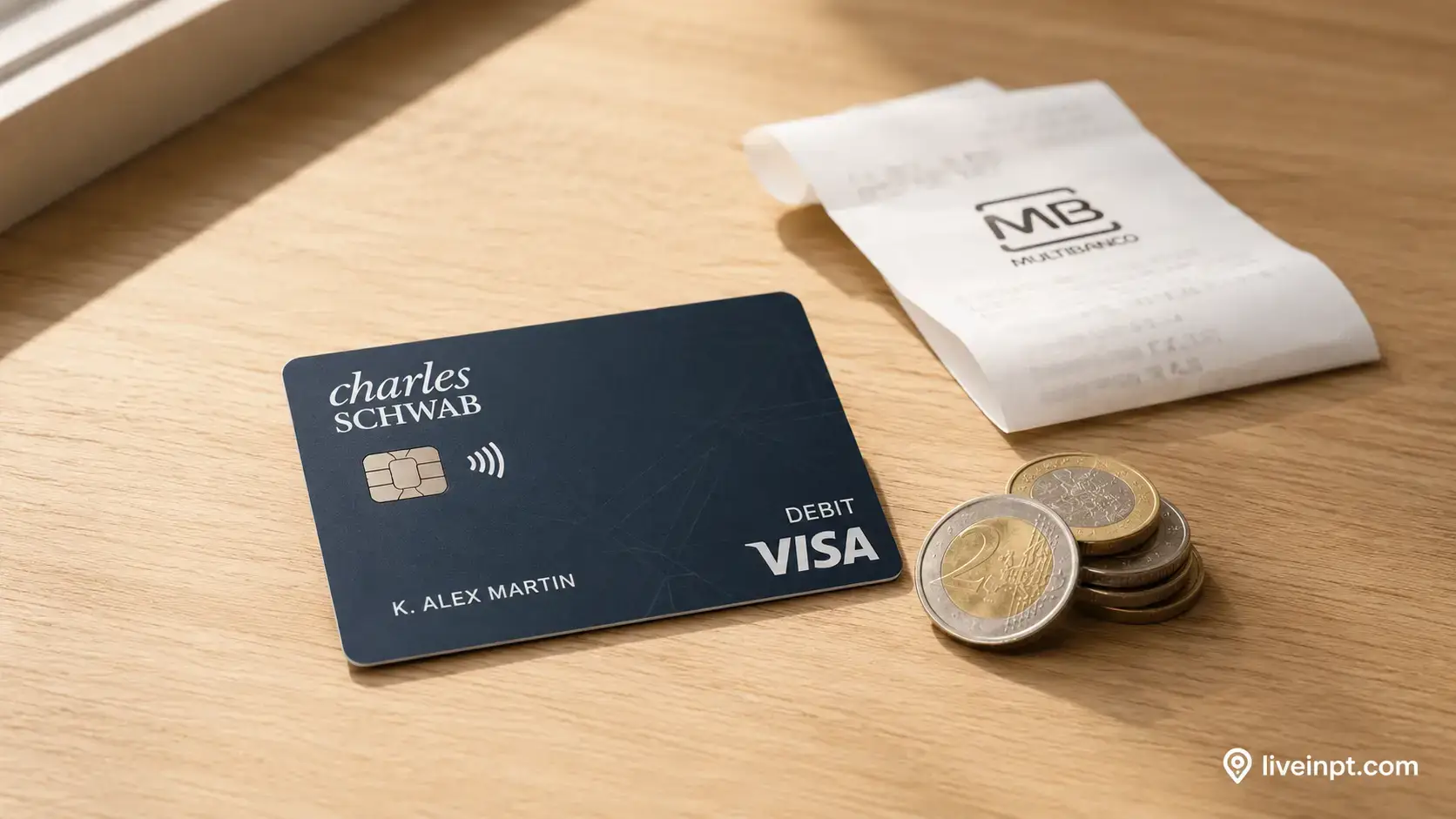
This is the banking conversation many Americans moving to Portugal have too late. They keep their Chase, Bank of America, Wells Fargo, or regional US account as their main account, move to Portugal, then discover that foreign addresses, foreign logins, international transfers, and US phone-number verification can create problems at exactly the wrong time.
That does not mean every US retail bank account will be closed the moment you move abroad. Some Americans keep old accounts open for years. But the risk is common enough that you should not rely on a traditional US retail checking account as your only financial backup once you are living in Portugal.
The good news is that a few US accounts work much better for Americans abroad, especially if you set them up before leaving the US. The bad news is that opening the same accounts after you have already moved to Portugal can be harder.
Quick Summary: Charles Schwab’s High Yield Investor Checking account is usually the cleanest US banking setup for Americans moving to Portugal. It has no monthly service fee, no foreign transaction fees, unlimited worldwide ATM fee rebates, and a US routing number that works for US payments and direct deposit. Open it before you leave the US. Fidelity’s Cash Management Account is a strong alternative, especially if your investments are already with Fidelity. Both are US-domiciled accounts, so they are not FBAR-reportable foreign accounts.
Best US Accounts to Consider Before Moving to Portugal
| Account | Best for | Main benefit | Main caution |
|---|---|---|---|
| Charles Schwab High Yield Investor Checking | Most Americans moving to Portugal | No foreign transaction fees and unlimited worldwide ATM fee rebates | Easier to open before leaving the US |
| Fidelity Cash Management Account | Existing Fidelity customers | Banking-style cash management linked to your wider Fidelity setup | Re-check current debit card and ATM terms before relying on it |
| State Department Federal Credit Union (SDFCU) | Americans already abroad or needing a fallback | Often mentioned by expats when opening from abroad is needed | Less seamless than Schwab or Fidelity for everyday use |
| Existing Chase, Bank of America, Wells Fargo, or regional bank account | Temporary backup only | Existing relationship and familiar online banking | Higher risk of address, verification, or compliance problems abroad |
Why Your Current Bank May Become a Problem
The issue is not that Portugal is unusual or risky. The issue is that many US retail banks are built around US residents, US addresses, US phone numbers, and US-based fraud patterns.
After you move, several things can trigger extra checks:
- updating your address to Portugal;
- logging in regularly from a Portuguese IP address;
- receiving or sending international transfers;
- losing access to your US mobile number;
- failing a text-message verification step while abroad.
A bank review may simply ask you to confirm details. In other cases, it can lead to account restrictions or a closure notice. The timing is what makes this stressful. Two weeks to resolve a US banking issue does not feel like much when you are also dealing with housing, a NIF, a Portuguese bank account, utilities, and residence paperwork.
The phone verification problem makes this worse. Some US banks still rely heavily on SMS-based two-factor authentication. If you cancel your US number before setting up an alternative, you may not be able to receive the codes needed to log in, approve transfers, or respond to a review.
The practical lesson is simple: do not make a traditional US retail bank your only US account once you are moving to Portugal. Keep it if it still works for you, but set up a more expat-friendly backup before leaving.
Charles Schwab High Yield Investor Checking: Why Many Americans Abroad Use It
Charles Schwab’s High Yield Investor Checking account is the account most often recommended by Americans who spend significant time outside the US.
The terms fit Portugal well. Schwab says the account has no monthly service fees, no foreign transaction fees, and unlimited ATM fee rebates for cash withdrawals worldwide. That matters in Portugal because you may use Multibanco ATMs during your first weeks, especially before your Portuguese bank card is fully working.
A Schwab debit card also gives you a practical bridge while you are setting up Portuguese banking. Your local Portuguese account will eventually be important for rent, utilities, MB Way, Multibanco, and salary payments, but the first few weeks after arrival can be messy. Having a working US debit card reduces that pressure.
The checking account is linked to a Schwab brokerage account, which is opened at the same time. You do not need to actively trade or fund the brokerage account just to use the checking account, but it is part of how Schwab structures the product.
Open it before you move. This is the most important detail. Schwab’s US checking account process is much easier while you still have a US residential address and can receive the debit card in the US. A good practical window is four to six weeks before departure, so the card arrives, activates, and works before you fly.
Also be careful not to confuse Schwab’s US Investor Checking account with Schwab International brokerage access. Schwab International may be available to residents of some countries, including Portugal, but that does not automatically mean you can open the same US checking account after you have already moved.
Fidelity Cash Management Account: Good if Your Investments Are Already There
Fidelity’s Cash Management Account is the main alternative to Schwab, especially if you already have retirement savings, an IRA, brokerage assets, or workplace-account history with Fidelity.
Fidelity’s current debit card information says eligible Cash Management Account debit cards can receive ATM fee reimbursements, and Fidelity says it does not charge foreign transaction fees. That makes it useful as a travel and expat cash-management account.
The same timing rule applies: open it before you move if you can. New account applications are generally smoother while you still have a US address, US phone access, and easy access to any verification documents.
The main reason to choose Fidelity over Schwab is consolidation. If your US investments are already at Fidelity, keeping cash management there may be simpler. If you do not already use Fidelity, Schwab is usually the cleaner first choice for Portugal.
Because financial institutions can change card terms, ATM reimbursement rules, and foreign-use policies, re-check Fidelity’s current fee and debit card pages before using it as your only US account abroad.
The US Mailing Address Question
Most US financial institutions ask for a US residential address because of identity-verification and banking-compliance rules. Some people use a trusted family member’s address. Others use a commercial mail forwarding service that provides a street-address format rather than a P.O. Box.
This is useful for mail and account administration, but it is not a magic tax solution.
A no-state-income-tax mailing state such as Florida, Texas, Nevada, or South Dakota is commonly discussed by Americans abroad. But a mailing address alone does not determine state tax residency or domicile. If you are leaving a high-tax state, especially California, do not assume that switching to a forwarding address automatically ends all state-tax exposure.
A safer way to think about this is:
- use a stable US address so your banks can reach you;
- avoid relying on a P.O. Box when a bank asks for a residential address;
- keep records showing when you actually left your previous state;
- speak to a US tax adviser if you are leaving a state known for aggressive residency rules.
The safest address is usually a trusted family member’s real residential address. A long-established mail forwarding service can be a practical second option, but some banks may flag commercial forwarding addresses during verification checks.
USAA and SDFCU: Two Alternatives Worth Knowing
USAA can be excellent if you qualify through current or former US military service or an eligible family relationship. USAA is used by many Americans abroad and is generally more comfortable with members living outside the US than a normal retail bank. The limitation is simple: you either qualify or you do not.
State Department Federal Credit Union (SDFCU) is worth knowing if you have already moved abroad and missed the chance to open Schwab or Fidelity before leaving. SDFCU is often mentioned in expat communities because it is more accessible to Americans overseas than many standard banks. It may not feel as polished or convenient as Schwab for day-to-day use, but it can be a real fallback when other options are closed.
The US Phone Number Problem: Solve This Before You Cancel Your Number
This is the piece of banking infrastructure many people forget until it fails.
US banks often use SMS-based two-factor authentication to verify logins, card use, transfers, and suspicious activity. Once you cancel your US mobile number, you may lose the ability to receive those codes.
A common solution is to port your US mobile number to Google Voice before cancelling your carrier plan. Google says porting a mobile number to Google Voice costs $20, and it warns users not to cancel the original phone plan until the port is complete.
That said, Google Voice is VoIP. Some banks may reject VoIP numbers for verification or require a real US carrier number for certain security checks. Treat Google Voice as a useful backup, not a guaranteed replacement for every bank.
If you want a stronger setup, keep a low-cost US mobile or eSIM plan active for banking verification. This adds a small monthly cost, but it can save you from being locked out of important US accounts while abroad.
Your Portuguese Bank Account: The Account You Also Need
The US account handles your American financial life. For day-to-day living in Portugal, you also need a Portuguese bank account.
This is not optional for most people. Rent, utilities, local transfers, MB Way, Multibanco, and salary payments are much easier with a Portuguese IBAN. Some landlords and service providers strongly prefer, or effectively expect, a Portuguese or EU bank account.
Opening a Portuguese bank account usually requires a NIF, proof of identity, and proof of address or residence situation. Before your move, if you have sorted the NIF remotely and secured a rental from the US, the bank account process follows naturally after arrival.
The full process, including which banks are most accessible for non-residents, is covered in the Portuguese bank account guide. Once set up, the MB Way and Multibanco guide explains how everyday payments and cash withdrawals work in Portugal.
FBAR: Your US Accounts Are Not the Problem
One clarification for Americans who have heard about FBAR: US bank accounts held at US-domiciled institutions, such as Schwab, Fidelity, or SDFCU, are not foreign accounts. They do not become foreign accounts just because you live in Portugal.
FBAR reporting applies to foreign financial accounts. That means accounts held at Portuguese or other non-US financial institutions. If the aggregate value of your foreign financial accounts exceeds $10,000 at any point during the calendar year, you generally need to file FinCEN Form 114.
The FBAR is separate from your US tax return. It is normally due on April 15, with an automatic extension to October 15 if you miss the April deadline.
Do not rely on old penalty figures from forum posts or outdated articles. FBAR penalties can be serious, and maximum amounts can be adjusted over time. If your Portuguese or other non-US accounts cross the threshold, file the FBAR or speak to a US tax professional.
The full picture of FATCA and FBAR obligations for Americans living in Portugal is covered in the US citizens in Portugal tax obligations guide, publishing shortly as the next article in this cluster.
What to Do Before You Move
If your move is within the next few months and you are still in the US, the sequence is:
- Open a Charles Schwab High Yield Investor Checking account using your current US address. Leave enough time for the debit card to arrive and be activated.
- If your retirement or investment accounts are already at Fidelity, consider opening the Fidelity Cash Management Account as well.
- Decide how you will keep access to a US phone number for bank verification. Google Voice can help, but a low-cost real carrier number may be more reliable.
- Set up a stable US mailing address using a trusted family member or a reputable commercial mail forwarding service.
- Move critical direct deposits, autopay, and emergency funds away from any account you would struggle to access from Portugal.
- Open a Portuguese bank account after arrival so you can handle rent, utilities, MB Way, Multibanco, and local payments.
If you have already moved without sorting this, SDFCU may be your practical fallback. It is not as convenient as opening Schwab before departure, but it is worth checking if you need a US account from abroad.
For the complete picture of what the US-to-Portugal move involves, the Moving to Portugal from the US guide covers the full process from visa to settled life. If you are also managing the timing and costs of shipping belongings, having your US banking access sorted before the container arrives removes one financial variable from an already complicated period.
Frequently Asked Questions
Will Schwab close my account if I update my address to Portugal?
Schwab is generally viewed by many Americans abroad as more expat-friendly than traditional retail banks. That does not mean every account situation is identical. Product availability, address rules, and compliance checks can change. Many Americans abroad keep a stable US address on file as an additional precaution.
Can I open a Schwab account after I have already moved to Portugal?
It may be possible in some circumstances, but it is not something to rely on. The US Investor Checking account is much easier to open while you are still in the US with a US residential address and access to US phone verification. If you have already moved, SDFCU may be a more realistic fallback.
Does Schwab work with IRS direct deposit for Social Security or tax refunds?
Schwab’s High Yield Investor Checking account provides a standard US routing number and account number. That is the type of setup normally used for US direct deposits, including IRS refunds and Social Security payments.
Can I use a VPN to appear as if I am in the US when accessing my bank account?
Some Americans abroad use VPNs to reduce foreign-login friction. A VPN may reduce some login flags, but it does not solve the underlying address, phone-number, or compliance issue. The cleaner solution is to use accounts that are more suitable for life abroad and to keep reliable verification methods active.
My Chase account is still open and I have not had any problems. Should I switch?
You do not necessarily need to close an account that is working. The safer approach is to open a more suitable backup, such as Schwab, and gradually move critical payments and emergency funds there. That way, if your old retail account is ever restricted, you are not trying to solve the problem from Portugal with no backup.
Does my Portuguese bank account trigger FBAR?
A Portuguese bank account is a foreign financial account for US reporting purposes. If the aggregate value of your foreign financial accounts exceeds $10,000 at any point in the year, FBAR may apply. Your US-based Schwab, Fidelity, or SDFCU account is different because it is held at a US financial institution.