

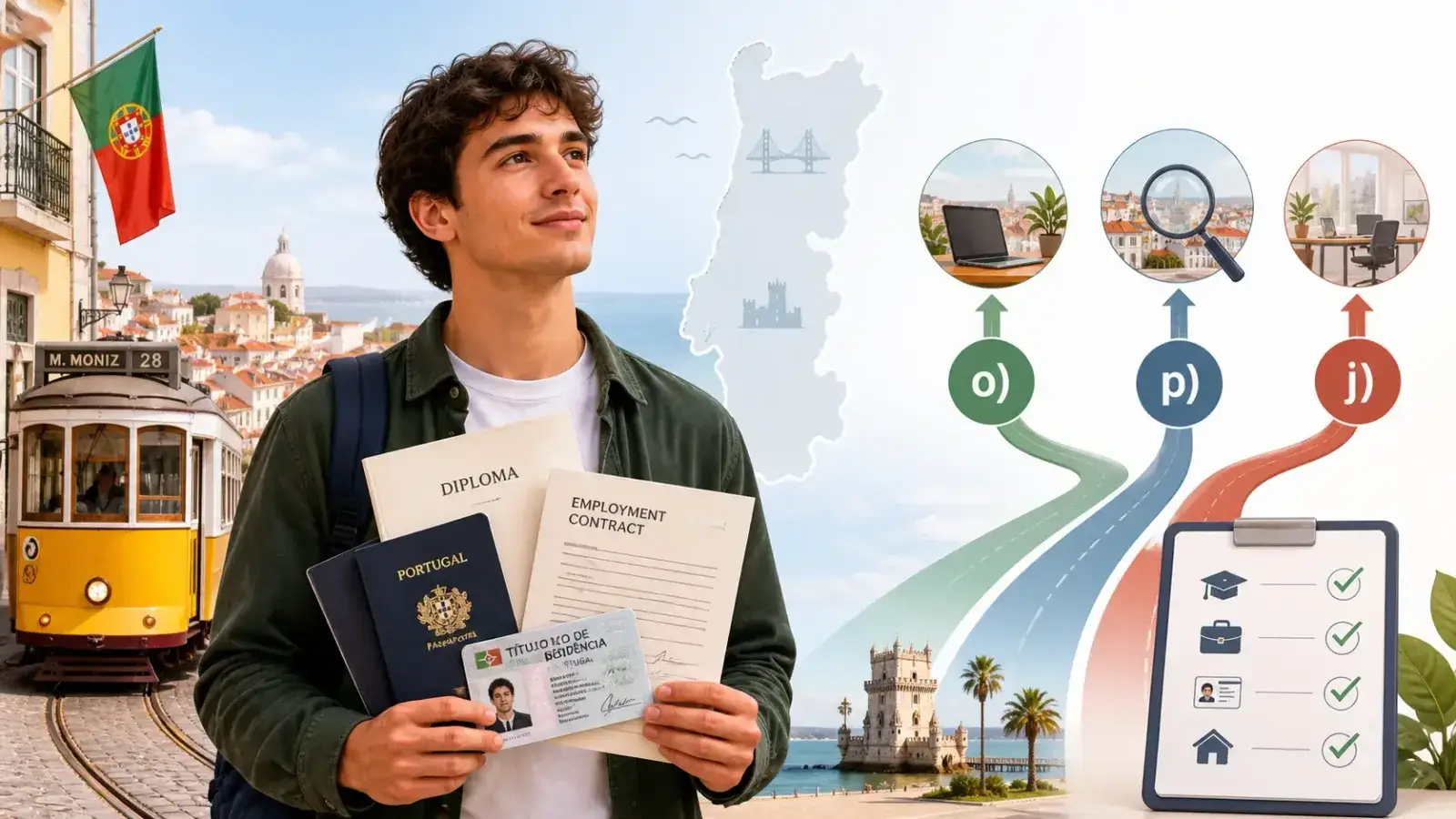
Your student residence permit has expired — or will soon — and you want to stay in Portugal. What happens next depends entirely on which category of Article 122 applies to you. Get the category wrong and AIMA can reject or redirect the application on procedural grounds, even if you might have qualified under a different letter. This guide covers the student-relevant pathways under Article 122 of Law 23/2007 and explains, in plain terms, what each one actually requires.
Quick Answer: Article 122 of Law 23/2007 allows certain foreign students, graduates, and researchers to apply for a Portuguese residence permit directly with AIMA — without leaving Portugal and without obtaining a new residence visa from a consulate. The main student routes are: alínea o) for those who have finished studies and already have work/self-employment documents, alínea p) for those who qualify for the one-year job-search or business-creation period, and alínea j) for some people whose residence right has expired and who remained in Portugal, including the 2026 AIMA contact-form route for students who did not complete their course but are working. Applications go through AIMA at AIMA Article 122 student guidance.
Which Article 122 Letter Should I Use?
Use this as a practical starting point. The exact route still depends on your current residence permit, study cycle, work status, and whether your residence card has already expired.
| Your situation | Likely route | Why |
|---|---|---|
| You finished your degree or research and already have a work contract | Article 122(1)(o) / alínea o) | You are asking to switch directly into residence for professional activity |
| You finished eligible higher education or research and need time to find work or create a company | Article 122(1)(p) / alínea p) | This is the job-search or business-creation period, usually up to one year |
| You finished only a bachelor’s degree and want the one-year job-search route | Check carefully before filing | AIMA’s public wording for alínea p) refers to 2nd and 3rd cycle higher education/research, while a separate AIMA form mentions broader student situations |
| You did not finish your course but stayed in Portugal and are working | Article 122(1)(j) / alínea j) | AIMA has a dedicated 2026 contact-form route for this specific student-worker situation |
| Your student residence permit already expired and you have documented continuous presence | Possibly alínea j) | This route is more document-heavy and depends on the facts of your case |
| Your family member also wants to stay | Separate family route | They normally need their own legal basis, often family reunification under Article 98 |
What Article 122 Actually Is
Portuguese immigration law — Law 23/2007, of 4 July — normally requires a foreign national to obtain a residence visa from a Portuguese consulate in their home country before they can apply for a residence permit in Portugal. That consular step takes months and means leaving the country.
Article 122 lists the specific situations where that rule is waived. The article is titled “Autorização de residência com dispensa de visto de residência” — residence permit with waiver of a residence visa. There are nearly 20 subparagraphs, called alíneas in Portuguese, each covering a different life situation. For someone whose student permit is expiring, the relevant ones are usually alínea o), alínea p), and — in some expired-status situations — alínea j).
The critical point: Article 122 is not a grace period or an amnesty. It’s a formal application process, submitted while you’re lawfully in Portugal, that lets you change the legal basis of your stay without going back to a consulate. The distinction matters because AIMA won’t automatically accept you under it. Your file has to show that you meet the requirements of whichever letter you’re citing.
The Three Pathways Students Actually Use
Letter o) — Direct Conversion to a Work Permit
This is the route for graduates who already have a job lined up.
Letter o) — alínea o) — is the direct conversion route for many students who have completed studies and are ready to move into professional activity. It is especially relevant where AIMA asks for proof of completed studies plus a contrato de trabalho (employment contract), promessa de contrato de trabalho (promise of employment contract), or documents proving atividade independente (self-employment/freelance work). The completion must be genuine — your degree must be awarded, your academic file must be closed, or your research project must be formally concluded.
Under letter o), you apply directly to AIMA for a residence permit for professional activity — either atividade profissional subordinada under Article 88, with an employment contract, or atividade profissional independente under Article 89, as a freelancer/service provider. You do not need to return to your home country. You do not apply at a consulate.
What AIMA actually checks: proof that the studies are finished, a valid employment contract or proof of independent professional activity, compliance with tax and social security obligations where applicable, no criminal convictions resulting in more than one year of imprisonment, and proof of adequate accommodation and subsistence.
The key practical constraint is timing. Letter o) does not give you an extended job-search period — it assumes you already have the professional activity sorted. If you have graduated but do not yet have a contract, letter p) may be the right route if your study cycle and documents fit AIMA’s requirements.
Letter p) — The One-Year Job Search Period
This is the pathway most international graduates in Portugal actually use.
Letter p) — alínea p) — is the route for the one-year job-search or business-creation period. AIMA’s public guidance describes it for people who benefited from residence authorisation for students of the 2.º ou 3.º ciclos do ensino superior (2nd or 3rd cycle higher education: master’s or PhD) under Article 91, or residence authorisation for research under Article 91-B, and who completed those studies or research. The purpose is to give up to one year of lawful residence to look for work or create a company in Portugal compatible with your qualifications.
That “compatible with your qualifications” clause is worth taking seriously. AIMA can, in theory, question whether a job you find is genuinely consistent with a master’s degree in engineering. In practice, the bar isn’t set painfully high, but if you’re planning to take completely unrelated work, the application carries more risk.
What the application requires under letter p):
- Proof of completed studies (diploma, certificate from the university, confirmation that all fees are paid and the academic file is closed)
- For master’s or doctoral completers: proof the thesis has been submitted and the jury evaluation concluded
- A signed declaration stating that you intend to use the one-year period to find work or set up a business
- Proof of sufficient means of subsistence
- Proof of accommodation in Portugal
- Permission for AIMA to consult your Portuguese criminal record
Once you receive the permit under letter p), you have up to 12 months to find qualifying employment. When you do, you then apply to convert to a work permit (Article 88, 89, or 90 depending on the type of activity). That second application also goes directly to AIMA without requiring a consular step, because Article 122(3) allows it.
The permit issued under letter p) should not be treated as a normal work permit. Its purpose is job search or business creation, followed by conversion once you have qualifying employment or independent activity. This is one of the most commonly misunderstood parts of the whole framework.
Letter j) — For Those Who Overstayed (and Students Working Without Completing Their Degree)
This pathway exists for a different situation: people who remained in Portugal beyond the authorised period of their student visa or permit, built a life here, and are now looking to regularise. Since February 2026, it also covers a specific group that previously had no clear application route: student visa holders who never completed their degree but have been continuously working in Portugal and never left.
Letter j) covers foreign nationals who, despite being in an irregular situation, can demonstrate that they have been continuously living in Portugal. The provision requires proof of continuous residence, no criminal record with sentences exceeding one year of imprisonment, and evidence of genuine ties to the country — employment, tax records, social security contributions, banking history.
Importantly, AIMA has been accepting letter j) applications from people whose lawful residence lapsed some time ago, provided the factual and documentary conditions are met. This is more accessible than it used to be, partly because extended processing times at AIMA have created a grey area where permits expire while applications are pending.
Letter j) does not apply to people who just missed a renewal deadline by a few days. It’s for people with documented, continuous presence — typically measured in years.
If you overstayed your student permit by a few weeks while waiting for an AIMA appointment that never came, letter j) may not be the right framing. Speak with an immigration lawyer before filing, because the wrong category is grounds for refusal.
Contact Form: Request for Temporary RA — Art. 122(j)
On 10 February 2026, AIMA launched a dedicated contact form specifically for student visa holders who did not complete their course, are currently working in Portugal (employed or self-employed), and have not left the country. This is a new title issuance, not a renewal — the resulting document is a fresh temporary residence authorisation under letter j), not an extension of your student permit.
Before this form existed, people in this situation had no dedicated channel: they relied on phone queues to AIMA’s contact centre or, in many cases, sought a court-ordered scheduling. The form removes that barrier.
Who this form is for. You qualify if all of the following are true:
- You held a student residence permit (autorização de residência para estudantes)
- You did not complete your study plan
- You are currently working, either as an employee (contrato de trabalho) or self-employed (prestação de serviços / atividade independente)
- You have not left Portugal since your student permit lapsed
Who this form is not for. If you completed your degree and want to stay on, use letter o) (if you have a job) or letter p) (if you need time to find one). Those are separate routes with separate requirements.
How to submit. Go to contactenos.aima.gov.pt/contact-form and fill in the contact form as follows:
- Tipo de Assunto: Autorização de Residência
- Subtipo de Assunto: Autorização dispensa de visto de residência – Art. 122 – alínea j)
Documents to attach with the form submission:
| Document | Notes |
|---|---|
| Digitised copy of employment contract | Or, for the self-employed: service provision contract plus the declaration of opening of independent activity lodged with the Autoridade Tributária (AT) |
| Proof of NISS registration | Comprovativo de inscrição junto da Segurança Social |
| Proof of social security contributions | Comprovativo de descontos efetuados à Segurança Social |
| Copy of valid passport | All pages, including expiry page |
| Copy of expired student residence permit | Both sides |
AIMA will use this initial submission to assess the file and schedule your in-person appointment for biometric data collection. The comprovativo issued at that appointment is your proof of legal status while the card is processed.
Portuguese Terms You Will See on AIMA Forms
AIMA forms and appointment pages often use Portuguese wording, even when the situation is explained in English elsewhere. These are the terms worth knowing before you file.
| Portuguese term | Plain English meaning | Why it matters |
|---|---|---|
| Autorização de residência com dispensa de visto de residência | Residence permit without needing a new residence visa | This is the legal title of Article 122 |
| Alínea o) | Letter o) | Usually the direct work/self-employment conversion route after studies/research |
| Alínea p) | Letter p) | Job-search or business-creation period after eligible studies/research |
| Alínea j) | Letter j) | Route for some people whose residence right expired and who did not leave Portugal |
| Comprovativo | Receipt/proof issued by AIMA | Used as proof that your process is pending or that an appointment/application step happened |
| Contrato de trabalho | Employment contract | Key document for employed work |
| Promessa de contrato de trabalho | Promise of employment contract | Sometimes accepted where the job is agreed but the contract starts later |
| Prestação de serviços | Service provision/freelance contract | Used for self-employed work |
| Atividade independente | Independent professional activity | The Portuguese tax/social security setup for freelancing, often linked to recibos verdes |
| Declaração de início de atividade | Declaration of activity opening at Finanças | Needed if you register as self-employed |
| NIF | Portuguese tax number | Your tax record and address should be correct before applying |
| NISS | Social security number | Important if you worked or are applying through employment/self-employment |
| Segurança Social Direta | Online social security portal | Where you check NISS registration and contribution history |
| Comprovativo de meios de subsistência | Proof of subsistence funds | Bank statements or other proof that you can support yourself |
| Morada de residência | Residential address | Must be consistent with your accommodation evidence and fiscal address |
All Relevant Article 122 Letters at a Glance
| Letter | Who It Covers | What You Get | Key Requirement |
|---|---|---|---|
| o) | Completed higher ed (Article 91) or research (Article 91-B) | Residence permit for professional activity (employed or self-employed) | Active job contract or proof of self-employment at time of application |
| p) | AIMA guidance refers to completed 2nd/3rd cycle higher education or research; some AIMA form wording also mentions broader student situations | Up to 1 year to look for work or start a business | Declaration of intent + completed studies/research proof + closed university file |
| j) | Person who remained beyond authorised period with continuous residence; also students who didn’t complete their degree but are working in Portugal and never left | Residence permit for the applicable category | Documented continuous presence + contribution to Portuguese society; for the student-worker route, employment docs + NISS + contribution history submitted via the AIMA contact form |
| k) | Parent of a minor with Portuguese nationality or Portuguese residence permit | Residence permit for the parent | Proof of parental responsibility, child’s status documents |
| q) | Held a temporary stay visa for research or highly qualified activity | Residence permit for research, teaching, or highly qualified work | Evidence of the planned activity at a recognised institution |
Letters k) and q) are less commonly relevant to graduating students but worth knowing if your situation is more complex. If you are dealing with family members, read our family reunification with AIMA guide before assuming they are covered by your own Article 122 application.
Letter o) vs. Letter p) — The Practical Differences
This is where most people get confused. Both cover the same starting point (finished your degree) but lead to different applications with different documents.
| Letter o) | Letter p) | |
|---|---|---|
| Purpose | Immediate switch to work permit | One-year job search period, then work permit |
| Employment contract required at filing? | Yes — or proof of independent activity | No — you’re filing without a job |
| Document for studies | Diploma / completion certificate | Diploma + declaration of intent to seek work |
| Resulting permit type | Work permit (Article 88/89/90) | Job-search permit, then work permit |
| Best for | Graduates with a job offer in hand | Graduates still looking or building a business |
| Risk of refusal | If employment docs are incomplete | If AIMA questions compatibility of intended work with qualifications |
The choice between o) and p) comes down to one thing: whether you have a job offer when you file. If you do, go with o). If you don’t, use p) to buy yourself the year.
The Application Process — Step by Step
Before You Apply
Your current residence permit should still be valid when you file. Article 78 of Law 23/2007 protects your lawful stay while the application is pending, but only if you apply before expiry. If your permit has already expired, you’re in a legally more precarious position — still possible to apply under Article 122, but the file needs to be cleaner and stronger.
The AIMA portal (AIMA Article 122 student guidance) is where applications are now submitted. Since the new digital renewal portal launched in July 2025, most initial and renewal applications go through the online system first. For first-time Article 122 applications (where you’ve never held a Portuguese residence permit in the new category), you still need an in-person AIMA appointment for biometric data collection.
Documents Required for Letter p) — The Full List
| Document | Specific Notes |
|---|---|
| Valid passport | At least 3 months validity remaining beyond intended stay |
| Proof of completed studies | Diploma, parchment, or formal completion letter from the institution |
| University file closure confirmation | Receipt of all academic fees paid, confirmation of formal enrolment termination |
| Thesis submission proof | For master’s and PhD — confirmation of jury evaluation |
| Declaration of intent | Signed statement that you intend to seek work or start a company compatible with your qualifications |
| Proof of accommodation | Rental contract in your name, or formal hosted accommodation declaration |
| Proof of means of subsistence | Bank statements showing sufficient funds — the 2025 subsistence threshold is based on the Portuguese minimum wage (€1,020/month in 2025) |
| Health insurance | Or proof of SNS coverage |
| Portuguese criminal record authorisation | AIMA checks this directly — you sign a consent form |
| Tax registration (NIF) | Your NIF must be up to date at Finanças |
| Social security number (NISS) | Required if you worked during studies |
For letter o), add to this list: the employment contract or promise of employment contract, and any relevant documents for self-employment registration.
Fees (Updated March 2026)
AIMA updated its fee table from 1 March 2026. Do not rely on old forum posts or screenshots, because the amount can depend on whether AIMA charges separately for receção e análise do pedido (receipt and analysis), concessão (granting/issuance), card delivery, renewal, or another procedural item.
| Fee Point | What to Check |
|---|---|
| Application analysis | Whether your Article 122 request has a separate analysis fee |
| Granting/issuance of the residence permit | The fee for issuing the temporary residence authorisation |
| Card delivery or collection | Whether delivery/collection is charged separately |
| Renewal later | The renewal fee may differ from the first concession fee |
Before filing, check AIMA’s current Tabela de Taxas e demais encargos rather than copying a fee range from another site. Fees are usually paid after AIMA confirms the relevant application step, not simply because you filled in an online form.
Processing Times — Law vs. Reality
| Stage | Official Timeline | What Actually Happens |
|---|---|---|
| Application submission | Immediate (online or in person) | Online often faster; AIMA appointment may take weeks to schedule |
| AIMA decision | 90 days from application | Routinely 4–9 months in practice; some cases over a year |
| Comprovativo issued | At in-person appointment | This receipt is commonly used as proof that your process is pending; employers and border officers may still ask questions |
| Residence card physical delivery | 45 working days after approval | Reported at 30–60 working days in practice |
The comprovativo — the stamped receipt or proof issued after your AIMA appointment/application step — is one of your most important documents while the card is processed. In practice, people use it to prove that their process is pending and to explain their status to employers, banks, universities, and border officers. Keep the original safe and carry a copy when needed.
What Happens If You Do Nothing
If your student permit expires and you take no action, you’re overstaying. Portugal’s immigration enforcement has intensified since 2024, and AIMA is more active on overstay cases than SEF was.
An overstay of 90 days or fewer generally results in a warning. Beyond that, the penalties escalate: fines, a ban on re-entry to Portugal (typically 3 to 5 years), and removal to your country of origin. An entry ban on your record also affects your ability to get a Schengen visa or enter other EU countries.
Letter j) exists partly to catch people who let this situation develop. But AIMA’s acceptance under letter j) is not guaranteed and has become more discretionary since 2024. Applying proactively under letter o) or p) before your permit expires is always the better position.
Law vs. Reality
| What the official framework says | What actually happens |
|---|---|
| Applications decided within 90 days | Most Article 122 applications take 4–9 months; some run longer |
| Comprovativo helps prove your pending process | Employers, banks, or border officers who do not know Portuguese immigration practice may still ask for additional explanation — bring AIMA documentation showing what it is |
| Letter p) gives 1 year to find work | AIMA has occasionally questioned whether the graduate’s intended job is “compatible with qualifications” — this is rare but real |
| No criminal record required | Minor offences with under 1 year of total imprisonment don’t disqualify you — but anything more serious does |
| Tax and social security compliance required | AIMA cross-checks this electronically. If you worked during studies and didn’t register for social security, fix it before filing |
| Applications submitted complete from April 2025 | Since April 28, 2025, AIMA rejects any application missing documents at submission — no second chance to submit missing items |
| Letter j) required a phone appointment or legal action | Since February 2026, students working without completing their degree can submit directly via the AIMA contact form at contactenos.aima.gov.pt |
Common Mistakes
Mistake: Filing under letter p) when you already have a job
People apply under p) to avoid the pressure of needing a job at filing, not realising that p) doesn’t give them the right to work immediately. If you have an employment contract by the time you file, letter o) is the correct route and it’s faster — you skip the intermediate job-search permit and go straight to the work permit.
Mistake: Submitting before the university formally closes your academic file
AIMA rejects letter p) applications where the student has sat their dissertation defence but the university hasn’t issued the formal completion paperwork yet, or where there are outstanding fees. Your degree may be finished — your academic file may not be. Contact your university’s academic secretariat and confirm in writing that all records are closed and all fees are settled before you file.
Mistake: Thinking the comprovativo covers travel outside the Schengen Area
The comprovativo issued by AIMA after your appointment is commonly used as supporting proof for Schengen movement, but it is not the same as a residence card and does not function as a visa for countries outside the Schengen Area. If your passport requires a visa for a third country, having a pending Portuguese residence process does not remove that requirement. Plan travel carefully, especially before receiving the physical card.
Mistake: Waiting until the permit expires to book the AIMA appointment
AIMA appointment availability in Lisbon and Porto routinely runs 6 to 10 weeks out, sometimes more. If you wait until your permit expires and then try to book, you’ll be in an expired-permit situation for months before you’re even seen. Start the process at least 3 months before your permit expires. The six-month window before expiry — during which the permit is not considered to have lapsed — is your protection, but only if you’ve filed an application, not just started thinking about it.
Mistake: Assuming your qualification level determines the letter
Whether you completed a bachelor’s, master’s, or PhD all matters for which letter applies — and the updated text of letter p) specifically refers to “completion of studies at the second and third cycle of higher education” (master’s and doctoral level). If you completed a bachelor’s only and want the one-year job-search period, discuss the correct legal basis with an immigration lawyer before filing. The categories have shifted through successive amendments to Law 23/2007 and the current wording is what applies.
Mistake: Using the letter j) contact form if you completed your degree
The AIMA contact form launched in February 2026 for letter j) is intended exclusively for students who did not finish their degree. If you graduated, the form will not help you and AIMA will likely redirect your file. Use letter o) or p) instead.
Real Scenarios
The Master’s graduate in Porto with a gap between graduation and job offer
A Brazilian student completed a master’s in architecture at the Universidade do Porto in June 2025. Her residence permit expired in August. She had two interviews scheduled but no offer. She filed under letter p) in July, before expiry, submitting her degree certificate, the university’s closure confirmation, the subsistence declaration, and her accommodation contract. AIMA issued a comprovativo at her October appointment. She received a work offer in January 2026 and immediately filed to convert under letter o) — the second application also handled in Portugal without consular involvement. Her residence card for professional activity arrived in March 2026.
Lesson: Filing under p) before you have a job, and before the permit expires, is the intended sequence. Don’t wait.
The PhD researcher who overstayed by four months
A Ukrainian researcher completed a PhD at the Universidade de Lisboa. His Article 91-B permit expired in January 2025. He delayed filing because he was waiting for his diploma certificate, which took longer than expected. By the time he had all his documents, he was four months beyond his permit expiry.
He filed under letter j), supported by: his research completion certificate, university correspondence, bank records showing continuous activity in Portugal, and a letter from his former department. His tax and social security records were clean. AIMA accepted the application and scheduled an appointment for June 2025. The comprovativo issued at the appointment covered him through the decision, which came in October 2025.
Lesson: A gap between expiry and filing doesn’t automatically close the Article 122 door, but the file needs to be demonstrably solid — and letter j) is more demanding to satisfy than o) or p).
The bachelor’s graduate who assumed she qualified for the one-year period
A student from India completed a bachelor’s degree in management at a private Portuguese university. She assumed letter p) applied and began gathering documents. On consultation with a lawyer, she was advised that the current wording of letter p) references “second and third cycle” higher education — master’s and doctoral level — and that a bachelor’s (first cycle) may not cleanly fit. She filed instead under letter o) with an employment contract from a company that had offered her a junior analyst role. The application was accepted.
Lesson: Don’t read Article 122 in isolation. The Portuguese higher education system uses cycle terminology (1st cycle = bachelor’s; 2nd cycle = master’s; 3rd cycle = PhD) and the current legislative text matters. If your situation is at the border of a subparagraph, get legal advice before filing.
The student who dropped out and kept working
A student from Brazil came to Portugal on a student permit to study computer science. After two years, he left the programme without completing his degree — but had found employment as a junior developer and continued working in Portugal on a valid employment contract, paying social security contributions throughout. His student permit lapsed.
When AIMA launched the Art. 122(j) contact form in February 2026, he submitted immediately via contactenos.aima.gov.pt/contact-form, selecting the correct subtype, and attached his employment contract, NISS registration, and his social security contribution history from Segurança Social Direta. AIMA scheduled an in-person appointment and issued a comprovativo at that appointment. His temporary residence authorisation under letter j) is now in processing.
Lesson: If you left your course but stayed in Portugal working and paying social security, the February 2026 contact form is your fastest route into the system. You no longer need to seek a court order or rely on the phone queue.
Pro Tips — What Most People Miss
Your NIF address must match your actual accommodation. AIMA may compare your fiscal address at Finanças against the accommodation you declare. If your NIF still shows a previous address, update it at the Portal das Finanças before filing. If you are still sorting this out, start with our NIF guide for foreigners and Portal das Finanças guide.
The social security number (NISS) issue is common for students who worked part-time. If you worked during your studies — even briefly — AIMA may check for NISS registration and contributions. Gaps in contribution records for periods where you were working create complications. Pull your Segurança Social Direta record and review it before submitting. These two guides help with that: how to get a NISS in Portugal and Segurança Social Direta.
Article 122 applications are not always online-only. Unlike simple permit renewals, a first-time Article 122 application can require an in-person appointment for biometric data. Book early and keep screenshots/proof of attempts if appointment availability is poor. For the appointment side, read our AIMA appointment guide.
Protect your lawful residence history. Your time on a valid student residence permit may matter later for permanent residence and nationality timelines. Portugal’s nationality rules are under political and legal change in 2026, so avoid relying on old claims that it is definitely 5, 7, or 10 years for every applicant. The safest practical move is simple: keep your residence continuous, keep proof of each permit/application period, and avoid unexplained gaps. For the bigger picture, read our Portugal citizenship and residency requirement guide.
If you plan to freelance rather than take employment, plan ahead. Independent professional activity under letter o) or after letter p) requires registration as a trabalhador independente — the recibos verdes freelance system — before AIMA will usually accept the work basis. The tax office and social security registration both need to be in place. This is not impossible, but it takes time to set up and AIMA will expect documents. Read our recibos verdes guide for foreigners before filing as self-employed.
If you dropped out but kept working, the Art. 122(j) contact form is now your fastest route. Since February 2026, AIMA accepts direct form submissions from students who did not finish their degree but have continuous employment and NISS contributions. You no longer need to attempt a phone appointment or seek a court order to get in front of AIMA. File through contactenos.aima.gov.pt/contact-form, select the Art. 122 alínea j) subtype, and attach your employment documents, NISS confirmation, and contribution history. Make sure your Social Security record on Segurança Social Direta is consistent with what you submit.
Frequently Asked Questions
Can I work in Portugal while my Article 122 application is pending?
Under letter p), do not assume you can work just because the job-search process is pending. The purpose of that route is to find work or create a business and then convert. Under letter o), your application is based on professional activity from the start, so the comprovativo is normally used as proof that the process is moving while the card is being processed. In practice, some employers understand this well and others ask for additional AIMA documentation.
How long does an Article 122 application take to be decided?
AIMA has a legal deadline of 90 days to issue a decision on applications under Article 122. In practice, decisions have been running 4 to 9 months across most categories, though some applications have taken over a year. The comprovativo protects you during the waiting period.
Do I need to leave Portugal to apply?
No. That is the entire point of Article 122 — it is a visa waiver mechanism that lets you apply and resolve your status from within Portugal. You do not attend a consulate. You do not return to your home country.
What happens after the one-year period under letter p) runs out?
If you haven’t secured employment or started your business by the time the year ends, your lawful stay under that permit expires. You’d need to either file for a different category (with supporting documents) or face the consequences of an expired permit. The year is not automatically renewable under letter p). Use it.
Does completing a Portuguese degree give me an automatic right to stay?
No. Completion of your degree is a qualifying condition for Article 122 — it doesn’t create an automatic right. You need to actively apply, meet all the administrative requirements, and receive AIMA’s approval. Degrees don’t generate residence permits on their own.
What if AIMA refuses my application?
You have the right to a prior hearing (audiência prévia) before AIMA issues a formal refusal — this is a procedural protection under Article 78 of Law 23/2007. Use it. Present any missing documentation, correct any errors, and argue your case. If AIMA still refuses, you have 15 days to file an appeal (reclamação) at AIMA, or pursue administrative court proceedings. Immigration lawyers handle this routinely.
Can I travel to other Schengen countries while my application is pending?
The comprovativo is commonly used as supporting proof for Schengen travel while your Portuguese card is being processed, but it is not as strong as having the physical residence card. Before you receive the comprovativo — during the period between filing and your appointment — the legal picture is less clear. Your expired student permit and filed application may help explain your status, but travel still carries risk. Plan non-essential travel for after the comprovativo is in hand, and avoid complicated trips until your card arrives if possible.
Is there a criminal record check?
Yes. AIMA accesses your Portuguese criminal record as part of the assessment. You sign an authorisation form for this. Foreign criminal records are not checked by AIMA itself, but if a foreign conviction is relevant, the question of disclosure is more complicated. A sentence or combined sentences exceeding one year of imprisonment in any jurisdiction disqualifies you from Article 122 residence.
Can my family members stay in Portugal with me?
Letter o) and p) cover only the primary applicant. Family members who want to remain in Portugal need their own legal basis — typically family reunification under Article 98 of Law 23/2007. If you convert to a work permit under Article 122(o), you can subsequently apply for family reunification for qualifying dependants.
What if I graduated from a foreign university but have been in Portugal for research?
Article 91-B covers foreign researchers at recognised Portuguese research institutions. If your residence permit was issued under Article 91-B and your research project concluded, letters o) and p) both apply to you in the same way as to degree students. Your research institution’s formal confirmation of project completion takes the place of a degree certificate.
Does the one-year job search period count toward my five years for permanent residence?
For permanent residence, lawful residence periods generally matter, including student and post-study residence periods where properly documented. For citizenship, Portugal’s rules and political debate around residence-counting have changed several times, so check the current nationality framework before making a long-term plan. In practical terms, keep every residence card, AIMA receipt, renewal proof, and comprovativo because continuity is what you may need to prove later.
I left my course without finishing. Can I use the Art. 122(j) contact form?
Yes, if you are currently working in Portugal (employed or self-employed), have been paying social security contributions, and have not left the country. Submit via the AIMA contact form at contactenos.aima.gov.pt/contact-form, selecting Autorização de Residência as the subject type and the Art. 122 alínea j) option as the subtype. Attach your employment contract or freelance documentation, NISS registration, and social security contribution records.
Finishing your degree in Portugal is the easy part. The paperwork that follows is where people lose their legal status — usually not through negligence, but because the categories under Article 122 are genuinely easy to confuse and the documents required are specific.
The first thing to do: establish which letter applies to you. If you have a job offer in hand, that’s letter o). If you need time to find one, that’s letter p). If you’ve already overstayed — or left your course and kept working — that’s letter j), and since February 2026 you can reach AIMA directly via the dedicated contact form without needing a court order or an impossible phone queue.
Book your AIMA appointment through the AIMA contact form as early as possible. If you’re planning to work as a freelancer after graduation, read our guide on recibos verdes guidance before you apply — the registration needs to be in place before you file. And if you’re thinking further ahead, understand how your student years may feed into Portugal citizenship and residence-counting rules — because every period of lawful stay should be documented properly.