

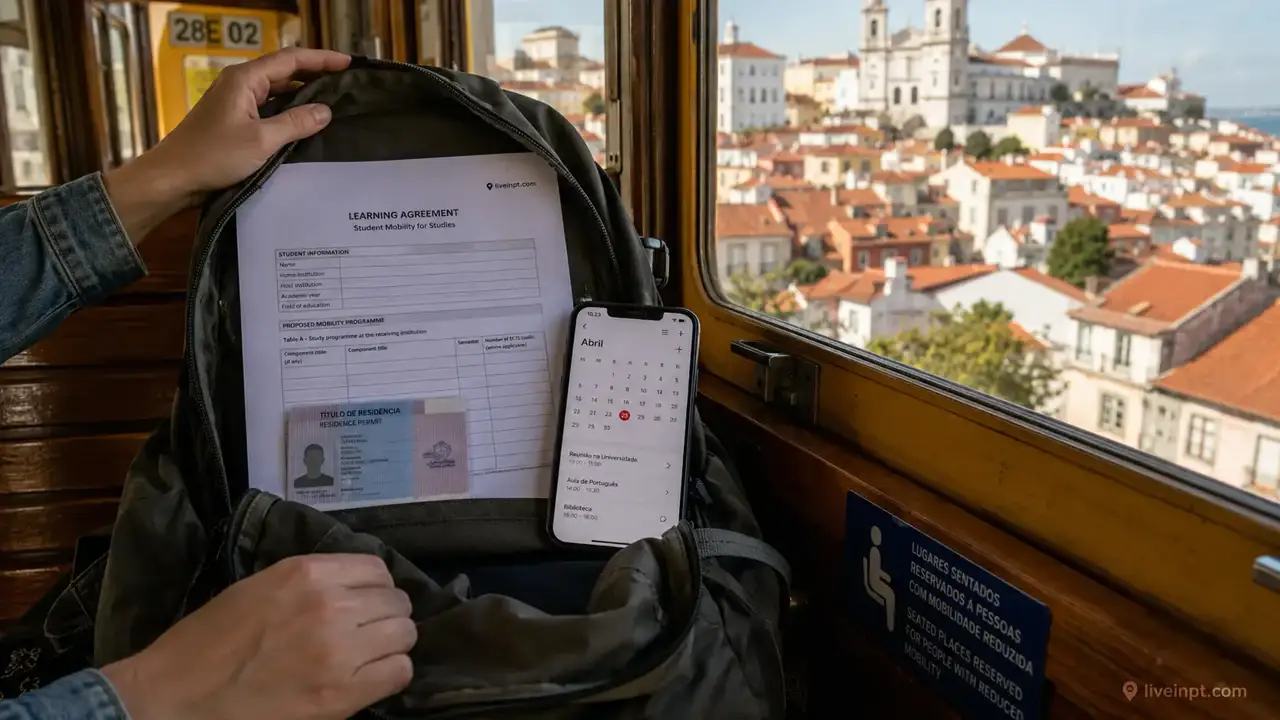
Most incoming Erasmus students assume that arriving in Portugal with their German, French, or Dutch residence permit already in hand is enough paperwork. In practice, there is one more step: notifying AIMA under Article 91-A before the mobility period begins. It is not a visa application, it is not an AIMA appointment with biometrics, and in many cases your host university will handle it entirely. But it does need to happen — and understanding why tells you a lot about how the EU’s student mobility rules actually work.
Article 91-A of Lei n.º 23/2007 implements Directive (EU) 2016/801, which established a common EU framework for the entry and residence of third-country nationals for research, study, and training. The provision specifically covers intra-EU student mobility: the situation where a non-EU student who already holds a student residence permit in one EU member state wants to study in Portugal for part of their programme.
This is a deliberately narrow provision. It does not apply to EU citizens (who have free movement rights and do not need it). It does not apply to non-EU students arriving fresh from outside the EU without any existing EU permit (who must apply for a Portuguese D4 visa and Article 91 residence permit). Article 91-A sits in between those two cases.
Quick Answer: Article 91-A allows non-EU students who hold a residence permit from another EU member state to study in Portugal for up to 360 days without applying for a full Portuguese residence permit. The mechanism is a notification to AIMA — submitted by email, at least 30 days before arrival — rather than a standard permit application. No biometric data collection is required. The process can be handled by the student or by the Portuguese host institution.
Who This Provision Is Actually For
To use Article 91-A, you need to satisfy three conditions simultaneously.
First, you must be a third-country national — a citizen of a country outside the EU, EEA, and Switzerland. A Brazilian student studying in Germany on a German residence permit, planning a semester at a Lisbon university, is the exact profile this provision targets.
Second, you must hold a valid residence permit issued by another EU member state for the purpose of study. That permit must remain valid for the entire mobility period in Portugal.
Third, your mobility must be covered by a recognised framework: an EU or multilateral programme with formal mobility measures (Erasmus+ is the most common), or a bilateral agreement between two higher education institutions. Informal arrangements — coming to Portugal to sit in on lectures while on a German permit without any institutional agreement — do not qualify.
If you do not meet all three conditions, Article 91-A is not your route. Non-EU students arriving directly from outside the EU for Portuguese degree programmes apply under Article 91, which requires a D4 student visa and a full AIMA residence permit application.
The Notification Process: How It Works
Unlike a standard residence permit application, Article 91-A runs on a notification system. You are not asking AIMA for permission — you are informing AIMA that a mobility period is starting, giving them the opportunity to raise any objection.
The notification should be submitted to AIMA at least 30 days before the mobility period begins. It should be submitted preferably by email. Either the student or the Portuguese host higher education institution can submit it. In practice, universities with established Erasmus programmes often handle Article 91-A notifications as a standard part of their incoming student onboarding. Check with your host institution’s international office as early as possible; they will know whether they process this on your behalf or whether you are expected to submit it yourself. What I would emphasise is that “the university handles it” should be verified, not assumed. Ask for written confirmation of what they will file and when.
The notification must include:
A copy of your residence permit from the EU member state where you are currently enrolled — the permit that will remain valid throughout your time in Portugal.
A copy of your valid passport.
Proof of admission to the Portuguese higher education institution under the relevant mobility programme or inter-institutional agreement. For Erasmus+ students, the Learning Agreement and your acceptance letter from the Portuguese institution together establish this. For students on bilateral university agreements, the official admission letter from the Portuguese institution is the core document.
A criminal record certificate from your country of nationality, or from the EU member state where you have lived for more than one year. This certificate should be current — not ordered so far in advance that it has become stale by the time you submit the notification.
Evidence of sufficient means of subsistence for the mobility period. This cannot be income obtained through benefits from the Portuguese social security system — it should come from your own funds, your scholarship, a grant, or the financial support provided through the mobility programme itself.
Proof of health insurance covering Portugal for the duration of the stay.
No biometric data collection is required at this stage. There is no AIMA counter appointment for the notification itself.
What AIMA Issues in Return
Once AIMA receives the notification and does not raise a written objection within 30 days, a declaration is issued confirming that you are authorised to remain in national territory for up to 360 days and to enjoy the rights provided by law. This declaration is your formal documentation of authorised stay in Portugal under Article 91-A.
Carry this declaration with your passport and your EU member state residence permit throughout your time in Portugal. Together, these three documents establish your immigration status: a non-EU student on a valid EU permit, authorised under Article 91-A to complete part of your studies here.
If AIMA does raise an objection within the 30-day window, the written communication will explain the basis. At that point, the question is whether a full Portuguese student visa and Article 91 permit application is the appropriate alternative — which would depend on the specific circumstances and whether sufficient time remains before the intended programme start.
Work Rights During Your Mobility Period
Students covered by Article 91-A may engage in professional activity under Article 97 of Lei n.º 23/2007. In practical terms, this mirrors the work rights available to full Portuguese student permit holders: you may carry out subordinate or independent professional activity complementary to your study programme.
In my view, this work permission is one of the underappreciated features of Article 91-A compared to a simple Schengen tourist entry — it means a student on an exchange semester can legitimately take on a part-time role or short freelance contract without creating an immigration problem.
If you take up any paid work in Portugal during the mobility period, you will need a NIF (Número de Identificação Fiscal) for tax purposes. Getting this sorted early is straightforward. The guide to getting a NIF in Portugal covers the full process, including whether you can apply before arriving in Portugal through a Portuguese consulate in your home country. If you work under an employment contract, you will also need to register for NISS through Segurança Social Direta — the NISS guide covers that step.
What Article 91-A Does Not Cover
It is worth being explicit about the boundaries of this provision, because the overlap with tourist entries and Schengen rights creates genuine confusion.
A tourist entry under Schengen short-stay rules, meaning 90 days within any 180-day period, is not the same as an Article 91-A mobility stay. The Schengen 90/180 day rule guide explains how that limit works. Article 91-A gives you up to 360 days in Portugal, but it requires the full notification procedure with a valid EU member state student permit and a formal programme framework. From what I have seen, the Schengen confusion is the most common error incoming exchange students make: they assume their existing tourist-entry rights and their Article 91-A notification are interchangeable. They are not. The notification establishes a different, longer-duration authorisation with work rights attached; skipping it and relying on Schengen days leaves you without that status.
Article 91-A also does not convert into a permanent Portuguese residence permit. At the end of the mobility period you return to the EU member state where your primary programme is based. If you later want to stay in Portugal long-term, whether for a full Portuguese degree or for work, a separate visa and permit process applies.
One scenario worth knowing about is what happens if the residence permit you hold from another EU state expires mid-way through your Article 91-A mobility period. If the permit that underpinned your notification lapses while you are still in Portugal, your basis for staying under 91-A becomes precarious. Contact AIMA promptly. Depending on timing and your study situation, a full Article 91 residence permit obtained via a D4 student visa from a Portuguese consulate may be the correct path forward. Do not let it drift.
Practical Notes for the Incoming Semester
What I have seen cause the most friction in this process is notification timing. Thirty days before the mobility period begins sounds like plenty of time, but the criminal record certificate alone can take weeks to obtain and apostille, and students often underestimate how long the institutional admission documentation takes to finalise in writing. If I were setting up an incoming exchange semester in Portugal, I would treat the criminal record certificate as the long-lead item and order it the week my placement is confirmed — not once I have my Learning Agreement signed.
Start the document preparation as soon as your Erasmus placement or inter-university exchange is confirmed. Do not wait until you have your flight booked. And if your Portuguese host institution handles Article 91-A notifications routinely, follow their timeline — they will know from experience how far in advance AIMA needs to receive the file.
For anything involving your NIF, NISS, or tax situation during your time in Portugal, the AIMA online portal guide explains how to navigate AIMA’s digital systems for the kinds of queries and updates that arise after the initial notification is processed.
Frequently Asked Questions
What is Article 91-A in Portugal’s immigration law?
Article 91-A implements intra-EU student mobility rules under Directive 2016/801. It allows non-EU students who hold a residence permit from another EU member state to come to Portugal for up to 360 days of study under a notification system, without applying for a full Portuguese residence permit, as long as they are covered by Erasmus+ or an inter-institutional agreement.
Who can use Article 91-A?
Third-country nationals with a valid student residence permit from another EU member state, coming to Portugal under a formal mobility programme. EU citizens do not need this provision. Non-EU students arriving directly from outside the EU without any existing EU permit must apply for a Portuguese D4 visa and Article 91 permit instead.
Do I need to apply for a Portuguese residence permit for Erasmus?
Not in the standard sense. Under Article 91-A, you notify AIMA — you do not submit a full application. The notification is done by email, at least 30 days before the mobility starts, by the student or the host university.
How long can I stay under Article 91-A?
Up to 360 days per mobility period. AIMA issues a declaration confirming this authorisation.
Can I work in Portugal on Article 91-A?
Yes — professional activity complementary to your studies is permitted under Article 97. You will need a NIF for any paid work, and a NISS if you enter employment.
What if AIMA objects to the notification?
AIMA must respond in writing within 30 days if it has an objection. If no objection is communicated within 30 days, the mobility is authorised by default and the declaration is issued.
Article 91-A makes Portugal one of the more administratively straightforward Erasmus destinations in the EU for incoming non-EU students, precisely because it runs on notification rather than application. The practical burden is modest compared to a full permit process: gather the documents, submit the notification on time, and the 360-day declaration follows. The part that requires the most attention is simply starting early enough. If your host university’s international office handles this regularly, let them guide the timing — they will have dealt with AIMA’s Article 91-A process before and will know exactly what format and lead time works.