

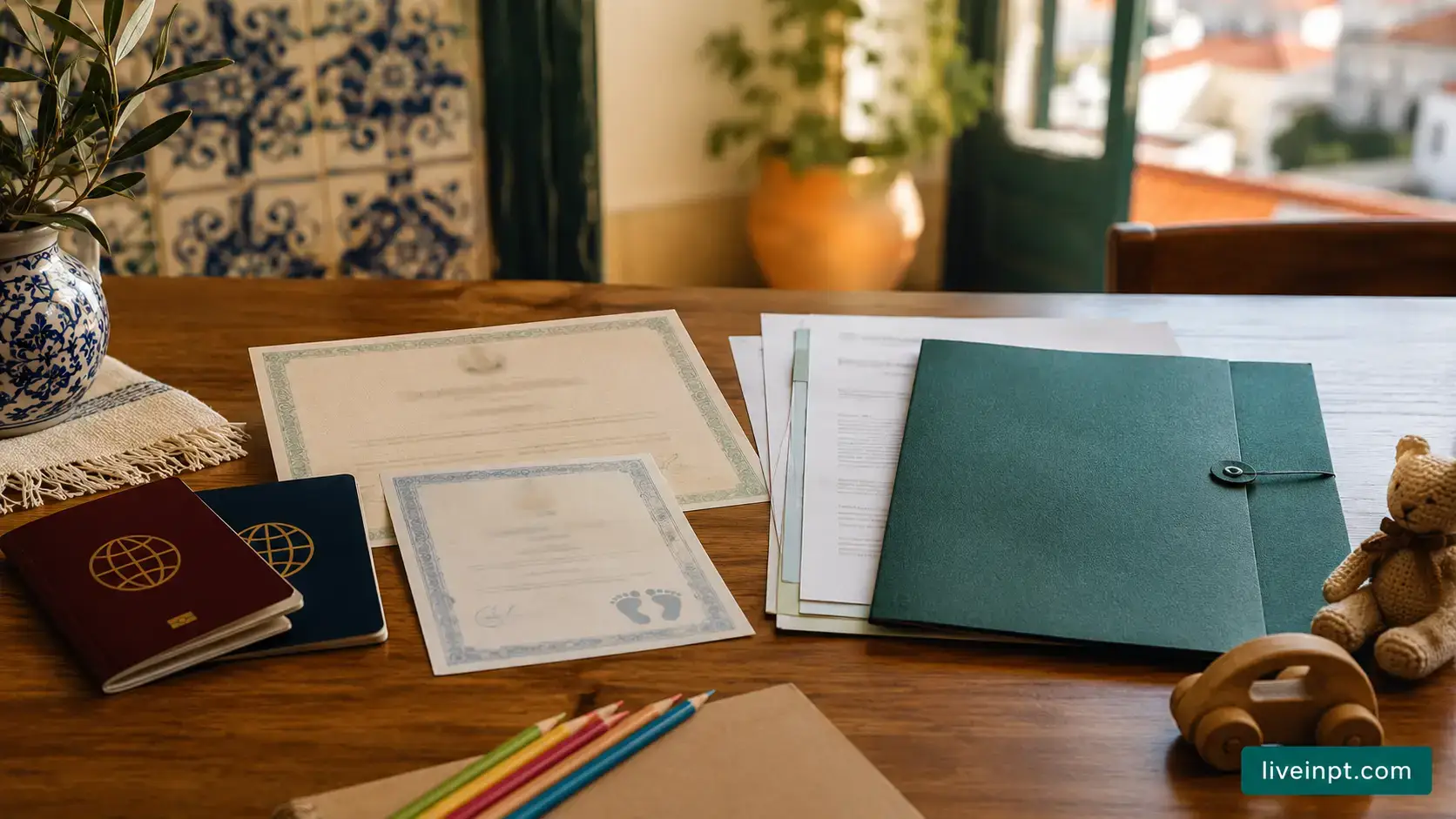
Spouse and child cases are the most common family reunification cases in Portugal, but they are also the cases where people make avoidable document mistakes. Article 99 is important because it tells you who counts as a family member. The process itself still sits within the wider Article 98 family reunification route, and the residence permit issued after approval is linked to Article 107.
Last verified: June 30, 2026. This guide focuses on spouse and minor-child cases. Use the main Portugal family reunification guide for the full 2026 process and waiting-period rules.
Quick answer
Article 99 covers spouses, minor or incapacitated children, adopted minors, certain dependent adult children, dependent first-degree ascendants, and minor siblings under guardianship. For most families, the practical Article 99 case is a spouse and minor children joining a legal resident in Portugal through family reunification. The sponsor must still satisfy Article 98 rules, income, housing, and document requirements.
Article 99 does not replace Article 98
A common misunderstanding is to call this an “Article 99 residence permit” as if Article 99 alone creates the process. It does not. Article 99 defines which family members count for family reunification. Article 98 contains the right to reunification. Article 103 covers the request. Article 107 covers the residence permit after the family member enters with the correct visa or after the in-country reunification request is approved.
This distinction matters because a spouse may clearly be a family member under Article 99, but the sponsor may still fail the Article 98 waiting-period, income, or housing test.
Who qualifies as spouse or child
For this guide, the main categories are:
- the sponsor’s spouse;
- minor children of the couple;
- minor or incapacitated children of one spouse who are dependent;
- adopted minors where the adoption decision is accepted for Portuguese purposes;
- in some cases, adult children who are unmarried, dependent, and studying under the specific legal category that applies.
A spouse or equivalent partner must be at least 18 years old at the date of the request, and the marriage or equivalent relationship must be valid and recognised under Portuguese law.
If the couple is not married, use the Article 100 união de facto guide instead of forcing the case into a spouse category.
The sponsor waiting period still matters
For spouse cases, the current 2026 rules can be strict. The sponsor usually needs to hold a valid residence permit for at least two years. A shorter 15-month rule may apply where the spouse or legally equivalent partner lived with the sponsor for at least 18 months immediately before the sponsor entered Portugal.
There are exceptions, especially for minor or incapacitated dependants and certain residence categories. Do not assume the same timing rule applies to both spouse and child in the same file.
Documents for the spouse
A strong spouse file usually includes:
- valid passport;
- marriage certificate;
- apostille or legalisation, if the certificate is foreign;
- certified Portuguese translation, if required;
- proof that the marriage is legally valid and not contradicted by divorce or name records;
- criminal record certificate where required;
- visa-stage documents requested by the consulate or visa centre;
- copies of the sponsor’s residence permit, passport, income proof, and housing proof.
If the marriage certificate is old, check whether the consulate or AIMA wants a recently issued version. Some countries can issue fresh civil-registration extracts, while others issue only older certificates. Do not leave this until the week of submission.
Documents for minor children
For a minor child, the file usually needs:
- child’s valid passport;
- child’s birth certificate showing the parent-child relationship;
- apostille or legalisation, if foreign;
- certified Portuguese translation, if required;
- proof of custody where parents are separated, divorced, or not both moving;
- consent from the non-travelling parent where required;
- adoption or guardianship decision if relevant;
- school and health documents after arrival in Portugal.
The most common child-document problem is not the birth certificate. It is custody and travel authority. If one parent is staying behind, prepare written consent or a court/custody decision in the correct legal form.
Income examples for spouse and children
Using the 2026 minimum wage of €920, the usual AIMA reference calculation is:
| Family composition after reunification | Monthly reference |
|---|---|
| Sponsor + spouse | €1,380 |
| Sponsor + spouse + one minor child | €1,656 |
| Sponsor + spouse + two minor children | €1,932 |
| Sponsor + one minor child | €1,196 |
AIMA can still look at stability, not just the mathematical threshold. A sponsor with variable freelance income should prepare more evidence than a sponsor with a stable employment contract.
Housing evidence for a spouse and child
A spouse-and-child file should show that the family can actually live at the address in Portugal. Useful documents include:
- rental contract or property title;
- proof of address;
- landlord authorisation if the lease or building rules make it relevant;
- utility bill or other address evidence;
- enough space for the household size.
If the sponsor is renting a room, the case may be harder. AIMA may question whether the accommodation is normal for a family with a child.
Can the spouse work in Portugal?
In ordinary family reunification residence-permit cases, the reunited spouse should be able to work in Portugal without applying for a separate work visa. They will still need ordinary Portuguese administrative steps such as a NIF, NISS, and a proper employment contract.
If the spouse wants to become self-employed, they should understand recibos verdes, tax, and Social Security before opening activity.
School and healthcare for children
After arrival and residence registration, children should be registered for school and healthcare. In practice, families usually need:
- residence evidence;
- passport and birth certificate;
- vaccination records;
- proof of address;
- NIF if requested by local services;
- utente number for SNS healthcare.
See the utente number guide and the public vs private healthcare guide if you are planning arrival with children.
Permit duration and renewal
The family member’s residence permit is normally linked to the sponsor’s permit duration. If the sponsor has a temporary permit expiring soon, the family member’s permit may also be short.
At renewal, keep evidence of:
- continued residence in Portugal;
- valid relationship or family status where relevant;
- school attendance for minor children;
- income and housing if requested;
- compliance with any integration measures that apply under the updated law.
What happens if the relationship ends
A spouse’s residence position can become more complicated after separation, divorce, death of the sponsor, or domestic violence. Portuguese law allows autonomous residence in some exceptional situations, including divorce, widowhood, death of an ascendant or descendant, domestic-violence prosecution, and when a child reaches majority age.
Do not delay getting advice if the relationship breaks down before renewal. The worst approach is to ignore the change and hope AIMA will not notice.
Common mistakes
- Treating Article 99 as the whole process.
- Assuming a spouse can always be brought immediately after the sponsor gets a first card.
- Submitting a foreign marriage certificate without apostille, legalisation, or translation.
- Forgetting custody consent for a child from a previous relationship.
- Using weak housing proof for a family with children.
- Showing income that reaches the threshold only for one month.
- Confusing spouse cases with união de facto cases.
Common questions
Can I bring my wife or husband to Portugal?
Possibly, if you have the right sponsor status, the marriage is valid and recognised, and you meet the family reunification conditions. The current waiting-period rules must be checked before assuming you can apply immediately.
Can my child join me in Portugal?
Minor or incapacitated children are one of the strongest family categories, but the documents must still be correct. Birth, custody, and travel-consent documents matter a lot.
Does my spouse need a job offer?
No, the spouse does not usually need a job offer to qualify as a family member. The sponsor must show sufficient income and housing for the family.
Can my spouse work after receiving the permit?
Usually yes. They still need normal Portuguese tax and Social Security registration to work legally.
Can I include stepchildren?
Sometimes, but you need strong proof of the relationship, custody, dependency, and permission from the other parent or competent authority where required.
Final practical advice
For spouse and child cases, the relationship is usually easy to explain but not always easy to prove in the format Portugal accepts. Build the file around clean civil documents, custody clarity, stable income, and suitable housing. That is what makes the case feel complete instead of fragile.