


Most people selling property, shares, or crypto in Portugal know they might owe tax. What trips them up is the mechanics specifically, that Portugal’s rules for each asset type are fundamentally different from each other, and different again from what they’re used to back home.
The 50% rule for property. The 365-day clock for crypto. The holding-period reductions on stocks that came into force in 2024. Each has its own logic, its own filing requirements, and its own set of traps. This guide covers all three, with the practical detail that official sources don’t always surface.
Quick answer: Portugal can tax capital gains differently depending on the asset, your tax residence status, and whether the gain comes from property, shares, crypto, or another investment. This guide breaks down the common cases for 2026.
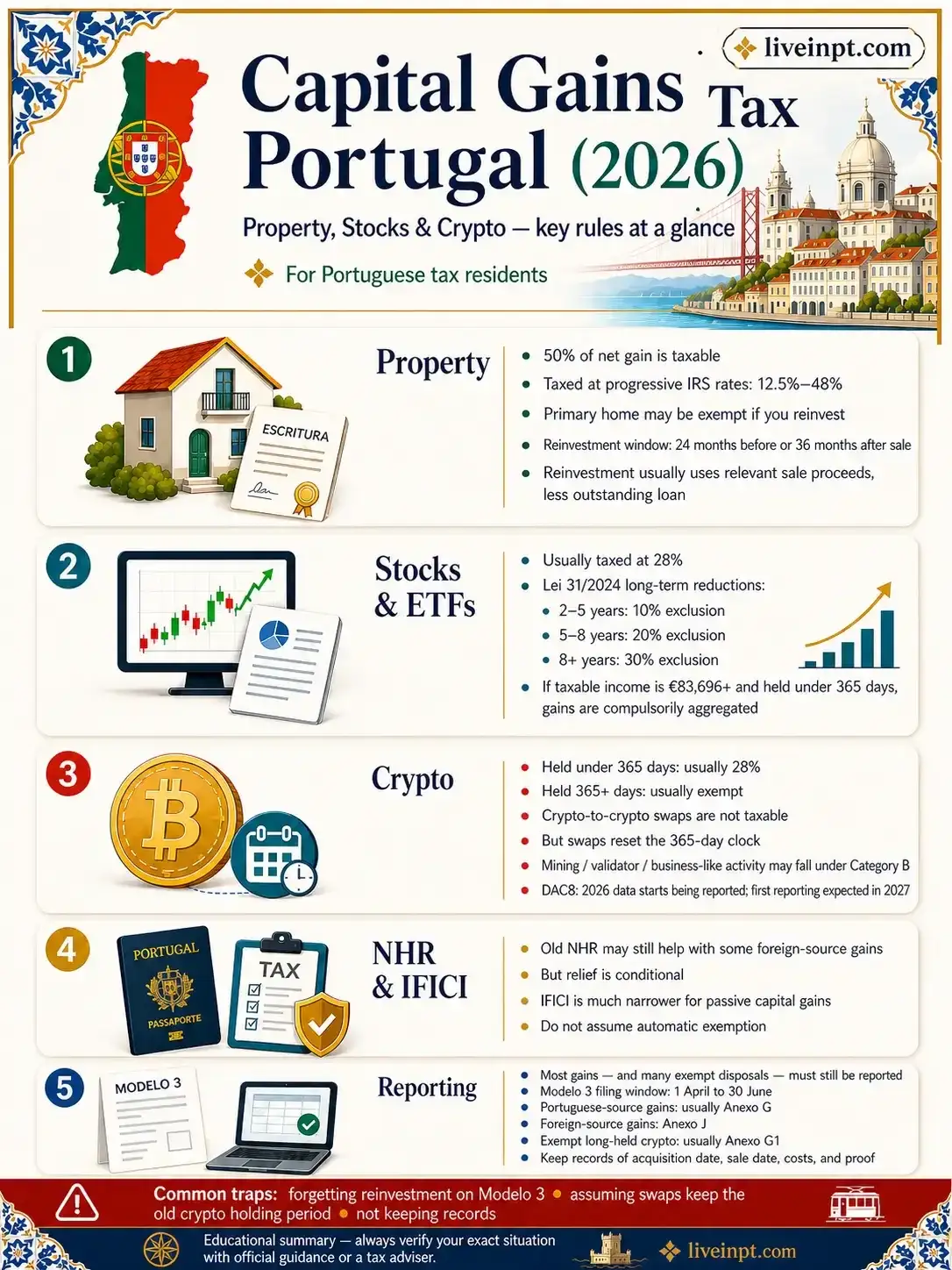
This guide covers capital gains tax for private individuals: private property sales, listed shares and ETFs, and crypto disposals, whether you file as a resident or non-resident. It doesn’t cover corporate capital gains under IRC, gains from crypto or trading treated as a business activity (Category B), or inheritance and gift tax, which run under separate rules entirely.
| Property gain (residents) | 50% of net gain taxed at progressive rates (12.5%–48%) |
| Stocks/ETFs (residents) | Flat 28%, or progressive rates if you elect englobamento |
| Qualifying crypto held 365+ days | Generally exempt; exceptions apply |
| Mandatory englobamento threshold for covered short-term securities gains (2026) | €86,634 taxable income, including the gains balance (Art. 72(14) CIRS) |
| Filing window | 1 April – 30 June, via Portal das Finanças (Modelo 3) |
| Primary legal basis | Article 10.º, Código do IRS |
How Portugal Taxes Capital Gains (Mais-Valias): The Basics
Mais-valias (capital gains) in Portugal are covered primarily by Article 10 of the Código do IRS (CIRS). Portugal taxes its tax residents on worldwide gains which means selling a flat in London, shares on the New York Stock Exchange, or Bitcoin on Coinbase while living in Lisbon all fall inside the Portuguese tax net.
What the system does not do is apply a single uniform rate. Property, financial assets, and crypto each sit in their own framework with their own rates, exemptions, and reporting paths.
Your NIF (número de identificação fiscal) is the anchor for all of this. If yours isn’t correctly registered with the Autoridade Tributária e Aduaneira (AT), nothing else works cleanly. If you still need to sort that, the guide to getting a NIF in Portugal covers the process.
Property Gains (Mais-Valias Imobiliárias)
The 50% Inclusion Rule
When a Portuguese tax resident sells property, only 50% of the net gain is brought into taxable income. That 50% is then added to other income and taxed at the progressive IRS rates which run from 12.5% to 48% for 2025/2026.
This means your effective rate on the gain itself is roughly half your marginal rate. If your marginal rate is 35%, the effective rate on a property gain is around 17.5%. If you’re in the 48% bracket, the effective rate is around 24%.
One thing that catches high-value sellers off guard: a large enough property gain can push total taxable income into the additional solidarity surcharge (taxa adicional de solidariedade, Article 68-A CIRS): 2.5% on the slice between €80,000 and €250,000, and 5% above €250,000, on top of the normal IRS due. AT applies it as part of the tax calculation; it is not an elective charge.
Capital Gains Tax for Non-Residents Selling Property in Portugal
Non-residents selling Portuguese property pay tax on the gain under the same 50% inclusion rule as residents, not a flat rate on the full amount. This wasn’t always the case, and the history explains why so many older guides still get it wrong.
Until 2023, non-residents were taxed at a flat 28% on 100% of the gain, while residents were taxed on only 50% of it. The European Court of Justice ruled this discriminatory against free movement of capital first in the Hollmann case (C-443/06), then again in the MK case (C-388/19) after Portugal’s first fix proved insufficient. The State Budget Law for 2023 finally aligned the two: non-residents now also have only 50% of the gain taxed, with the rate set using progressive-rate logic where worldwide income can be taken into account to determine which rate applies.
Worked example: a UK-resident couple bought an apartment in Lagos in 2018 for €200,000 and sell it in 2026 for €320,000, with €10,000 in deductible costs (agent commission, notary fees). The gross gain is €110,000. Only 50%, or €55,000, enters the Portuguese tax calculation. Portugal applies progressive-rate logic to set the applicable rate rather than a flat 28%, so the couple’s actual liability depends on their total income picture a Portuguese tax adviser can model this precisely, but it is not simply €55,000 × 28%.
The HPP-to-HPP reinvestment rules refer to the permanent residence of the taxpayer or their tax household. In binding information Processo 28272, issued in November 2025, AT accepted that a non-resident spouse could qualify where the sold property was—and the replacement property would become—the permanent residence of the qualifying spouse and dependants in Portugal, provided all other statutory conditions were met. This is a fact-specific ruling, so do not assume that non-resident status alone either grants or prevents the exclusion.
Calculating the Net Gain
The gain is not simply “what you sold for minus what you paid.” The Portuguese calculation gives you credit for:
| Deductible Item | Notes |
|---|---|
| Acquisition price (adjusted) | Multiplied by the coeficiente de desvalorização da moeda (inflation coefficient), published annually by AT for assets held 2+ years |
| IMT (Imposto Municipal sobre Transmissões Onerosas) paid at purchase | Property transfer tax you paid when buying |
| Imposto de Selo (stamp duty) on acquisition | |
| Notary and land registry fees at acquisition | Keep all receipts |
| Real estate agent commission | Usually 3–5% this reduces the gain directly |
| Documented improvement works (obras de melhoramento) | Must have receipts from certified contractors; only works done in the last 12 years count |
Most people under-deduct. If you spent €15,000 on a kitchen renovation three years before selling, that reduces your taxable gain but only if you kept the invoices.
Worked example (resident): you bought a flat in Coimbra in 2014 for €120,000 and sell it in 2026 for €210,000. You paid €4,800 in IMT and stamp duty at purchase, and spent €12,000 on a documented bathroom and kitchen renovation with proper invoices. Applying AT’s inflation coefficient for a 2014 acquisition to the €120,000 purchase price, then deducting the €4,800 in acquisition taxes and €12,000 in improvement costs, gives an adjusted acquisition value that’s meaningfully higher than the raw €120,000 you paid narrowing the taxable gain before the 50% inclusion rule is even applied. Skip the coefficient and the deductions, and you’d be declaring tax on money that was never really a gain, just inflation and your own renovation spend.
The Primary Residence Reinvestment Exemption
This is the exemption most owner-occupiers are eligible for, and many miss it entirely.
Under Article 10(5) of the Código do IRS: if you sell your habitação própria e permanente (HPP primary residence) and reinvest the relevant sale proceeds into another HPP in Portugal, the EU, or EEA the gain can be fully exempt. In practice, the reinvestment amount normally means the sale proceeds reduced by any outstanding loan linked to the property sold.
The reinvestment window runs from 24 months before the sale to 36 months after it. So if you’ve already bought your new home, you may already be partway through the window.
Two conditions catch people out. First, the property being sold must genuinely be your permanent residence a holiday home doesn’t qualify. Second, the exemption is not automatic. You must declare it on Modelo 3 (Anexo G). If you don’t declare the reinvestment, AT will assess the gain as if no exemption applies and send a bill.
For those aged 65 or older, or retired: there’s an alternative path. Instead of buying another property, you can reinvest into certified retirement savings products or life insurance contracts that meet specific criteria. The rules here are tighter and worth verifying with a tax adviser.
New for 2026: Reinvestment Exemption for Buy-to-Let Housing
Updated July 2026: this is a genuinely new exemption, introduced by Lei n.º 9-A/2026 of 6 March and Decreto-Lei n.º 97/2026 of 20 May, part of a wider housing tax package.
For qualifying residential-property sales from 1 January 2026 through 31 December 2029, reinvesting the relevant proceeds in residential rental property in Portugal can exclude all or part of the gain from IRS. The reinvestment must occur between 24 months before and 36 months after the sale. For 2026, the monthly rent cannot exceed €2,300.
The replacement property must generally be placed under a qualifying residential lease within six months of the reinvestment or sale, whichever is later. It must remain rented for at least 36 months, consecutive or interrupted, during the first five years and cannot be sold during that five-year period. A breach can bring the previously excluded gain back into tax, with compensatory interest.
This runs alongside the older HPP-to-HPP exemption rather than replacing it; they are separate routes with different conditions. Qualifying rental income under this housing regime is subject to a 10% autonomous IRS rate through 31 December 2029, unless a more favourable rate applies.
My honest advice, given how new this is: treat the published conditions as a starting point, not the full picture. Regulations this fresh tend to pick up clarifying guidance and edge-case rulings from AT in their first year, and the eligibility criteria for what counts as a qualifying rental property are still being worked through in practice. Confirm your specific situation with a tax professional before committing to a purchase on the strength of this exemption alone.
Law vs Reality: Property Gains
| What the official rules say | What happens in practice |
|---|---|
| Inflation coefficient adjusts acquisition price | AT publishes the coefficients, but most people don’t know to apply them meaning they over-declare their gain |
| Improvement works in last 12 years are deductible | AT requires proper invoices. A receipt from a handyman on Bissau paper gets rejected. Work must be from a registered contractor with an NIF |
| Reinvestment exemption covers full gain | You must declare it explicitly on Modelo 3. Omit it and AT assesses the gain in full |
| 36-month reinvestment window | Use the official sale date and check your CPCV/escritura dates carefully they can differ. The 24-month pre-purchase window is also often overlooked |
| New rental-property exemption allows reinvestment from 24 months before to 36 months after the sale | The property must generally be let within 6 months, remain rented for at least 36 months during the first 5 years, and not be sold during that period |
Stocks and ETFs (Ações e ETFs)
The Standard 28% Rate
Capital gains from selling listed shares, ETFs, bonds, and units in investment funds are taxed at a flat 28% rate for Portuguese tax residents. This is the taxa liberatória a final withholding-style rate that applies unless you elect otherwise.
The gain is calculated as sale proceeds minus acquisition cost, with brokerage commissions on both sides deductible. Portugal uses FIFO First In, First Out (Primeiro a Entrar, Primeiro a Sair). You can’t cherry-pick which lot you’re selling to optimise taxes. If you bought shares at five different prices over three years, the oldest shares are treated as sold first.
Holding Period Reductions Under Lei n.º 31/2024
Since June 28, 2024, long-term investors in listed securities benefit from progressive exclusions from the taxable gain:
| Holding Period | Exclusion | Effective Tax Rate on Gain |
|---|---|---|
| Under 2 years | None | 28% |
| 2 to 5 years | 10% | 25.2% |
| 5 to 8 years | 20% | 22.4% |
| 8 years or more | 30% | 19.6% |
These reductions apply automatically when you file at the flat 28% rate (taxa liberatória). Practically: if you bought shares in January 2016 and sold them in January 2026 (10 years), only 70% of the gain is taxable saving real money on a large gain.
There’s a complication for foreign securities. Abreu Advogados raised a concern that the AT’s 2024/2025 tax forms only allow the holding-period exclusion to be claimed in the domestic securities annex (Anexo G), not in Anexo J where foreign securities are reported. This creates a gap between what the statute says and what the filing system currently supports. If you’re holding long-term foreign positions, this issue is worth tracking and potentially worth challenging through your accountant.
Englobamento: When You Can (and Can’t) Choose
Portuguese residents can elect englobamento meaning you opt to add your investment income to your other taxable income and be taxed at progressive rates instead of the flat 28%. This makes sense if you’re in a low income bracket where progressive rates fall below 28%.
If you elect englobamento, it applies to all categories of investment income for that year: gains, dividends, and interest. You can’t apply it to just the gains and keep dividends at flat rate.
For covered securities held for less than 365 days, aggregation is mandatory when taxable income—including the net gains balance—reaches €86,634 in 2026, the lower limit of the final IRS bracket. The resulting income is taxed at progressive rates potentially reaching 48%, with the solidarity surcharge applying above its separate thresholds. Article 72(14) does not make employment, pension, or self-employment income alone the test.
Losses
Capital losses offset capital gains within the same category in the same year. Leftover losses carry forward for five years. You cannot use losses from shares to reduce a property gain the two categories are separate.
Crypto (Criptoativos)
The 365-Day Rule
Portugal’s crypto tax framework, introduced in 2023 via Lei n.º 24-D/2022, is simple in principle: hold for less than a year, pay 28% on gains; hold for 365 days or more, pay nothing.
This 365-day exemption applies to Category G gains profit from selling crypto for fiat currency. It’s one of the more generous regimes in Europe for long-term holders, and it’s the primary reason Portugal still attracts crypto investors despite closing NHR.
A few mechanics matter:
Crypto-to-crypto exchanges are not taxable. Swapping Bitcoin for Ethereum is not a taxable event under Portuguese law confirmed by AT. You pay no tax on the swap itself. But the clock resets. The ETH you receive starts a new 365-day holding period from the date of the swap. This catches a lot of people out: they swap, hold a few months, sell, and assume long-term exemption applies. It doesn’t.
The 28% rate is on the gain, not the full sale amount. If you bought 1 ETH for €2,000 and sold it for €3,500 after 200 days, you pay 28% on €1,500 not on €3,500.
High earners and englobamento. The mandatory aggregation rule in Article 72(14) is written for specified securities gains, not crypto disposals. Short-term Category G crypto gains are generally taxed at 28%, although different treatment can apply when the activity is business-like or another statutory exception applies.
Reporting still matters even when the gain is exempt. Short-term crypto gains usually go in Anexo G or Anexo J, depending on whether the platform/source is Portuguese or foreign. Long-held crypto disposals that are exempt after 365 days are usually reported in Anexo G1. The key point is simple: “tax-free” does not always mean “do not report.”
Staking, Mining, and Other Crypto Income
Crypto income is not always Category G. The label your exchange uses “staking,” “rewards,” “yield,” or “interest” does not automatically decide the Portuguese tax category.
Mining, validator activity, regular trading activity, and business-like crypto operations may fall under Category B (income from self-employment and business activities rendimentos empresariais e profissionais). That can mean progressive rates, specific coefficients, and sometimes Segurança Social exposure.
Passive crypto-related returns, such as lending or yield-style income, may be treated differently, including as Category E (rendimentos de capitais investment income), depending on the structure.
The specific category determines which Anexo you file, so getting this wrong produces errors in your return. This is one area where you should not guess from an exchange label alone.
DAC8: The Compliance Shift You Need to Know About
From 1 January 2026, the EU’s DAC8 directive requires crypto-asset service providers operating in or serving EU residents including many platforms headquartered outside the EU to start collecting and reporting transaction data to tax authorities. The first reporting for 2026 data is expected in 2027, so this is not an instant “same-day” feed, but it is a major compliance shift.
If you’ve been treating offshore exchange holdings as invisible to Portuguese tax authorities, that assumption is becoming much weaker. Exchanges like Coinbase, Binance, and Kraken are the type of platforms these rules are designed to cover. Portuguese residents with undeclared crypto gains from previous years should factor this into any disclosure decisions they make.
What NHR and IFICI Mean for Capital Gains
If you registered under the old NHR (Non-Habitual Resident) regime before it closed in December 2024, some foreign-source capital gains may still benefit from exemption for the remaining years of your 10-year period. But this is not automatic. The result depends on the asset, the source country, and whether the income could be taxed in the source country under an applicable double tax treaty.
The new IFICI regime (Incentivo Fiscal à Investigação Científica e Inovação), established by Article 58-A of the Estatuto dos Benefícios Fiscais, is built around qualifying professional roles in research, technology, innovation, and certain eligible businesses. For eligible taxpayers, Article 81(4) of the Código do IRS applies the exemption method to foreign-source income in Categories A, B, E, F, and G, including qualifying capital gains. Those exempt amounts are still aggregated to determine the rate applied to other taxable income. Income connected to a listed low-tax jurisdiction is instead subject to the special 35% rules, so confirm the source and asset classification before relying on the exemption. The guide to what replaced NHR in Portugal covers the eligibility rules and broader differences.
Foreign-Source Gains and Double Taxation
Portugal taxes its residents on worldwide income. Selling a buy-to-let in Manchester, shares in a US brokerage, or property in France while Portuguese-resident all land in your Portuguese tax return.
The good news: Portugal has an extensive network of double tax treaties (tratados para evitar a dupla tributação). Where a treaty exists, tax paid in the source country can usually be credited against your Portuguese liability. You won’t pay twice on the same gain but you do need to declare it correctly.
Foreign gains go in Anexo J of your Modelo 3. You’ll need the sale amount in euros (using the ECB exchange rate on the date of transaction), the acquisition cost, and documentation of any tax withheld at source. The guide to UK and US tax treaties with Portugal covers how treaty credits work in practice, primarily for pensions and investment income.
If there is no treaty and some jurisdictions don’t have one Portugal applies its domestic rates in full with no credit.
How to Report: Modelo 3, Anexo G and Anexo J
Most capital gains and many exempt disposals must be reported in your annual IRS return (Declaração de IRS Modelo 3). The return covers the previous calendar year and must be submitted between April 1 and June 30 through Portal das Finanças. Our Portal das Finanças guide explains the login and basic navigation. The correct annex depends on the asset, source country, and whether the gain is taxable or exempt.
| Gain Type | Annex | Key Fields |
|---|---|---|
| Portuguese property | Anexo G, Quadro 4 | Acquisition/sale dates, amounts, deductible costs, reinvestment declaration |
| Portuguese shares and ETFs | Anexo G, Quadro 9 | Trade-by-trade entries, FIFO lot matching |
| Crypto under 365 days (Category G) | Anexo G or Anexo J | Transaction dates, amounts in EUR, acquisition cost, source/platform location |
| Crypto held 365+ days and exempt | Usually Anexo G1 | Reportable exempt disposal; keep records proving the holding period |
| Foreign shares/ETFs/property | Anexo J | Source country, gross gain, tax withheld |
| Crypto staking/mining (Category B) | Anexo B | Declared as business income |
Portugal’s AT does not automatically import data from brokers or exchanges. Every trade goes in manually or using a third-party tax tool that generates the Modelo 3 import file. If you’re using Interactive Brokers, DEGIRO, eToro, or a crypto platform, exporting a full transaction history before you sit down to file is not optional.
For anyone new to filing Portuguese taxes, the IRS Portugal guide for foreigners explains the Modelo 3 system from the start, including how to access the filing portal and what each annex covers.
Common Mistakes
Mistake: Not applying the coeficiente de desvalorização to property acquisition costs
The inflation adjustment coefficient is published by AT each year for properties held longer than 24 months, in a portaria specific to the year of sale (2025 disposals used Portaria n.º 382/2025/1; 2026 disposals will use a separate portaria published later in the year check the current one against your acquisition year rather than reusing a figure from an older guide). Many people and even some accountants not specialised in Portuguese tax file the original acquisition price without applying it. For an older property, the coefficient can meaningfully reduce your declared gain. Not applying it inflates your declared gain and your tax bill.
Mistake: Assuming the new buy-to-let exemption replaces the old HPP exemption
Since Lei n.º 9-A/2026 introduced the reinvestment-into-rental exemption, some sellers assume it’s a straight swap for the older primary-residence exemption, or that they can pick whichever is more convenient after the fact. In practice these are two distinct routes with different conditions (primary-residence-to-primary-residence versus reinvestment into a moderate-rent rental), and you need to identify which one applies before the sale, not after Modelo 3 is due.
Mistake: Treating crypto-to-crypto swaps as neutral events for the 365-day clock
People know swaps aren’t taxable events. They file accordingly no tax due. What they miss is that the swap resets the holding period on the new coin. Someone who held BTC for three years, swapped to ETH, then sold ETH four months later has a short-term gain not an exempt long-term one. The BTC holding period does not transfer to ETH.
Mistake: Not declaring the reinvestment exemption on Modelo 3
You sold your main home, bought another. The gain should be exempt. But you didn’t declare the reinvestment in Anexo G. AT sees a gain and raises an assessment. The burden is on you to claim the exemption it’s not automatic. This generates avoidable letters, delays, and reclamação (appeal) procedures that can take months.
Mistake: Assuming Lei n.º 31/2024 holding-period reductions apply to foreign shares in Anexo J
The statute doesn’t distinguish between Portuguese and foreign listed securities. But in practice, the AT’s filing system only gives you the mechanism to claim the holding-period exclusion in Anexo G (domestic). If you’re claiming it for shares held in foreign brokers and filed in Anexo J, AT may assess the full gain. This is an emerging dispute well worth raising with a tax professional rather than assuming the exclusion will be accepted silently.
Mistake: Not keeping crypto transaction records for 10 years
AT’s audit window in Portugal runs up to 10 years in cases of fraud or concealment. Even with the exemption on long-term crypto gains, you need records of every acquisition date, cost, and disposal to prove the holding period. “I held it more than a year” is not a position AT will accept without documentation. Records from exchanges that have since closed down are the taxpayer’s problem to recover.
Real Scenarios
The UK property seller who under-declared
A British couple living in Cascais sold a buy-to-let in Leeds for a significant gain in 2024. They knew Portugal taxes worldwide income. What they hadn’t accounted for: the UK already taxed the gain through UK capital gains tax, and they believed the double tax treaty meant no further Portuguese liability. It doesn’t work that way automatically. The gain had to go in Anexo J; the UK tax paid was creditable but had to be formally declared with supporting documentation. They filed without Anexo J entirely and received a liquidação adicional (additional assessment) the following year. The fix required an amended return and documentation from HMRC. Straightforward once addressed but avoidable.
A US home sale shortly after Portuguese residency begins
Consider someone who becomes Portuguese tax-resident and sells their former US home a few weeks later. Paying US federal or state capital gains tax does not remove the Portuguese reporting obligation. The gain may also need to be declared in Portugal on Anexo J, with eligible foreign tax claimed through the applicable double-tax relief rules. The residency start date therefore matters as much as the sale date. If a property sale straddles your move, have the timing and treaty treatment checked before filing.
The retiree who almost missed the reinvestment exemption
A retired Irish couple sold their HPP in the Algarve in October 2024, planning to move to Spain. They’d lived there as their main residence for seven years. The gain was around €200,000. Their accountant correctly identified the reinvestment exemption but the couple wanted to rent temporarily in Spain for 18 months before buying. That’s fine: the 36-month post-sale window accommodates it. They declared the intended reinvestment on their 2024 Modelo 3, and when they purchased in Spain in early 2026, they submitted the proof to AT. Exemption confirmed. The critical piece: declaring the intention on the original return, not waiting until the new purchase was complete.
Pro Tips
Check the AT coeficiente de desvalorização table before doing any property gain calculation. AT publishes updated coefficients for each year of acquisition, usually in April. The portaria (ministerial order) is the official document. Applying the correct coefficient to your purchase year’s price can materially reduce your declared gain or even eliminate it for older properties.
If you’re approaching 365 days on a crypto position, don’t sell early. The rate difference is 28% vs 0%. Even a few extra days matter. Set a calendar reminder for the exact date of acquisition (or the date of the most recent crypto-to-crypto swap if applicable) and plan sales accordingly.
Collect building receipts as you go, not at point of sale. Improvement work deductions for property gains require invoices from registered contractors with their NIF on the document. The time to get those is during the works, not five years later when you decide to sell. AT has been consistent in rejecting informal receipts.
If covered short-term securities gains could bring your 2026 taxable income to €86,634, the timing of sales matters. Article 72(14) tests taxable income including the net gains balance. Spreading disposals across two tax years may change whether mandatory aggregation applies, but the wider tax consequences should be modelled before trading.
Keep a dedicated log for each crypto acquisition. AT doesn’t accept “approximately this date” for the 365-day calculation. Your exchange history needs to show acquisition date, amount, price in EUR on that date, and disposal date and amount. Some platforms auto-generate this; others require you to reconstruct it manually from transaction exports. Don’t leave this for filing season.
The most important practical point across all three asset types: most gains and many exempt disposals still need to be reported even when no tax is owed. Portugal’s AT is increasingly connected to international data sources DAC8 for crypto, CRS for financial accounts, and treaty exchange agreements for property. The question isn’t whether your gain is visible to AT; it’s whether your return accurately reflects it.
Start with the asset you’re planning to sell next, understand which Anexo it belongs in, and build your records now. If you haven’t filed Portuguese taxes before, the IRS Portugal guide is a practical starting point before you sit down with Modelo 3 for the first time. For anything complex foreign property, staking income at scale, or gains near the englobamento threshold a Portuguese tax professional who handles these cases regularly is worth the fee.