

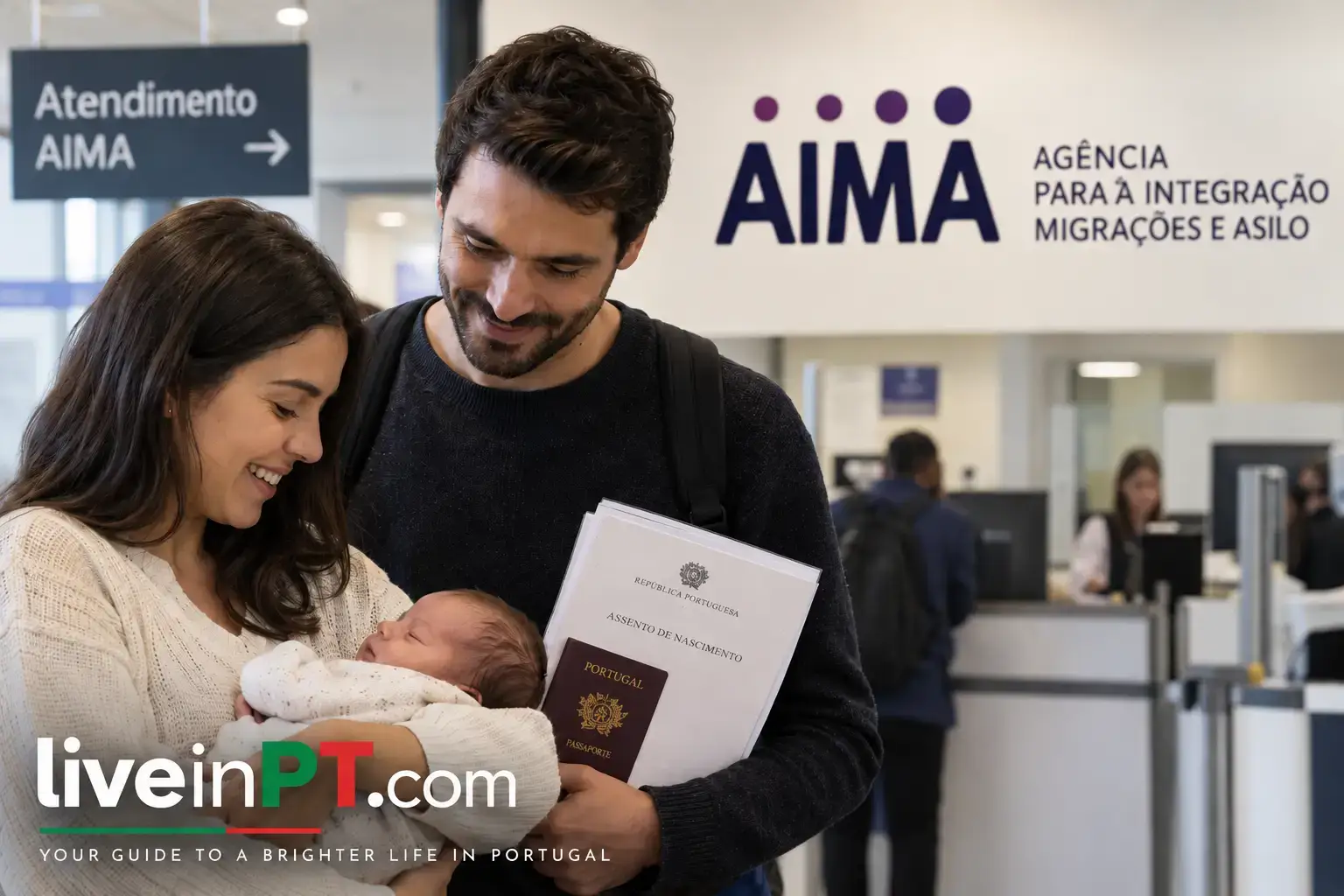
If your baby was born in Portugal and at least one parent holds a Portuguese residence permit, there is now a specific AIMA route for the child’s residence. It is based on Article 124 of Lei n.º 23/2007, and AIMA created a dedicated Contact Form option for it on 18 May 2026.
The deadline is the part not to lose sight of. A parent should present the request within six months after the child’s birth registration. The clock does not simply start on the day the baby was born.
Direct answer: use the AIMA Contact Form and select
Autorização de Residência→Pedido agendamento Bebés/menores estrangeiros nascidos Portugal – Art. 124. Fill the form with the child’s details and upload the Portuguese birth record, one resident parent’s passport and valid residence title, plus the other parent’s residence title when applicable.
This guide is for a foreign child born in Portugal to a parent in Portugal’s residence-permit system. Article 124 is about residence. It does not itself grant Portuguese nationality, and it is not the normal family-reunification route for a child arriving from abroad.
AIMA Article 124 at a glance
| Question | Current position |
|---|---|
| Who it covers | Foreign minor born in Portugal with a legally resident parent |
| What Article 124 gives | Resident status identical to that granted to either parent |
| Deadline | 6 months after the child’s birth registration |
| First step | Dedicated AIMA Contact Form appointment request |
| Exact subtype | Pedido agendamento Bebés/menores estrangeiros nascidos Portugal – Art. 124 |
| Details entered in the form | The child/minor’s details |
| Baby passport needed to request the appointment | Not listed by AIMA |
| Baby NIF or NISS needed to request the appointment | Not listed by AIMA |
| Detailed residence procedure | AIMA places it under Article 122(1)(a) |
| Published Article 124 response time | None |
| If 6 months have passed | Article 124(3) provides a curador de menores route |
Who Article 124 applies to
Article 124(1) says that foreign minors born in Portuguese territory benefit from resident status identical to that granted to either of their parents.
AIMA’s dedicated May 2026 procedure is aimed at babies or foreign minors born in Portugal whose parent is a foreign citizen holding a residence permit. In a straightforward case, that means:
- the child was born in Portugal;
- the child is using the foreign-minor residence route; and
- at least one parent holds a Portuguese residence permit.
AIMA asks for the passport and valid residence title of one parent who holds a residence permit, then the other parent’s residence title when applicable. The route is therefore not written as requiring both parents to hold Portuguese permits.
If both parents have different residence statuses, take both cards to the appointment. The law says the child benefits from status identical to that granted to either parent, but AIMA does not publish a separate online rule explaining how every mixed-status family is handled.
Do not use this workflow simply because a child is living in Portugal. A child born outside Portugal, or a child using EU/EEA/Swiss free-movement rights, can fall under a different legal route.
The six-month deadline starts from birth registration
Article 124(2) says a parent should present the request in the six months following the child’s birth registration. AIMA repeats the same wording in its May 2026 instructions.
So if a baby is born on 3 June but the Portuguese birth is registered on 10 June, the six-month period runs from 10 June.
The date I would put in the calendar is the registration date shown by the Portuguese civil record. Keep the assento de nascimento, the AIMA submission confirmation and every uploaded file together from the start.
Do not treat six months as a suggested waiting period. It is the outer legal window. The safer approach is to submit the dedicated AIMA request as soon as the listed booking documents are ready.
AIMA describes the new digital step as a pedido de agendamento, an appointment request. That is important because the Contact Form does not mean the residence card has already been applied for and approved. It gets the child into the correct appointment route.
For a time-sensitive case, keep evidence of when you used that official channel. Save the on-screen confirmation, confirmation email if one arrives, screenshots showing the selected subtype and copies of the attachments.
How to request the Article 124 residence permit
Step 1: Get the Portuguese birth record
AIMA requires the child’s assento de nascimento issued by the competent Portuguese authority.
This is the document you use for the booking request. Check the child’s name, both parents’ names and the dates against the passports and residence cards before uploading it. A spelling or identity mismatch is much easier to investigate before the AIMA appointment than at the counter.
Step 2: Use the dedicated AIMA Contact Form route
Open the official AIMA Contact Form and choose:
- Tipo de Assunto:
Autorização de Residência - Subtipo de Assunto:
Pedido agendamento Bebés/menores estrangeiros nascidos Portugal – Art. 124
Then enter the child’s information in the applicant fields.
The parent is physically making the request, but AIMA expressly says the form fields should contain the baby’s or minor’s data because the child is the holder of the right.
This is not a small formality. AIMA warns that forms submitted outside the dedicated subject, or without the required documents, will be automatically disregarded.
If you need help with AIMA’s wider booking channels, see the AIMA appointment guide. For a qualifying Portugal-born child, however, use the specific Article 124 subtype rather than a generic residence or family request.
Step 3: Upload the booking documents
AIMA lists the following for each baby or minor:
- the Portuguese
assento de nascimento; - a scanned passport copy of one parent who holds a residence permit;
- that parent’s valid residence title; and
- the other parent’s residence title, when applicable.
That is the dedicated booking-stage checklist.
Notice what is not on it: AIMA does not list the baby’s passport, NIF or NISS as mandatory attachments for requesting the Article 124 appointment.
This answers one of the most important sequencing questions. You do not need to hold up the six-month AIMA step while waiting for a consulate, a NIF request or a NISS request.
Start the baby’s passport or consular identity process in parallel because identity documentation is relevant at the later residence stage. The child’s NIF and NISS can also be handled separately if needed for other Portuguese systems.
I would not let a slow consular appointment consume a legal deadline that AIMA’s own booking checklist lets you protect now.
Step 4: Save proof of exactly what you submitted
Keep more than the email subject line. Save:
- the submission date;
- screenshots of both AIMA dropdown selections;
- the child’s details entered in the form;
- every uploaded document;
- the on-screen confirmation; and
- any email or reference AIMA sends afterward.
If the appointment does not arrive quickly, that file becomes your evidence that the Article 124 route was used within the six-month window.
Article 124 vs Article 122(1)(a)
The two article numbers can make the process look more complicated than it is.
Article 124 is the special rule for foreign minors born in Portugal. It gives the child the corresponding resident status and sets the six-month deadline.
Article 122(1)(a) says that a minor born in Portugal to a foreign citizen who holds a residence permit can obtain a temporary residence permit without first holding a residence visa.
That is why AIMA uses Article 124 for the new appointment request but files its detailed child-residence page under Article 122(1)(a). They are not rival applications. They work together.
This is also why a qualifying newborn should not automatically be pushed into the ordinary family-reunification process. The child was born in Portugal and the law provides a specific no-prior-residence-visa route.
What to prepare for the AIMA appointment
The four booking attachments should not be confused with the complete file you may need when AIMA actually receives the residence application.
AIMA’s current Article 122(1)(a) page lists:
- valid passport;
- a declaration, under honour, of the residential address and the legal basis for living there;
- supporting housing evidence depending on whether the home is owned, rented or otherwise occupied;
- proof of means of subsistence;
- the child’s birth certificate;
- consular registration with a photograph or a valid passport;
- Modelo 1, which AIMA marks as mandatory; and
- Modelo 4, where applicable.
Follow the appointment notice first if it gives a more specific or updated checklist. Take originals where possible and organise the parent’s residence documents, the child’s identity documents and the family-link evidence so they are easy to check.
There is an official document-list mismatch
This is one detail worth understanding before the appointment.
Article 61(1) of Decreto Regulamentar n.º 84/2007 contains the general document elements for Article 122 residence applications, including identity, accommodation and means of subsistence.
But Article 61(2) creates a specific rule for Article 122(1)(a). It says this child application is supported by information proving the family link, under Article 42-T, with dispensation from the documents in Article 61(1).
AIMA’s public Article 122(1)(a) page nevertheless continues to show passport, address and means-of-subsistence documents.
That difference is real, but I would not arrive at AIMA with a deliberately thin file just to test it. If the documents on AIMA’s current page are reasonably available, take them. The regulation is useful context if questions arise, but the practical goal is to get the child’s residence processed, not win an argument over which checklist should have been shorter.
After you submit: appointment, waiting time and card
AIMA does not publish a specific response-time guarantee for the Article 124 Contact Form request.
A correct submission can therefore sit without an immediate appointment date. Do not turn a timeline reported online into an official AIMA deadline.
If you need to follow up, AIMA’s current general contacts are:
- Contact Center: (+351) 217 115 000
- Hours: Monday to Friday, 08:00 to 20:00
- Email:
geral@aima.gov.pt
Use the child’s full name, date of birth, birth-registration date and original Article 124 submission date. Refer back to the first request rather than sending an unexplained duplicate every few days.
Once AIMA holds the appointment and registers the actual residence process, keep the comprovativo, process number or other receipt it gives you. You can then try the newer route in our AIMA residence process tracker guide.
The tracker should not be confused with the earlier Contact Form appointment request. It is most useful once an actual residence process exists.
If the case is approved but the card itself does not arrive, the problem has moved to production or delivery. Use the AIMA card and CTT tracking guide instead of opening another newborn appointment request.
Fee
AIMA’s Article 122(1)(a) page links to its general fee table rather than publishing one single Article 124 baby-residence total.
AIMA updated the applicable table from 1 March 2026. Because the procedure page itself does not state one clean newborn total, I would not turn a general table row into false precision. Check the current AIMA table and the payment instructions tied to the child’s appointment or residence process.
Problems that need extra care
The resident parent’s card is expired or renewal is pending
AIMA’s May 2026 Article 124 checklist expressly asks for a valid residence title from the qualifying parent.
The same page does not publish a newborn-specific workaround for a parent whose physical card has expired while a renewal is pending. If that is your situation, do not assume an expired card automatically satisfies the wording. Contact AIMA, keep the parent’s renewal evidence, and keep a dated record of every attempt to protect the child’s six-month deadline.
Only one parent has a Portuguese residence permit
AIMA asks for the qualifying parent’s passport and valid residence title, with the other parent’s residence title when applicable. The dedicated route is therefore compatible with a case where one parent is the Portuguese residence-permit holder.
If the other parent’s circumstances create questions around identity or parental responsibility, take the relevant supporting documents to the appointment rather than trying to force the case into a standard two-resident-parent checklist.
The parents hold different residence permits
Article 124 says the child’s resident status is identical to that granted to either parent. AIMA does not publish a detailed online selection rule for every combination of parental permits.
Use the qualifying parent’s documents in the booking request and take both residence cards to the appointment if both parents hold them. Let AIMA record the child’s status against the actual family file rather than guessing which expiry or category the physical card will carry.
The six months have already passed
Missing six months does not make Article 124 disappear.
Article 124(3) says that after the deadline any citizen may ask the curador de menores to substitute for the parents and request the child’s resident status.
What changes is the procedure. AIMA does not publish a simple “late Article 124” Contact Form equivalent to the standard newborn route.
If you are already outside the six months, do not hide that fact in a normal submission. Ask AIMA for case-specific direction on the curador de menores step or obtain qualified Portuguese immigration/legal assistance if needed.
You need to travel before the baby’s card arrives
The Article 124 Contact Form confirmation and Portuguese birth record are not travel documents.
Travel depends on the child’s own passport or recognised travel document and the rules that apply to the child’s nationality, destination and re-entry into Portugal. A parent’s residence card does not become the baby’s border document simply because the child has an Article 124 residence route.
If travel is unavoidable, verify the child’s exact document and re-entry position before leaving Portugal. Do not plan on an AIMA submission screenshot solving the issue at the airport.
Common Article 124 mistakes
Using the parent’s details in the AIMA applicant fields
The parent submits the request, but AIMA says the form fields should contain the child’s details.
Using generic family reunification
AIMA created a dedicated subtype for foreign babies and minors born in Portugal. Using a different family route can put the request outside the procedure AIMA told parents to use.
Waiting for the baby’s passport, NIF or NISS before submitting
None of those is listed among the mandatory Article 124 booking attachments. The passport should be progressed for the later residence stage, but it does not need to hold up the initial request.
Counting six months from the birth date
The law and AIMA use the birth-registration date.
Treating the four booking uploads as the complete appointment file
The dedicated Contact Form checklist gets the appointment request into the right channel. AIMA’s detailed Article 122(1)(a) page publishes a broader residence file. Prepare for both stages.
Assuming Article 122 and Article 124 are different choices
Article 124 provides the child’s status and deadline. Article 122(1)(a) provides the residence-without-prior-visa route used to issue the permit.
Frequently asked questions
Can I submit Article 124 as soon as the birth is registered?
Yes. Once the Portuguese birth record and AIMA’s listed parental documents are ready, there is no published waiting period you need to serve before requesting the appointment. The six months are a deadline, not a reason to wait.
Does the baby need a residence visa first?
No. Article 122(1)(a) specifically covers minors born in Portugal to residence-permit holders among the categories that can obtain temporary residence without a prior residence visa.
Is the Article 124 Contact Form the actual residence application?
AIMA describes the new form as a request for an appointment to obtain residence under Article 124. It starts the correct procedure, but it does not mean the residence card has already been granted.
Can AIMA ignore an Article 124 form that was submitted successfully?
Yes, in the sense that AIMA expressly warns that submissions made outside the dedicated subject, or without the required documentation, are automatically disregarded. A successful technical submission is therefore not enough if the route or file was wrong.
What if my baby’s passport appointment is after the six-month deadline?
Submit the Article 124 booking request first. AIMA does not require the baby’s passport for that dedicated booking stage. Continue the passport process in parallel so the identity document is ready for the later residence procedure.
Does the baby need proof of accommodation and means of subsistence?
AIMA’s current Article 122(1)(a) page lists both for the residence procedure. Article 61(2) of the implementing regulation says this specific child route is dispensed from the general Article 61(1) document set. Because AIMA still publishes the broader checklist, prepare those documents for the appointment where reasonably possible.
Can I track the Contact Form request through AIMA’s process tracker?
Do not assume so. The Article 124 Contact Form starts as an appointment request. AIMA’s process-tracking route is more relevant once an actual residence process has been created and is associated with the child’s application details or email.
Does the child’s residence card expire on the same date as the parent’s?
Article 124 says the child benefits from resident status identical to that granted to either parent. AIMA’s Article 124 notice does not separately guarantee an identical printed expiry date on the physical card. Use the dates on the child’s issued residence title for later renewal planning.
What if I used the wrong AIMA subtype?
AIMA says out-of-scope Article 124 submissions can be automatically disregarded. Correct the route promptly using the dedicated subtype and keep evidence of the original and corrected attempts, especially if the six-month deadline is close.