

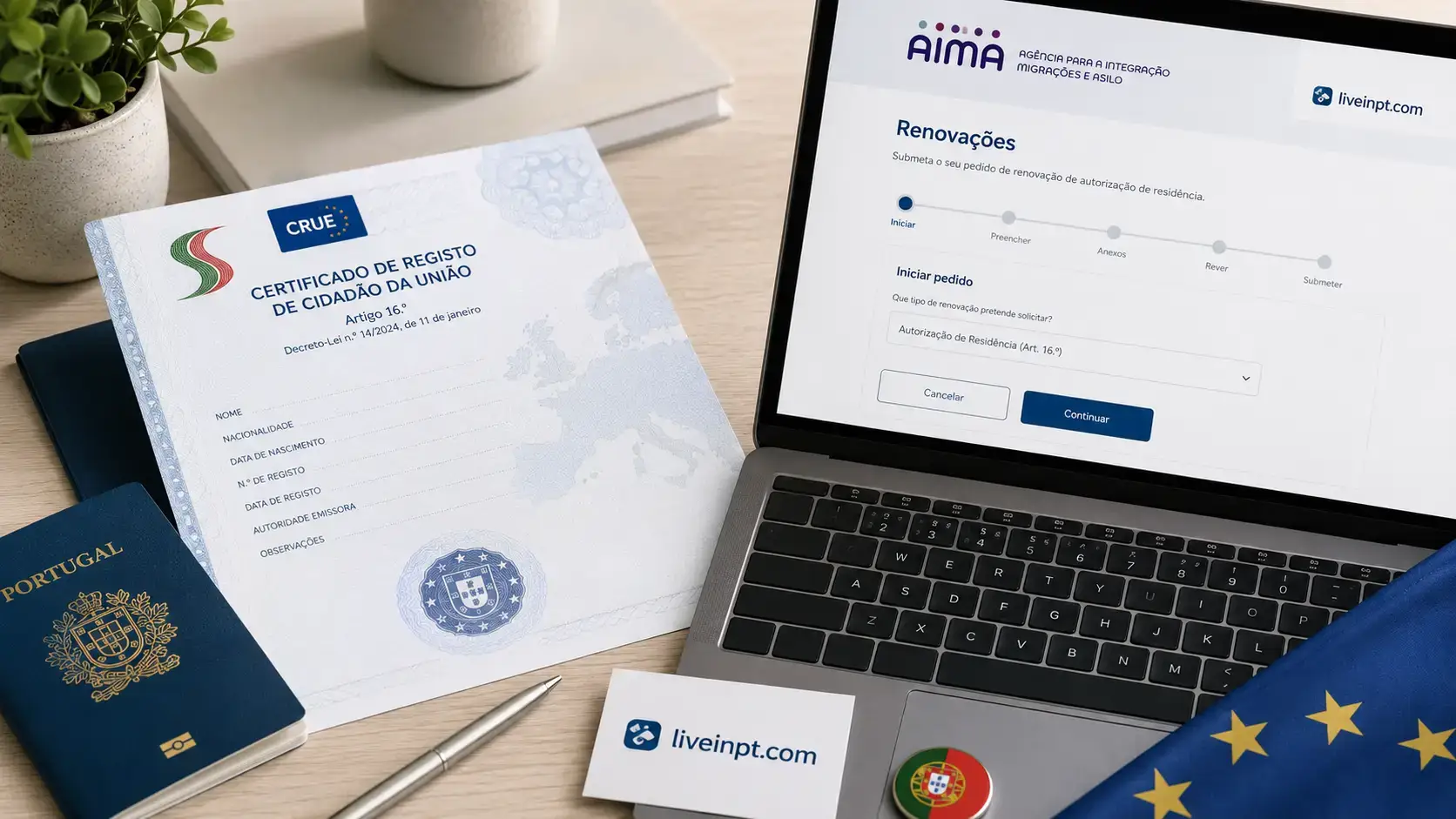
If your CRUE is reaching five years, the next step is usually not another ordinary CRUE renewal.
After five consecutive years of legal residence in Portugal, an EU citizen acquires the right of permanent residence under Article 10 of Lei n.º 37/2006. The document that proves it is the Certificado de Residência Permanente under Article 16.
Since 1 July 2026, AIMA handles new Article 16 requests through the Portal de Renovações.
Quick answer: Câmara Municipal handles your first CRUE. At five years, the standard route moves to AIMA for Article 16 permanent residence. AIMA currently asks for proof of five consecutive years of legal residence, valid ID or passport, your CRUE, and proof of a changed address where relevant.
This guide is for the EU citizen. If you are the non-EU family member of an EU citizen, your five-year permanent document is Article 17, covered in the Article 15 AIMA guide.
Permanent residence card or certificate?
People often search for an EU permanent residence card in Portugal, but AIMA’s official name for the EU citizen’s document is:
Certificado de Residência Permanente para Nacionais UE
That is the Article 16 certificate.
The wording matters because AIMA also issues a Cartão de Residência Permanente under Article 17 to qualifying non-EU family members of EU citizens. They are parallel five-year routes, but they are not the same document.
If you are an EU citizen and an AIMA form is steering you toward a third-country-national residence card, stop and check the route before submitting.
CRUE after five years is not a normal renewal
The CRUE — Certificado de Registo de Cidadão da União Europeia — is issued by the Câmara Municipal when an EU citizen stays in Portugal for more than three months.
Under Article 14 of Lei n.º 37/2006, that registration certificate is normally valid for five years from issue, or for a shorter planned residence period where applicable.
At five qualifying years, the legal position changes:
CRUE / Article 14 registration → Article 16 permanent residence
That is why searching only for “renew CRUE Portugal” can be misleading. If you have completed five consecutive years of legal residence, the real question is whether you should now apply to AIMA for the permanent certificate.
AIMA applies this framework to EU citizens and also lists Iceland, Liechtenstein, Norway, Andorra and Switzerland within the service.
Who qualifies for Article 16 permanent residence?
For the standard route, the central test is simple:
five consecutive years of legal residence in Portugal.
Lei n.º 37/2006 also protects continuity during certain absences. The five-year period is not broken by:
- temporary absences of up to six consecutive months per year;
- longer absences for compulsory military service; or
- one absence of up to 12 consecutive months for an important reason such as pregnancy, childbirth, serious illness, study, vocational training or a professional posting.
Continuity can be proved by any admissible evidence.
There are limited Article 11 exceptions that allow some workers or self-employed people to acquire permanent residence before five years. Most readers will be on the ordinary five-year route.
Article 16 vs Article 17 vs Article 80 vs Article 125
Portugal has several statuses that sound almost identical in English.
| Your situation | Correct route | Main law |
|---|---|---|
| EU/EEA/Swiss-framework citizen after 5 years | Article 16 permanent residence certificate | Lei n.º 37/2006 |
| Non-EU family member of an EU citizen after 5 years | Article 17 permanent residence card | Lei n.º 37/2006 |
| Third-country national seeking Portuguese permanent residence | Article 80 permanent residence | Lei n.º 23/2007 |
| Eligible third-country national seeking EU long-term resident status | Article 125 ERLD / Longa Duração | Lei n.º 23/2007 |
If you are an EU citizen, do not copy the Article 80 checklist because both pages say “permanent residence.” Article 80 is a different legal regime.
The same applies to Article 125 EU long-term residence. Despite the name, Article 125 is a third-country-national status.
For ordinary third-country-national permanent residence, use the Article 80 guide.
Documents AIMA currently asks for
AIMA’s Article 16 checklist is short:
- proof that you have lived legally in Portugal for five consecutive years;
- valid identity card, Cartão de Cidadão where applicable, or passport;
- your CRUE; and
- if your address changed, proof of the new address.
For a changed address, AIMA gives examples including a Junta de Freguesia certificate, property deed or rental contract.
What AIMA does not list for the standard Article 16 request is just as useful:
- no A2 Portuguese certificate;
- no standard means-of-subsistence package;
- no Finanças no-debt certificate; and
- no Segurança Social no-debt certificate.
Those requirements belong to other residence routes and are a common source of over-preparing the wrong file.
How to apply through the AIMA Renewals Portal
For a new application, the current route is the Portal de Renovações.
The process is:
- Enter the residence-document details requested by the portal.
- Select the permanent-residence route for the EU citizen.
- Submit the documents requested for Article 16.
- Pay the amount generated by AIMA.
- Save the submission and payment evidence.
- Wait for AIMA’s decision or a biometrics notice.
If fresh biometric data is needed, AIMA schedules the appointment and tells you the date, time and location. You do not need to secure a separate biometrics appointment before starting.
Requests already submitted through AIMA’s old Contact Form by 30 June 2026 remain valid. Previously scheduled appointments also remain valid.
For the wider system, see the AIMA Online Portal guide.
Portal asks for a Título de Residência or rejects your CRUE number
This is the part I would prepare for before opening the portal.
Recent EU-citizen reports in July and August 2026 describe three recurring failures:
- the portal does not recognise the CRUE details;
- registration asks for a Título de Residência number that the person’s CRUE does not appear to provide in the expected format; or
- the permanent-residence route produces a generic error even though the person has already passed five years.
One of the freshest reports, from 27 August 2026, describes an expired CRUE being rejected while the portal asks for a residence-title number the applicant cannot identify on the certificate.
AIMA has not published a CRUE-specific number-format workaround for that problem.
Do not use the leading-zero trick on a normal CRUE
AIMA did publish one number workaround on 13 August 2026, but it is narrower than many people assume.
It applies only to older paper residence cards. If one of those card numbers starts with a zero, AIMA says to omit the first zero:
011641 → 11641
AIMA explicitly says that rule is exclusive to paper residence cards.
So if your ordinary Câmara-issued CRUE is rejected, I would not remove digits, add letters or invent a Título de Residência number just to get past the validation screen.
Save a screenshot of the error and use AIMA’s official contact channel.
For a covered paper residence card that still fails after removing the leading zero, AIMA tells the holder to email geral@aima.gov.pt with the subject:
Portal de Renovações, Agendamento CR papel, impossibilidade submeter pedido
and include personal details plus a copy of the paper card.
If your CRUE has already expired
An expired CRUE and loss of the underlying residence right are not the same thing.
Article 10 says the permanent residence right is acquired after five consecutive years of qualifying legal residence.
Article 21 goes further: possession of the residence certificate is not a precondition for exercising a right or completing a formality where the person’s status can be proved by other legally admissible evidence.
So if you completed the five-year period but the CRUE expired while you were trying to get AIMA to accept the request, do not assume you must return to the Câmara and start the residence history again.
The current AIMA service is Article 16 through the Renewals Portal.
This point matters because recent community threads still contain conflicting advice telling EU citizens to renew the old CRUE at a Loja do Cidadão. As of 1 September 2026, the official AIMA route for the five-year permanent certificate remains the Renewals Portal.
Article 16 fees
Portaria n.º 13/2024 sets the base issue fee for the Article 16 certificate.
| Application | Base fee |
|---|---|
| Digital request, applicant over 25 | €15 |
| Digital request, applicant under 25 | €12.50 |
| In-person request, applicant over 25 | €18 |
| In-person request, applicant under 25 | €15 |
If secure postal delivery is requested for the permanent-residence document, the same Portaria sets an additional €15 postal fee.
The portal-generated amount is the amount to follow for your actual application. Fee rules can change, so treat the table as the current statutory base rather than a promise that no other charge can ever appear.
How long Article 16 should take
There are two official timeframes on the books.
Lei n.º 37/2006, Article 16(2): the permanent residence certificate is issued within a maximum of 15 days, depending exclusively on verification of the residence duration.
AIMA’s current Article 16 page: three months after the request — maximum timeframe.
I would plan around AIMA’s published operational maximum while keeping the statutory 15-day wording and your submission date documented.
This is also why the distinction between the right and the document matters. Article 10 creates the permanent residence right when the qualifying conditions are met; Article 16 documents it.
What permanent residence changes
Once you acquire permanent residence, the right is no longer subject to the ordinary pre-permanent conditions in Chapter IV of Lei n.º 37/2006.
It is also harder to lose through travel. Article 10 says the acquired permanent right is lost only after an absence from Portugal exceeding two consecutive years.
For the wider comparison with other statuses, see the Portugal residence absence rules.
If you have a non-EU spouse or other qualifying family member, their document does not become Article 16 with yours. Their parallel permanent route is Article 17.
Permanent residence is separate from citizenship
Article 16 does not make you Portuguese and does not submit anything to IRN.
Permanent residence and citizenship have separate legal tests, separate authorities and separate applications.
If nationality is your next goal, use the current Portugal citizenship residence requirements rather than treating the CRUE’s five-year expiry as a citizenship deadline.
Common mistakes
- Going back to the Câmara to renew the same five-year CRUE. After five qualifying years, the standard permanent route is Article 16 through AIMA.
- Applying under Article 80. That is the national permanent-residence route for qualifying third-country nationals.
- Choosing Article 125 because it says EU long-term residence. ERLD is not the EU citizen’s Article 16 route.
- Preparing an A2 certificate and debt-clearance file because another permanent-residence guide lists them. AIMA’s Article 16 checklist is different.
- Changing your CRUE number until the portal accepts something. AIMA has not published a CRUE-specific number workaround.
- Using the paper-card leading-zero instruction on every document. AIMA restricted that instruction to old paper residence cards.
- Assuming an expired CRUE erases five years of residence. The document expiry and the underlying permanent right are separate legal questions.
Frequently asked questions
Do I renew my CRUE after five years?
Normally, no. If you have completed five consecutive years of legal residence, the standard next document is the Article 16 permanent residence certificate through AIMA.
Is Article 16 a card?
AIMA officially calls the EU citizen’s document a Certificado de Residência Permanente. People often call it a permanent residence card, but the Article 17 card is technically the document for qualifying non-EU family members.
Do I need A2 Portuguese?
AIMA’s current Article 16 checklist does not list Portuguese-language proof.
Do I need an AIMA appointment before applying?
No. Start through the Renewals Portal. If AIMA needs biometrics, AIMA schedules the appointment.
What if the portal asks for a Título de Residência number I cannot find?
Do not invent one. Keep evidence of the error and contact AIMA. The August leading-zero workaround is only for older paper residence cards, not a general CRUE fix.
What if my CRUE is already expired?
If you completed the five qualifying years, an expired certificate does not by itself erase the permanent residence right. Use the Article 16 route and keep evidence of the residence history and any portal failure.
How much does Article 16 cost?
The current statutory base digital fee is €15 for applicants over 25 and €12.50 for applicants under 25, with a separate secure-post fee where requested. Follow the amount generated by AIMA for the live case.
Can my non-EU spouse apply at the same time?
If they have also completed five qualifying years, their permanent document is Article 17, not your Article 16 certificate.
If your CRUE is at or past five years, the clean route check is:
EU citizen → Article 16 through AIMA
non-EU family member → Article 17
do not default to Article 80 or Article 125