

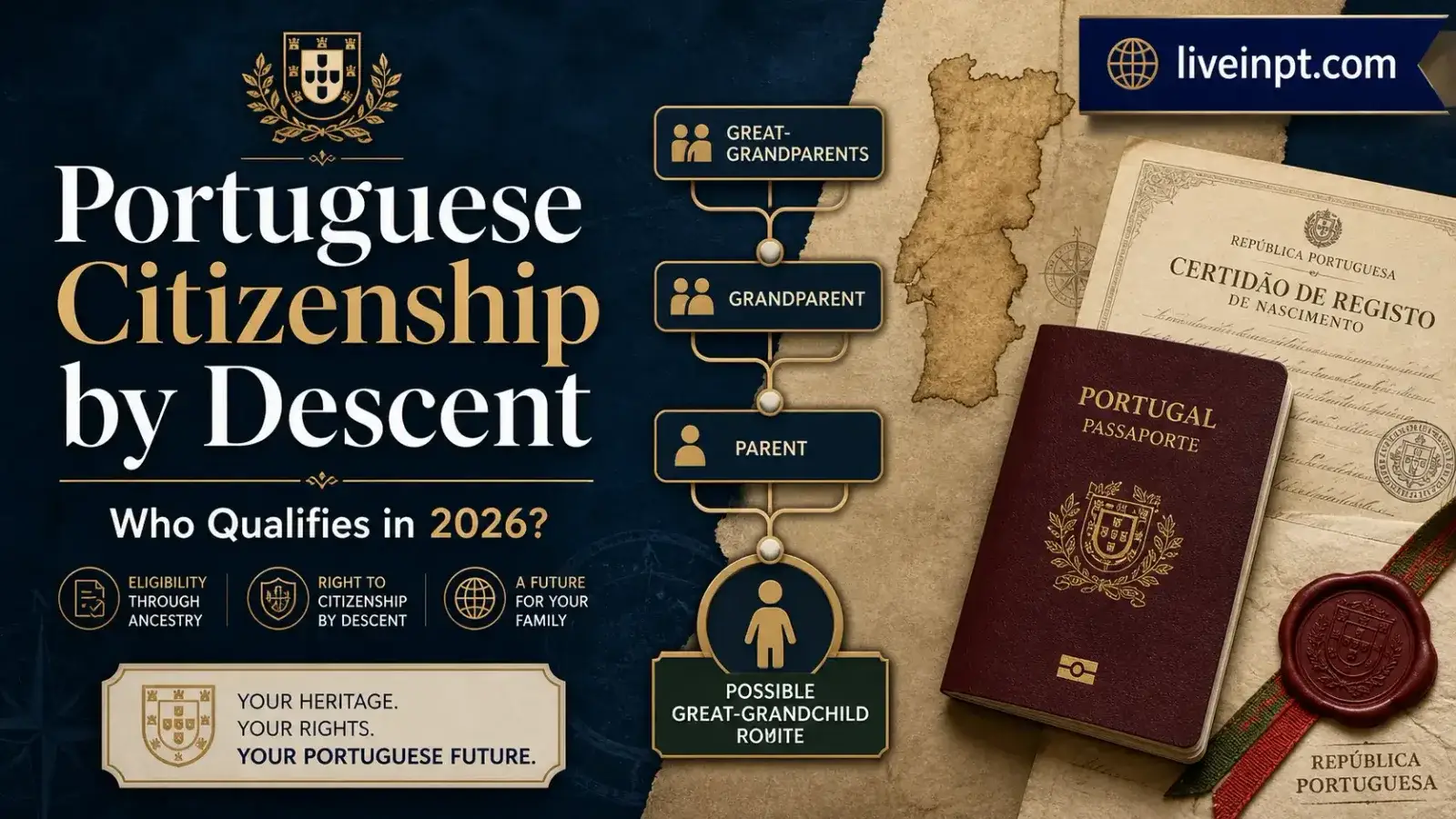
Portuguese citizenship by descent remains available in 2026, but eligibility now depends heavily on which Portuguese ancestor you have and when you apply.
Lei Orgânica n.º 1/2026 entered into force on 19 May 2026. It changed new grandchild applications and created a great-grandchild route that, unlike the parent and grandparent routes, requires legal residence in Portugal.
Quick Answer: If your mother or father is Portuguese, the child route is usually the simplest and does not require Portuguese residence or a language test. If your grandparent is an original Portuguese citizen, you can still apply without living in Portugal, but applications submitted from 19 May 2026 are subject to the new requirements in the Nationality Law. If your closest Portuguese ancestor is a great-grandparent, the new direct route requires at least five years of legal residence in Portugal and additional naturalisation requirements.
If I were starting a descent case today, I would first identify whether the Portuguese ancestor is a parent, grandparent or great-grandparent, then confirm how that person’s Portuguese nationality is recorded. That determines almost everything that follows.
Portuguese Citizenship by Descent 2026 Quick Eligibility Check
| Your Portuguese connection | Possible route in 2026 | Must live in Portugal? | Main issue to check |
|---|---|---|---|
| Portuguese mother or father | Nationality by origin under Article 1(1)(c) | No | Parent’s Portuguese nationality and your birth record |
| Original Portuguese grandparent | Nationality by origin under Article 1(1)(d) | No | New post-19 May 2026 requirements plus family chain |
| Original Portuguese great-grandparent | Naturalisation under Article 6(8) | Yes — at least 5 years legal residence | This is not the same no-residence descent route |
| Parent becomes Portuguese after your birth | Depends on how the parent obtained nationality and your age | Depends | Attribution by origin and later acquisition have different effects |
| Ancestor from Goa, Daman, Cape Verde, Angola, Mozambique, Timor-Leste or another former Portuguese territory | Case-specific | Depends | First prove the ancestor actually held Portuguese nationality |
The first mistake to avoid is treating every Portuguese ancestor as the same legal route. They are not.
What Changed for Portuguese Citizenship by Descent on 19 May 2026?
Portugal’s new Nationality Law was published on 18 May 2026 and entered into force the following day.
The date matters because the law contains an explicit transition rule:
- applications already pending on 19 May 2026 continue under the previous law
- applications submitted after the new law took effect are subject to the new rules
This is especially important for grandchildren.
Under Article 1(1)(d), a person with an original Portuguese grandparent who did not lose Portuguese nationality can still obtain nationality by origin. However, the new Article 1(3) now says this route also requires compliance with Article 6(1)(c) to (h).
Those provisions cover more than the old shorthand of simply proving A2 Portuguese. They include sufficient knowledge of Portuguese language and culture, Portuguese history and national symbols; knowledge of fundamental rights and duties and the political organisation of the Portuguese state; a solemn declaration of adherence to democratic rule-of-law principles; and criminal, security and sanctions checks.
There is an important operational issue as of 11 August 2026: Justice’s nationality-submission page says some 2026 changes still require complementary regulation and labels parts of the nationality service as being updated. So for a new grandchild application, do not assume an old checklist that mentions only an A2 certificate is the complete post-May-2026 requirement.
I would not rely on a pre-May 2026 checklist for a new grandchild application without checking the current IRN instructions first.
For a full breakdown of the reform itself, see the Portugal Citizenship Law 2026 guide.
Can You Get Portuguese Citizenship Through a Parent?
Yes. If you were born outside Portugal and your mother or father is Portuguese, Article 1(1)(c) provides the main nationality-by-origin route.
For a straightforward adult application, the current IRN Model 1C asks for:
- your full birth certificate
- the Portuguese parent’s birth registration
- a certified copy of your passport or equivalent identification
- a power of attorney only if someone is representing you
- the nationality declaration/application form
The current adult Model 1C lists an IRN fee of €175.
Do children of Portuguese parents need a Portuguese language test?
No language certificate appears in the standard Article 1(1)(c) child checklist.
That is an important difference from the grandchild route.
Do adult children need a criminal record certificate?
The standard adult Model 1C checklist does not list foreign criminal-record certificates as a base document. The previous version of this guide incorrectly grouped child and grandchild document requirements together.
Can you apply if your Portuguese parent has died?
Yes. The child route turns on the Portuguese parent’s nationality and the legal parent-child link, not on whether that parent is still alive.
The more important question is when and how the parent became Portuguese. If they obtained nationality only after your birth, read the sequential-generation section below before assuming Model 1C applies.
Can You Get Portuguese Citizenship Through a Grandparent?
Yes, if you have at least one original Portuguese grandparent who did not lose Portuguese nationality and you meet the other conditions for Article 1(1)(d).
There is no Portuguese-residence requirement for the grandchild route.
However, a new application submitted after 19 May 2026 should not be treated as if the only extra requirement is a CIPLE A2 certificate. The amended law now cross-references the broader Article 6(1)(c) to (h) requirements described above.
What documents does the IRN currently ask grandchildren for?
The current adult Model 1D lists:
- your birth certificate
- the Portuguese grandparent’s birth registration
- the birth certificate of your parent who is the child of that Portuguese grandparent
- foreign criminal-record certificates
- proof of sufficient knowledge of Portuguese
- a power of attorney if applicable
- the completed declaration
The adult Model 1D also lists an IRN fee of €175.
For criminal records, the form specifically refers to records from the country of birth, country of nationality and countries where the applicant has resided after age 16, subject to the form’s detailed exceptions.
Can you apply if the parent between you and your Portuguese grandparent has died?
Yes, potentially. The official grandchild checklist requires that intermediate parent’s birth certificate to prove the family chain; it does not say that the parent must first become Portuguese.
So if your qualifying original Portuguese grandparent is deceased, or your parent is deceased and never obtained Portuguese nationality, do not assume the route is closed. The key is whether you can prove the continuous civil-record link from the Portuguese grandparent to the parent and then to you.
Is CIPLE A2 still enough for grandchildren in 2026?
Do not assume an older CIPLE-only checklist is complete. The current IRN form still mentions Portuguese-language knowledge, but the law in force from 19 May also incorporates culture, history, national symbols, civic knowledge and a solemn democratic-rule-of-law declaration.
Justice says parts of the reform still need complementary regulation, so verify the current filing instructions. Grandchild applications already pending on 19 May 2026 remain under the previous law.
Can You Get Portuguese Citizenship Through a Great-Grandparent in 2026?
Yes, but the new direct great-grandchild route is often misunderstood.
Article 6(8) now allows the Government to grant Portuguese nationality to a person who is a third-degree direct descendant of an original Portuguese citizen and has been legally resident in Portugal for at least five years.
A Portuguese great-grandparent alone does not create the same no-residence route available to a child or grandchild.
The five-year residence requirement is written into Article 6(8), and the other applicable Article 6(1) knowledge, civic, criminal/security and means-of-subsistence conditions remain relevant. This is a naturalisation route, not nationality by origin.
If you already live legally in Portugal, see the Portugal citizenship residency requirement guide.
If My Parent Gets Portuguese Citizenship, Can I Apply Next?
This is one of the most important missed distinctions in citizenship-by-descent guides.
The answer is:
sometimes — but it depends on whether your parent’s nationality is attributed as nationality by origin or merely acquired later.
If your parent becomes Portuguese by origin
Article 11 of the Nationality Law says attribution of Portuguese nationality has effects from birth.
So, for example, if your parent successfully becomes Portuguese by origin through their own qualifying parent or grandparent, that can change how the next generation is assessed.
If this were my case, I would wait until the parent’s Portuguese nationality and birth registration are complete before treating the next generation as eligible under Article 1(1)(c).
If your parent acquires Portuguese nationality after your birth
Article 2 provides a follow-on route for minor or incapable children of a parent who acquires Portuguese nationality.
An adult child should therefore not assume that a parent’s later naturalisation automatically gives them a direct child route.
This distinction explains why searches such as “if my dad gets Portuguese citizenship can I apply?” cannot be answered with a universal yes.
What Documents Do You Need for Portuguese Citizenship by Descent?
Use the route-specific checklist rather than collecting one generic “citizenship package”.
| Document | Child of Portuguese parent | Grandchild of original Portuguese citizen |
|---|---|---|
| Applicant birth certificate | Yes | Yes |
| Portuguese parent’s birth registration | Yes | Intermediate parent’s birth certificate is required |
| Portuguese grandparent birth registration | No | Yes |
| Certified passport/ID copy | Yes | Follow current route instructions |
| Foreign criminal records | Not listed in standard adult 1C checklist | Yes |
| Proof of Portuguese knowledge | No standard requirement | Yes, plus check new 2026 requirements |
| Power of attorney | Only if represented | Only if represented |
| Adult IRN fee shown on current form | €175 | €175 |
Do foreign birth certificates need an apostille or translation?
Foreign civil records normally need the legalisation required for the issuing country, often a Hague Apostille where applicable.
There is currently an official-instructions mismatch worth knowing about. The Justice child/grandchild web pages broadly tell applicants to translate foreign certificates into Portuguese, while the current IRN 1C instructions say translation is dispensed with for documents in English, French or Spanish, unless specifically required. Check the current form for your route and the receiving office before paying for unnecessary translations.
Must your parents’ or grandparents’ marriage be registered in Portugal first?
Not as a universal rule. The standard Justice checklists for an adult child or grandchild do not list a marriage certificate as a base document in every case.
Community discussions repeatedly become confusing here because marriage transcription can matter when the Portuguese civil record needs updating or when names, parentage or civil status do not line up cleanly across the generations. Treat it as a case-dependent civil-record issue, not an automatic prerequisite and not something to dismiss automatically.
Before filing, compare the names and parentage shown on every birth record in the chain. I suggest fixing any unclear name, marriage or parentage link before submission rather than waiting for the IRN to raise it later.
How Do You Apply for Portuguese Citizenship by Descent?
There are three practical channels.
1. Through a lawyer or solicitor online
The official Nacionalidade online service is reserved for Portuguese lawyers and solicitors acting as representatives.
Individuals cannot simply create their own account and submit a citizenship application through that professional portal.
2. Submit without a lawyer by post
Justice allows applicants without a representative to send the application and supporting documents by post.
Use the current address shown on the relevant Justice/IRN application form at the time you send the file. This matters because different official pages and forms can be updated at different times.
If I were submitting by post, I would keep a complete scanned copy of the package and use trackable delivery.
3. Submit in person
Depending on the route, applications can also be presented at nationality desks/registry services and, for people abroad, through the Portuguese consular network.
If a consulate is involved, check that consulate’s own appointment and document-handling instructions before travelling. Consular procedures can add operational requirements even where the underlying nationality law is national.
For other IRN-related practical guides, see the LiveinPT IRN hub.
How Much Does Portuguese Citizenship by Descent Cost in 2026?
For the two adult descent forms most commonly relevant here:
- Adult child — Model 1C: €175
- Adult grandchild — Model 1D: €175
- Child under 18 — Model 1C: free on the current IRN minor form
This corrects the old article’s blanket €250 figure and avoids applying the adult fee to minors.
Other costs are case-specific and can include:
- obtaining foreign civil records
- apostilles or other legalisation
- certified copies
- translations where required
- Portuguese language testing
- legal representation if you choose to use it
Do not treat third-party service costs as part of the IRN government fee.
How Long Does Portuguese Citizenship by Descent Take in 2026?
There is no route-specific 2026 IRN processing-time promise that supports a reliable “3 months”, “12 months” or “24 months” guarantee.
The backlog is substantial.
IRN reported that on 30 June 2025, 515,334 nationality applications were still in analysis. Of those pending cases:
- 15% were nationality-by-origin applications from children of Portuguese citizens born abroad
- 12% were nationality-by-origin applications from grandchildren of Portuguese citizens born abroad
That is why the previous version of this article’s fixed planning ranges — such as 3–5 months for minors and 24–30 months for grandchildren — were too precise.
What should you realistically plan for?
Plan for many months and potentially years, especially for adult and grandchild cases. I would use community timelines only as a rough reference, not as a deadline for your own case, because registry workload and document issues can change the result considerably.
A clean child application can finish much sooner than a complicated grandchild file, but the route alone does not determine the date. Missing civil records, requests for additional evidence, criminal-record issues and the workload of the assigned registry can all change the timeline.
If you already have a nationality process number, use the official IRN status system rather than estimating progress from another applicant’s timeline.
What If Your Portuguese Ancestor Was From Goa, Daman, Cape Verde or Another Former Territory?
Bing is already showing this page for ancestry searches involving places such as Daman, Goa, Cape Verde, Timor-Leste and other former Portuguese territories.
These cases deserve a warning because the place of birth alone is not enough.
The key question is:
Was the ancestor legally a Portuguese national under the rules that applied to that person, and can that nationality/civil-registration chain be proved today?
A record saying an ancestor was born in a territory that was administered by Portugal at the time does not by itself answer the modern nationality question.
Before building the rest of the application, obtain or identify the ancestor’s civil-registration record and determine whether Portuguese nationality was retained, lost, attributed or otherwise affected by the historical legal regime. I would verify this first before paying to apostille or translate an entire family file.
What if you cannot find the Portuguese ancestor’s birth record?
Do not build the entire application around family stories, an old passport copy or the place of birth alone. The current IRN forms allow Portuguese birth records to be retrieved by the services when enough identifying details are supplied, such as the place and date of birth and, where known, the registry, record number and year.
For older or non-digitised records, locating the correct civil or archival record can therefore be the first project. This is especially common in community questions involving Madeira, the Azores, Goa and older family lines.
This is one of the situations where specialist registry/nationality help can be worth paying for before you apostille an entire family file.
Does Portugal Allow Dual Citizenship by Descent?
Portugal does not generally require renouncing another nationality. Your other country’s rules are separate, so check them before applying.
Citizenship and a passport are also different things: you establish Portuguese nationality first, then obtain Portuguese identity documents.
Can You Get a Portuguese Passport Immediately After Citizenship?
Not immediately from the descent application itself.
The nationality process first creates or updates your Portuguese civil-registration status. Once you have the Portuguese civil record needed for identification, you can move to the Cartão de Cidadão and then the Portuguese passport process.
So when someone searches for “Portuguese passport by descent”, the practical sequence is:
- establish Portuguese nationality
- complete the Portuguese civil registration
- obtain a Cartão de Cidadão
- apply for the passport
Do not include passport-processing time inside the nationality application’s timeline because they are separate procedures.
What Should You Do First?
Start with the shortest provable family chain:
- Portuguese parent: confirm the Portuguese birth registration and compare your file with Model 1C.
- Portuguese grandparent: confirm original Portuguese nationality, then check the current post-19 May requirements before filing Model 1D.
- Portuguese great-grandparent: remember the direct Article 6(8) route requires five years of legal residence; separately check whether an intermediate generation can qualify by origin.
- Former Portuguese territory: verify the ancestor’s actual Portuguese nationality record before collecting the rest of the file.
The key 2026 questions are which route applies, whether the case was pending on 19 May 2026, and whether nationality is attributed by origin or acquired later.
For a residence-based route instead, see moving to Portugal for citizenship.