

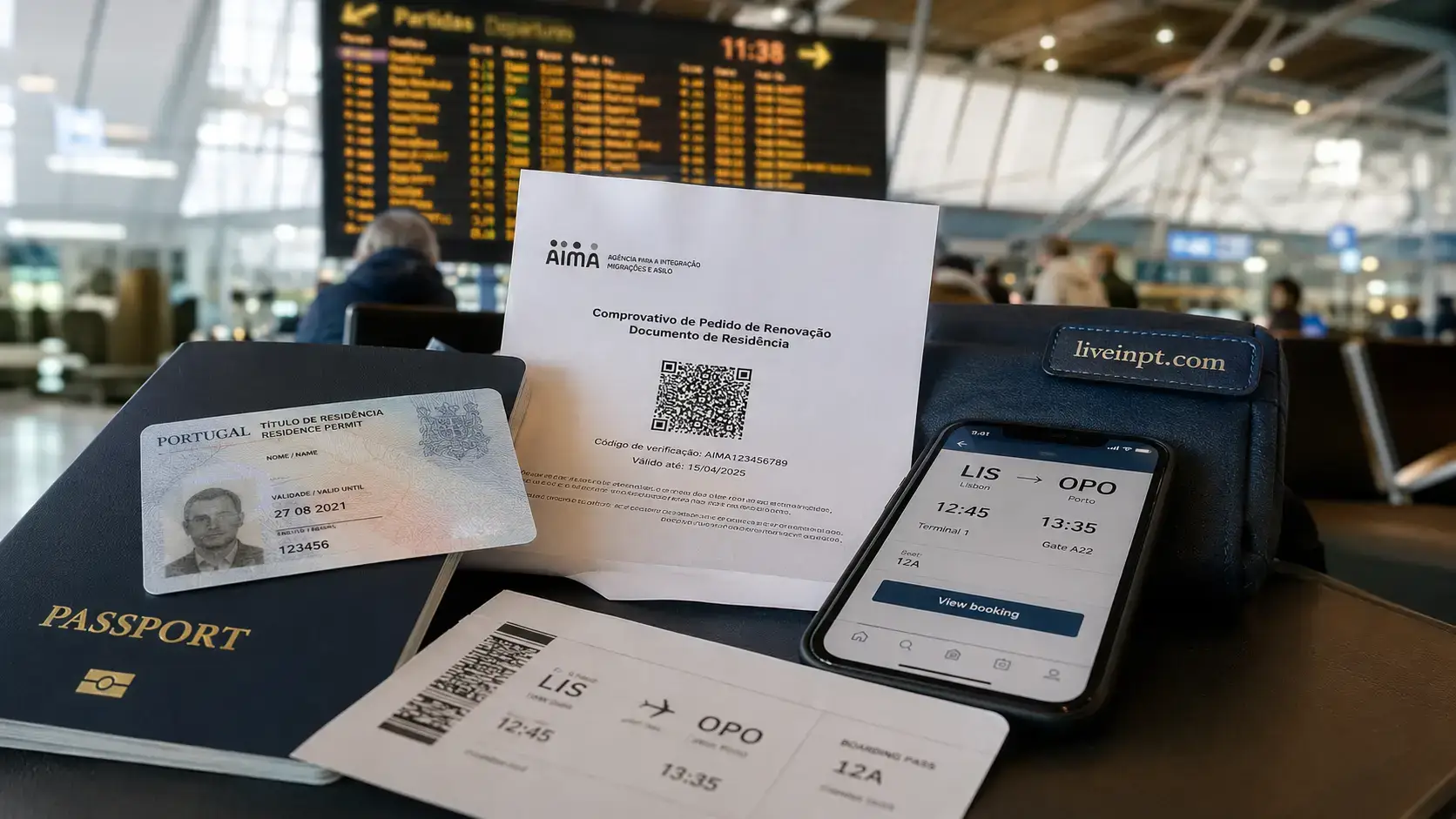
Having the legal right to remain in Portugal does not automatically mean that an expired residence card, AIMA receipt or QR-coded approval document will be accepted for international travel and re-entry. A valid passport remains essential, and the safest document for returning as a resident is a valid physical residence card.
Quick Answer: Travelling can be possible in some expired-card cases, especially when returning directly to Portugal with a valid passport and current AIMA renewal evidence. It is not guaranteed. Going by car, coach or train removes the airline check but does not make an expired card or AIMA receipt valid in another country.
This guide is mainly for non-EU nationals holding, renewing or waiting for a Portuguese residence permit. EU, EEA and Swiss citizens, and some non-EU family members protected by EU free-movement rules, can have different rights and should check the rules for their specific residence document.
It also answers a different question from the Portugal residence permit absence-limits guide. That article explains how long a permit holder may remain outside Portugal. This article explains whether your current documents are likely to let you travel by air, road or rail and return while the physical card is expired or pending.
Can I Fly With an Expired Portuguese Residence Card?
You can usually leave Portugal with a valid passport, but an expired residence card creates uncertainty about boarding the return flight and entering the Schengen Area again. The answer depends on the type of application, nationality, AIMA evidence, card-expiry date and route back to Portugal.
| Situation | Can departure be possible? | Main return risk | Practical risk level |
|---|---|---|---|
| Valid passport and valid residence card | Normally yes | Ordinary destination and passport requirements | Lower |
| Expired card with renewal registered and paid | Sometimes | Airline or border authority may not accept renewal evidence as equivalent to a valid card | Medium to high |
| Renewal approved but new card not received | Sometimes | Approval proof may verify status without functioning as a recognised travel document | Medium to high |
| First residence card pending after AIMA appointment | Leaving is possible | Expired residence visa and application receipt may not support boarding or re-entry | High |
| Visa-exempt passport holder | Often less difficult | Admission may be assessed under short-stay rules rather than as a returning resident | Lower than visa-required cases, but not risk-free |
| Visa-required passport holder | Possible only with accepted documentation | Airline refusal or refusal at the first Schengen border | High |
| Direct flight or non-Schengen connection ending in Portugal | Less complicated | Airline must still accept the documents before departure | Lower than Schengen transit |
| Car, coach or train from Portugal into Spain | No airline boarding decision | Police spot checks, carrier ID checks or temporary border controls can expose the same document problem | Medium to high |
| Connection through France, Spain, Germany or another Schengen country | Possible but riskier | That country becomes the first Schengen entry point | High |
Portuguese law and travel-document rules must be separated. Article 63(14) of Decree-Regulation No. 84/2007 says the right of residence does not lapse until six months after the residence title expires. AIMA repeated that rule in October 2025.
That six-month rule protects residence in Portugal. It does not state that every airline or foreign Schengen authority must treat the expired plastic card as valid for travel.
I would say: first establish whether you are legally resident in Portugal, then separately establish which document will allow you to travel and cross the border. Those are related questions, but they are not the same question.
Does the six-month residence rule make the expired card valid for travel?
No. The six-month rule concerns the underlying right of residence in Portugal, not a general extension of the physical card as an international travel document. A person may therefore remain lawfully resident while still facing difficulty proving an entitlement to board an aircraft or enter through another Schengen state.
Portugal ended the broad automatic document extensions on 15 October 2025. That announcement referred to proof valid for 180 days after a renewal was registered and paid. A more recent AIMA notice describes the downloadable Recibo Comprovativo do Pedido as valid for 60 days and renewable until the final decision.
Updated August 2026: applicants may therefore hold receipts generated under different renewal channels or earlier instructions. Use the expiry date printed on your newest PDF rather than assuming that every receipt lasts 180 days. Even a current receipt remains evidence of the Portuguese process, not a universal boarding guarantee.
Does an AIMA Renewal Receipt Count as a Travel Document?
An AIMA receipt is evidence of an application or renewal, but it is not the same as a passport, visa or valid physical residence permit. AIMA expressly states that the receipt for a residence-permit application is not a travel document and cannot be used to circulate in other Schengen countries.
The documents applicants call an “AIMA receipt” are not all identical. If your renewal has not yet been registered, use the Article 78 residence-permit renewal guide before making travel plans:
| Document | What it proves | What it does not guarantee |
|---|---|---|
| Appointment confirmation | An AIMA appointment is scheduled | Approval, lawful re-entry or airline boarding |
| Submission receipt | A residence application was received | That a residence permit has been granted |
| Payment receipt | Renewal fees were paid | That the renewal was approved or that the card was issued |
| Current renewal receipt | AIMA registered the renewal and issued time-limited evidence; use the validity date printed on the PDF | Universal acceptance outside Portugal |
| QR-coded approval proof | The approval document is authentic and linked to the applicant | Replacement of the physical card for every journey |
| Valid physical residence card | A current Portuguese residence permit | Entry to a non-Schengen destination without meeting that country’s rules |
AIMA’s explicit travel warning is written in the context of a receipt for the granting of a residence permit, which is particularly relevant to first-card applicants. AIMA has not published a general promise that every renewal receipt or QR approval document must be accepted by airlines and all Schengen border authorities.
Can I travel with the AIMA QR code declaration?
The QR code proves authenticity, not automatic travel eligibility. It allows the document to be checked against AIMA’s system and can show that a renewal or approval is genuine. That makes it useful supporting evidence, but it does not make the PDF identical to the biometric residence card listed as a recognised residence document.
Carry both a printed copy and the original PDF on your phone. Test the QR code before leaving and save the file locally rather than depending on airport Wi-Fi. A blurry screenshot that cannot be scanned removes much of the document’s practical value.
What if my AIMA renewal receipt has expired?
Do not rely on an AIMA receipt after the validity date printed on the PDF has passed. AIMA’s more recent renewal guidance says the online receipt is valid for 60 days and can be renewed until the final decision. Earlier AIMA material referred to a 180-day proof, which is why applicants may see different validity periods.
Sign in to the portal used for the renewal and generate or download the newest available receipt. The AIMA online portal guide explains the main account and portal routes if you are unsure where the process was submitted. Check the AIMA process tracker for a later approval or issuance event, and ask AIMA whether the card has entered production. The separate six-month right of residence in Portugal does not turn an expired receipt into a current travel document.
Can You Return Directly to Portugal With an Expired Residence Card?
Returning directly to Portugal is normally less complicated because Portugal becomes the first Schengen country to examine your entry. Portuguese border officers can assess Portuguese residence records and AIMA evidence directly. This avoids asking another Schengen state to interpret an expired Portuguese document.
Direct entry does not remove the airline problem. The carrier at the foreign departure airport decides whether to accept you for boarding based on the passport, destination rules, available database guidance and any documents you present. If the airline refuses check-in, Portuguese border authorities never get the opportunity to assess the case.
I would not describe a direct flight as safe. I would describe it as the least complicated route when essential travel cannot be postponed.
Does a connection in the UK, Turkey or the UAE still count as direct entry to Portugal?
It can still result in direct Schengen entry to Portugal when the connection remains outside Schengen and the first Schengen airport is Lisbon, Porto or another Portuguese airport. For example, a route through London, Istanbul or Dubai may avoid a Schengen border check before Portugal.
You must still meet the transit rules of the connecting country and the airline will examine your eligibility for the full itinerary. A self-transfer that requires passing immigration, collecting luggage or changing airports can create additional visa requirements.
Can I leave Portugal if my residence card is already expired?
The main obstacle is usually returning, not departing. A valid passport is required to cross the external border. Portuguese officers may ask about the expired residence document and status, but leaving Portugal does not itself renew, validate or preserve the card for the return journey.
Before leaving, take screenshots of the AIMA status, download all receipts and confirm whether the new card is already in production or with CTT. A card delivered a few days after departure can completely change the practical return options.
Can You Transit Through Another Schengen Country?
A Schengen connection creates greater risk because the connecting country normally becomes the first point of entry into the Schengen Area. A return route through Paris, Madrid, Frankfurt or Amsterdam is therefore not merely an airport connection. Border control usually occurs there before the internal flight to Portugal.
A valid Schengen residence permit is normally treated as equivalent to a visa for short travel and transit. The difficulty is that an expired card, pending-renewal receipt or AIMA approval PDF may not receive the same treatment as a valid permit.
I think the word “transit” causes much of the confusion. A Paris-to-Lisbon flight is an internal Schengen flight, so the passenger normally enters Schengen in France even if Portugal is the final destination.
Can I transit through France with an expired Portuguese residence card?
Transit through France is higher risk when the Portuguese card is expired because French authorities, not Portuguese authorities, make the first Schengen entry decision. The same principle applies to Spain, Germany, the Netherlands and other Schengen connection points.
Do not rely on the argument that you are only passing through to Portugal. The EU rule that facilitates transit to the state issuing a residence permit is framed around a valid residence permit or long-stay visa. An expired card may fall outside that protection.
What if the outbound flight leaves Schengen through another country?
An outbound connection can also place the Schengen exit check in the connecting country. A Lisbon-to-Paris-to-non-Schengen itinerary normally records departure from Schengen in France. An expired Portuguese card and long period in Portugal may then prompt questions about residence status or apparent overstay.
This does not mean every traveller will be stopped. It means the route adds another authority that must understand documents issued only in Portuguese and linked to a delayed AIMA process.
Does Your Nationality Change the Answer?
Yes. Visa-exempt and visa-required passport holders do not face the same fallback position after a residence card expires. The physical residence permit normally exempts visa-required residents from obtaining a Schengen visa. Once the card is no longer valid, nationality-based entry rules become much more important.
What changes for visa-exempt nationals?
A visa-exempt national may be able to request admission as a short-stay visitor using a valid passport, subject to the normal entry conditions and the 90-days-in-180 rule. This can make boarding and entry practically easier, but it is not the same as returning on a valid residence card.
The European Commission’s border guidance distinguishes visa-exempt people from nationals who require a visa after a residence permit expires. Time previously authorised under a residence permit is not normally counted as short-stay time, but the beginning and calculation of any new short stay may need to be established at the border.
Do the 90 visa-free days start automatically when my residence card expires?
Do not treat the expiry date as an automatic conversion from Portuguese residence to a tourist stay throughout Schengen. EU border guidance gives visa-exempt nationals a possible short-stay basis after a residence permit expires, but the traveller must still satisfy the normal entry conditions and may need the start of that short stay recorded or established by the authorities.
Leaving and re-entering can make the short-stay record clearer, but it does not solve the separate problem of airline boarding with an expired Portuguese card. Ask the first Schengen entry authority how the stay will be recorded in your exact case.
I believe many successful travel reports are misleading because they omit the traveller’s nationality. That missing detail can make an experience almost useless to someone whose passport requires a Schengen visa.
For a detailed explanation of the tourist calculation, see the Schengen 90/180 rule guide. Do not use that rule to assume that a Portuguese residence renewal has been converted into tourist status automatically.
What changes for visa-required nationals?
A visa-required national faces a higher boarding and re-entry risk without a valid residence card, valid long-stay visa or another document explicitly accepted for the itinerary. The airline may treat the expired card as insufficient because the passenger would ordinarily need a visa to reach Portugal.
AIMA renewal evidence can still be important, particularly when checked against current airline documentation rules, but it should not be treated as a guaranteed replacement for a valid permit. A direct return to Portugal reduces one layer of uncertainty without eliminating the airline’s document check.
Can You Travel While Your First Residence Card Is Pending?
Travelling while waiting for the first residence card is generally riskier than travelling during a renewal because the applicant has no previous Portuguese residence card to present. The person may hold only an expired residence visa, an AIMA appointment receipt and proof that the first application is pending.
AIMA states clearly that the receipt proving a first residence-permit application is not a travel document and cannot be used to travel through other Schengen countries. If the original residence visa remains valid and permits another entry, the visa terms may support the journey. Once that visa expires, the receipt does not automatically replace it.
This distinction is essential:
| First-card applicant | Renewal applicant |
|---|---|
| May have no previous Portuguese residence card | Can present the expired physical card |
| Often relies on a residence visa that may have expired | Can show an established history of Portuguese residence |
| AIMA receipt proves the application was received | Renewal proof may confirm registration, payment or approval |
| Re-entry risk is usually higher | Risk varies by nationality, route and document validity |
I would suggest postponing non-essential travel until the first physical card arrives unless the residence visa remains valid for the complete return journey or the airline and relevant border authorities confirm the exact document combination in writing.
Can You Travel After AIMA Approves the Renewal but Before the Card Arrives?
Approval improves the evidence of residence status but does not guarantee that the approval PDF will be accepted as a physical residence card for travel. The QR-verifiable document may show that AIMA granted the renewal, yet airlines and foreign Schengen authorities can still look for a recognised residence card or visa.
Check whether the status has moved from approval to production or dispatch. If a CTT object code exists, the remaining wait may be short enough that changing the trip is safer than testing an uncertain document combination.
The AIMA card not received and CTT tracking guide explains how to find the object code, interpret CTT statuses, deal with missed delivery and recover a card returned to AIMA.
Is an approved AIMA process enough to travel?
No official AIMA guidance promises that approval alone is sufficient for international travel. Approval answers whether AIMA granted the residence process. It does not by itself answer whether a carrier will board the passenger or whether another Schengen state will treat the PDF as equivalent to a valid biometric permit.
Use the approval proof as supporting evidence, not as the only document on which the trip depends.
Can You Travel Within Schengen While Waiting for the Residence Card?
A pending AIMA process does not create unrestricted travel rights across Schengen. Internal borders often have no routine immigration booth, but identity checks, airline document checks, police controls and temporary border controls can still occur.
Travelling by car to Spain does not change the document rule. The absence of a routine checkpoint is not the same as holding valid documents for the stay. Visa-required nationals face the greatest problem because the expired Portuguese permit may no longer provide the visa exemption normally attached to a valid residence card.
Can I fly from Portugal to Spain with an expired card and QR proof?
The airline may accept a passport for an internal Schengen flight, but that does not establish that the expired card and QR proof authorise the stay in Spain. A police or temporary border check can still require evidence of lawful short-stay entry or a valid residence document.
Visa-exempt travellers may have a possible short-stay basis. Visa-required travellers should not assume that a Portuguese renewal PDF removes the ordinary visa requirement in Spain.
What if the residence card expires during the trip?
The return documents are assessed on the return date. A card that was valid when you left but expires before the flight home is an expired card at check-in and at the border.
Check the expiry date against every sector of the itinerary, including delays and overnight connections. Renewing early and receiving the replacement before departure is safer than relying on the fact that the card was valid on the outbound date.
Can You Travel by Car, Bus or Train With an Expired Portugal Residence Card?
Driving, taking an international coach or using a train can remove the airline boarding decision, but it does not make an expired residence card or AIMA receipt valid in another country. Portugal and Spain are in the Schengen Area, so there is normally no systematic immigration booth at every land crossing. The Schengen Borders Code still permits police spot checks within the territory and temporary internal border controls.
I would not treat road travel as a loophole. The practical chance of being checked may be lower than at an airport, but the document question is the same if Spanish, French or another country’s authorities ask you to prove your identity and lawful presence.
| Journey | What road or rail travel changes | What risk remains |
|---|---|---|
| Driving from Portugal to Spain | No airline check-in desk | Spanish police can conduct identity or immigration-related spot checks |
| FlixBus or another international coach | No airline document team | The carrier may check identity and police can stop or board the coach |
| Train from Portugal into Spain | No airport or airline decision | Identity checks and temporary border controls remain possible |
| Driving from Spain into France | Land journey instead of a flight | France currently applies temporary controls at its internal border with Spain |
| A route that leaves Schengen | You may avoid an airline | Full external-border and destination visa rules apply in both directions |
Can I drive from Portugal to Spain with an expired residence card?
The absence of a routine checkpoint does not amount to permission to stay in Spain with invalid documents. A visa-exempt passport holder may have a possible short-stay basis under the normal 90-in-180 rules. A visa-required traveller may no longer have the visa exemption that normally comes from holding a valid Portuguese residence permit.
Carry the valid passport, expired card, newest AIMA receipt, payment evidence, QR approval proof if available and evidence that Portugal remains your residence. Those documents can explain the situation, but they do not force Spanish authorities to treat the expired Portuguese card as valid.
Before travelling, check the European Commission’s current list of temporarily reintroduced internal border controls. As of 4 August 2026, France has notified controls at all of its internal borders, including the land border with Spain, until 31 October 2026. A Portugal–Spain journey may therefore feel uneventful while a longer drive into France results in an actual document check.
Is FlixBus or a train safer than flying with an expired card?
It may be easier in the narrow sense that there is no airline employee deciding whether to issue a boarding pass. It is not legally safer if the traveller lacks the documents required in the destination country. International coach and rail operators may request a passport or other accepted identity document, and police can carry out checks at stations, on board or near borders.
Reddit reports often say that nobody checked on a particular journey. That describes one trip, not the rule for the next passenger. A traveller should decide based on the documents they can lawfully present, not on the probability of avoiding a check.
Do I still need my passport when travelling by road inside Schengen?
Yes—non-EU nationals should carry a valid passport. EU guidance says non-EU travellers need a valid passport and, depending on nationality and status, a visa or valid residence document. A driving licence is not a travel document, and an expired Portuguese residence card does not replace the passport.
The passport is also necessary to determine whether the traveller is visa-exempt and whether the normal short-stay rules could apply. Keep the original documents accessible rather than locked in luggage or left at the accommodation.
What happens if police stop me in Spain or France?
There is no universal outcome that can be predicted in advance. Officers may verify identity, passport history, visa requirements, residence status and the authenticity of the AIMA evidence. They can seek assistance from immigration or border authorities if the documents do not clearly establish lawful presence.
Show the documents honestly and explain that the Portuguese renewal is pending or approved. Do not claim that a Portuguese national extension binds another Schengen country unless the document itself or an official rule says so. Screenshots of Reddit success stories carry no legal weight during the check.
Can I travel to Madeira or the Azores with an expired residence card?
A direct journey from mainland Portugal to Madeira or the Azores remains within Portuguese territory and does not enter another Schengen state. That removes the foreign-country recognition problem, although the airline or ferry operator can still require a valid passport or other accepted identification.
Check the complete itinerary. A route that connects through Madrid, Paris or another foreign airport is no longer a purely domestic Portuguese journey and creates the transit issues explained earlier in this guide.
What changes when a road route leaves the Schengen Area?
Once the route crosses an external Schengen border, normal passport, visa and entry rules apply at that border. This can happen on road journeys through countries outside Schengen or when a ferry or rail itinerary enters a non-Schengen country. The expired Portuguese card and AIMA proof may help explain the traveller’s residence history, but they do not replace any visa or entry permission required by the country being entered.
Check every country on the route in both directions. A journey can leave Schengen briefly and require a fresh external-border inspection when it enters again, even when Portugal is the final destination.
Can an Airline Refuse Boarding With an Expired Residence Card?
Yes. An airline can refuse boarding when its staff are not satisfied that the passenger meets the entry or transit requirements. Carriers commonly use Timatic, the travel-document database behind the IATA Travel Centre, to check passport, visa, residence and transit conditions.
Do not ask only, “Can I travel with an expired card?” Give the airline’s document team the full case:
- passport nationality and expiry date;
- Portuguese residence-card type and expiry date;
- first application or renewal;
- date the renewal was registered and paid;
- exact name and validity date of the AIMA proof;
- whether an approval QR document exists;
- every airport on the outbound and return routes;
- whether any connection requires immigration or self-transfer.
Ask for written confirmation or a note in the booking record. A call-centre agent’s verbal answer can help, but the check-in team may still apply the current database result differently.
Does an airline’s “OK to board” guarantee entry?
No. An internal airline clearance means the carrier is willing to transport the passenger based on its document review. It does not bind Portuguese, French, Spanish or other border authorities, and not every airline offers a formal “OK to board” process for this situation.
I would treat airline approval as one required check, not as the final legal decision.
Do Emirates or Turkish Airlines Require “OK to Board” With an Expired Portuguese Card?
Neither airline publishes a special guarantee for passengers relying on an expired Portuguese residence card, but their official check-in procedures are useful. Contact the operating airline with the exact passport, expired-card date, AIMA proof and complete itinerary. Ask for the assessment to be attached to the booking reference where possible.
| Airline | Published procedure | What to do |
|---|---|---|
| Emirates | Emirates says passengers do not need to apply online for separate “OK to Board” approval; the required documents are presented at airport check-in | Call before travel, give the booking reference and request a document review for return to Portugal |
| Turkish Airlines | A physical boarding pass may be required on international journeys where visa checks apply | If the app does not issue a mobile pass, report to the counter with the original documents and allow time for verification |
What should an Emirates passenger do?
Call Emirates in Portugal on (+351) 213 665 533. Portuguese-language support is listed from 07:00 to 21:00 every day, while English support is available continuously. Give the agent:
- the PNR or ticket number;
- passport nationality and expiry date;
- expired Portuguese card type and expiry date;
- whether this is a first card or renewal;
- the date and validity of the newest AIMA receipt or QR approval proof;
- every airport on the return itinerary.
Emirates’ official FAQ says there is no separate online OK to Board application. That does not mean the expired card is accepted automatically; it means the documents are assessed through the normal check-in process.
What should a Turkish Airlines passenger do?
Turkish Airlines does not publish a general online OK to Board application for this situation. Its official boarding-pass guidance says a physical boarding pass may be required when visa checks apply, so failure to receive a mobile pass can mean that staff need to inspect the documents at the airport.
Use the Turkish Airlines Help Centre or call (+90) 212 463 63 63 with the PNR and exact itinerary. Turkish Airlines recommends arriving at least three hours before an international flight. Ask whether the booking can be noted for a counter document review; do not ask only whether an expired card is “accepted,” because nationality and transit points change the answer.
What Documents Should You Carry When Travelling?
Carry every document that establishes identity, Portuguese residence history, the active AIMA process and the planned direct return, while understanding that supporting evidence cannot guarantee admission. Use both printed and offline digital copies.
Take:
- A valid passport that satisfies the destination and transit-country validity rules.
- The expired Portuguese residence card.
- The newest AIMA submission or renewal receipt, provided its printed validity date has not passed.
- Proof that renewal fees were paid.
- The QR-verifiable approval document, if the process is approved.
- AIMA appointment confirmations and relevant emails.
- Screenshots or PDFs showing the current portal status.
- Evidence that Portugal remains your residence, such as a recent rental document, employment evidence or tax address.
- The complete return itinerary, preferably entering Schengen directly in Portugal.
- Written airline confirmation or the case reference from its document team.
Proof of a Portuguese job, home or tax registration can help explain the situation, but none of those documents replaces a passport, visa or recognised residence permit.
Who Should You Confirm the Trip With Before Travelling?
Three separate organisations control different parts of the journey: the airline controls boarding, border authorities control entry, and AIMA controls the residence process. Confirmation from one does not automatically decide the other two.
1. Ask the airline to check the exact itinerary
Use the IATA Travel Centre for an initial check, then ask the airline’s document or immigration-support team to review the booking. General baggage or reservations staff may not have access to the same document guidance used at check-in.
2. Ask Portuguese border authorities about entry documents
The Polícia de Segurança Pública now performs border control at Portuguese airports through the Unidade Nacional de Estrangeiros e Fronteiras (UNEF). The PSP directory lists the central contact as (+351) 218 111 000 and contacto@psp.pt. When calling, ask to be directed to the border unit responsible for the airport where you will enter Portugal.
Ask about the documents required for your exact return scenario. Do not present the answer as a pre-authorisation, because the final assessment is made with the traveller and documents at the border.
3. Ask AIMA to confirm the process and current proof
AIMA’s Contact Center is (+351) 217 115 000, Monday to Friday from 08:00 to 20:00, and its general email is geral@aima.gov.pt. AIMA can confirm the application stage, approval, document validity and whether the card has been sent for production.
AIMA does not operate the airline check-in desk and should not be treated as the only source for an international itinerary.
4. Check every Schengen transit country
When the route enters Schengen through France, Spain, Germany, the Netherlands or another country, ask that country’s consular or border authority whether it recognises the exact Portuguese document combination. Avoid asking only the Portuguese consulate about a border decision that will be made elsewhere.
What Should You Do if Travel Is Essential?
If the journey cannot wait, reduce the number of uncertain decisions rather than relying on one reassuring anecdote. Work through this order before buying a non-refundable ticket:
- Confirm whether the case is a first application or renewal.
- Check that the passport is valid for the full trip and all transit rules.
- Download the newest AIMA receipt, payment proof and QR document.
- Check whether the physical card has already entered production or CTT delivery.
- Prefer an itinerary whose first Schengen entry point is Portugal.
- Avoid self-transfers and Schengen connections where possible.
- Run the exact itinerary through the IATA Travel Centre.
- Obtain a written document review from the operating airline, not only the ticket seller.
- Ask PSP about Portuguese entry and the transit state about its own border.
- Carry printed and offline digital evidence in hand luggage.
- Use a flexible ticket and have a plan for denied boarding or delayed card delivery.
A success story involving a US, UK or Canadian passport may not apply to an Indian, Pakistani, Bangladeshi or other visa-required passport. The route, document dates and airline matter just as much as the expired card itself.
What Happens if the New Residence Card Is Delivered While You Are Abroad?
AIMA normally sends the card to the registered Portuguese address, so travel does not pause the CTT delivery and collection deadlines. Monitor email, SMS and the CTT object code while abroad.
If delivery fails, the registered letter may be held briefly at a CTT point before being returned to AIMA. Another person may collect it only when the shipment’s service and CTT authorisation rules allow third-party collection. Arrange any authorisation before leaving rather than after the collection deadline begins.
Can someone send the new residence card to me abroad?
AIMA’s published delivery procedure sends the card to the registered Portuguese address and does not advertise a foreign redirection option. If a trusted person lawfully receives the card, sending an identity document internationally creates loss, courier and destination-country risks. Check the carrier’s rules before placing it in a shipment.
Having a trusted person bring the card can avoid postal loss, but the person must receive it lawfully and the traveller may remain unable to board while waiting. Do not make the return plan depend on an unconfirmed delivery date.
What if CTT returns the card to AIMA while I am away?
Follow the returned-card procedure rather than asking CTT to reverse a completed return. The correct AIMA office and collection method depend on how the residence process was initiated. The dedicated CTT residence-card delivery guide covers the current AIMA summons, office and collection rules.
What Is the Safest Answer Before You Book?
Wait for the valid physical residence card whenever the journey can be postponed. When travel is essential, a renewal applicant with a current AIMA receipt, an expired card, a valid passport and a route entering Schengen directly in Portugal generally has a stronger practical case than a first-card applicant with an expired residence visa or a visa-required traveller connecting through another Schengen country.
The central point is that lawful residence in Portugal, airline boarding and Schengen admission are three separate checks. A receipt or QR-verifiable proof can support the case, but neither provides the same certainty as a valid physical residence card. Check the exact passport, document dates and complete itinerary before committing to the trip.