

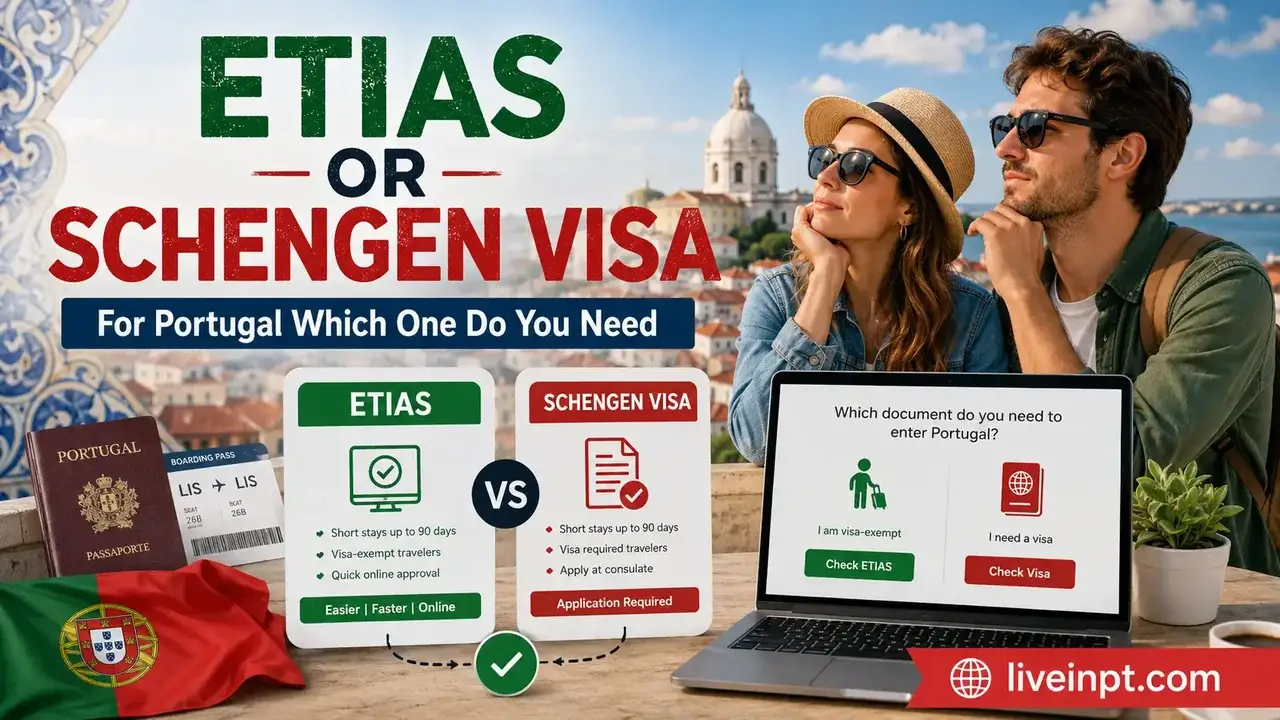
ETIAS and the Schengen visa are not two versions of the same thing. They are entirely separate systems built for entirely different groups of nationalities. Knowing which one applies to your passport takes one check, and gets you the right answer immediately.
The problem is that many people arrive at this question after reading guides that either ignore the distinction or bury the decision under several paragraphs of general information. This guide gives you the decision in the first section, then covers the differences in detail.
For a full overview of ETIAS itself and its current status, see the ETIAS Portugal guide.
Quick Answer: If your nationality requires a Schengen visa to visit Portugal today, stop here. ETIAS does not apply to you. Continue with your Schengen visa application. If your nationality currently allows you to visit Portugal visa-free for short stays, ETIAS is what you will need when it launches in Q4 2026. The two systems are for different nationalities. You cannot substitute one for the other.
The Decision: Which System Applies to You
| Your current situation | What you need |
|---|---|
| Your nationality requires a Schengen visa to enter Portugal | Schengen visa, applied for at the Portuguese consulate. ETIAS does not apply. |
| Your nationality has visa-free access to Portugal for short stays | ETIAS, online application before travel, launching Q4 2026. No Schengen visa needed. |
| You hold a valid residence permit from any Schengen country (including Portugal) | Neither, your residence document covers you at Schengen borders. |
| You are an EU, EEA, or Swiss citizen | Neither, free movement rights apply. |
If you are unsure whether your nationality is visa-exempt or visa-required for the Schengen Area, the full nationality breakdown covers this in detail.
ETIAS vs Schengen Visa: Full Comparison
| ETIAS | Schengen Visa | |
|---|---|---|
| Who needs it | Visa-exempt nationals (US, UK, Canada, Australia, Brazil, Japan, etc.) | Visa-required nationals (India, China, South Africa, Nigeria, Pakistan, etc.) |
| Purpose | Pre-travel online screening before a visa-free short stay | Permission to enter the Schengen Area |
| Official fee | €20 (adults 18–70); free under 18 and over 70 | €90 (adults); €45 (children 6–12); free under 6 |
| Where to apply | Official EU site: travel-europe.europa.eu/etias, once live | Portuguese consulate or VFS Global in your country |
| Processing time | Minutes (most cases); up to 4 days; up to 30 days for security review | 15–45 business days typically |
| Embassy or consulate appointment | No | Yes, usually required |
| Validity | 3 years or until passport expires | Single trip, or up to 5 years for multiple-entry types |
| Physical document | No, electronic, linked to passport number | Visa sticker affixed to passport |
| Covers | 30 countries (29 Schengen + Cyprus) | 29 Schengen countries |
| Guarantees entry | No, border officer has final say | No, same |
| Status as of May 2026 | Not yet live, Q4 2026 | Fully operational |
The practical gap between the two is significant. A Schengen visa costs more, requires a consulate visit, involves document submission, and takes weeks. ETIAS will be an online form, mostly processed in minutes, valid for three years, and covering unlimited trips. But that convenience only applies to nationalities that are already travelling visa-free.
The Nationalities That Cause the Most Confusion
UK citizens post-Brexit are the most common source of this confusion. Before Brexit, UK citizens had EU freedom of movement. After Brexit, they became third-country nationals, but they retained short-stay visa-free access to the Schengen Area. That is the key detail. Because they are visa-exempt (not visa-required), they fall into the ETIAS category. UK citizens do not need a Schengen visa for trips up to 90 days. They do need ETIAS when it launches.
Brazilian citizens are visa-exempt for the Schengen Area and need ETIAS. Brazil and Portugal have a strong travel relationship, and many Brazilians are surprised to learn a Schengen visa is not involved, but the correct system is ETIAS, not a consulate visit.
South African citizens need a Schengen visa. South Africa does not have visa-free Schengen access, so ETIAS is not relevant. South Africans searching for ETIAS information are looking at the wrong system.
Indian citizens need a Schengen visa. India is not on the visa-exempt list. Indian passport holders should apply for a Schengen visa through the Portuguese consulate, not look for an ETIAS application.
Nigerian citizens need a Schengen visa. Same situation as India and South Africa, ETIAS does not apply.
US citizens are visa-exempt and need ETIAS. Currently they enter Portugal with just their passport. When ETIAS launches, they will need to apply online before travel.
Australian and New Zealand citizens are visa-exempt and need ETIAS.
What the Opposite Mistake Looks Like
There are two directions this confusion runs.
The first: a US or UK citizen assumes they need nothing for Portugal (true right now, but ETIAS will change this). When ETIAS launches without proper awareness, some travellers will show up at the boarding gate without authorisation. Airlines will be required to verify ETIAS before allowing boarding, similar to how they currently check Schengen visas.
The second: a South African or Indian citizen reads about ETIAS and assumes it applies to them, either trying to apply (and finding no official site, because ETIAS is not yet live) or assuming ETIAS is a simpler alternative to the Schengen visa they already know they need. ETIAS cannot replace the Schengen visa for visa-required nationalities. If your nationality requires a visa, that requirement does not go away.
What Happens at the Border for Both Groups
Whether you hold a Schengen visa or will eventually hold ETIAS, the Entry/Exit System (EES) affects you at the border.
EES became fully operational across all Schengen external borders on 10 April 2026. It replaced routine passport stamping for non-EU short-stay travellers with digital entry and exit records, and it may collect fingerprints and a facial image. It applies to short-stay visitors, including visa-free travellers and Schengen visa holders. Holders of residence permits and long-stay visas are generally outside EES registration. It is automatic; you do not apply for it.
This is separate from ETIAS. EES is what happens when you arrive at Lisbon airport and step up to the border control kiosk. ETIAS is what will happen online before you even book your flight.
For travellers tracking their Schengen days, EES now records entries and exits digitally, so the Schengen 90/180-day rule is no longer monitored through passport stamps. EES does that automatically.
What to Do Now Depending on Which Applies to You
If you need a Schengen visa for Portugal: Apply through the Portuguese consulate in your country, or via VFS Global where available. Processing typically takes 15 to 45 business days. Start well before your travel date. ETIAS is irrelevant to your application.
If you are visa-exempt and will need ETIAS: Nothing needs to happen yet. ETIAS is not accepting applications. When it launches in Q4 2026, the process will take about 10 minutes online at travel-europe.europa.eu/etias. The authorisation will cost €20 and will be valid for three years.
If you live in Portugal with a valid AIMA residence permit: Neither system requires action from you for Schengen border crossings. Carry your residence document when travelling.
Frequently Asked Questions
Do UK citizens need a Schengen visa or ETIAS for Portugal?
ETIAS. Following Brexit, UK citizens became third-country nationals with visa-free short-stay access to the Schengen Area. Because they are visa-exempt, not visa-required, they fall into the ETIAS category. They do not need a Schengen visa for visits up to 90 days, but they will need ETIAS when it launches in Q4 2026.
Do South Africans need ETIAS or a Schengen visa for Portugal?
A Schengen visa. South Africa is not on the ETIAS-eligible list. South African citizens require a Schengen visa to enter Portugal, applied for at the Portuguese consulate or via VFS Global. ETIAS does not apply to them.
Do Brazilians need ETIAS or a Schengen visa for Portugal?
ETIAS. Brazilian citizens have visa-free access to the Schengen Area for short stays, which places them in the ETIAS category. When ETIAS launches in Q4 2026, Brazilians will need to apply online before travelling to Portugal.
If I have a Schengen visa, do I also need ETIAS?
No. ETIAS and the Schengen visa are for different nationalities. If you already hold a valid Schengen visa, ETIAS does not apply to you. The two systems do not overlap.
Can I use ETIAS instead of applying for a Schengen visa?
No. If your nationality requires a Schengen visa to enter Portugal, ETIAS is not available to you. It is not a substitute or a simpler alternative. You must apply for a Schengen visa through the Portuguese consulate.
I’m Indian, do I need ETIAS for Portugal?
No. Indian citizens require a Schengen visa to visit Portugal. ETIAS applies only to nationalities that already have visa-free Schengen access. Indian passport holders should apply for a Schengen visa, not ETIAS.
Does EES affect both Schengen visa holders and ETIAS holders?
Yes, if they are travelling for a short stay. The Entry/Exit System (EES), fully operational since 10 April 2026, applies to non-EU short-stay travellers crossing Schengen external borders, including Schengen visa holders and visa-free travellers who may later need ETIAS. Holders of residence permits and long-stay visas are generally outside EES registration.