

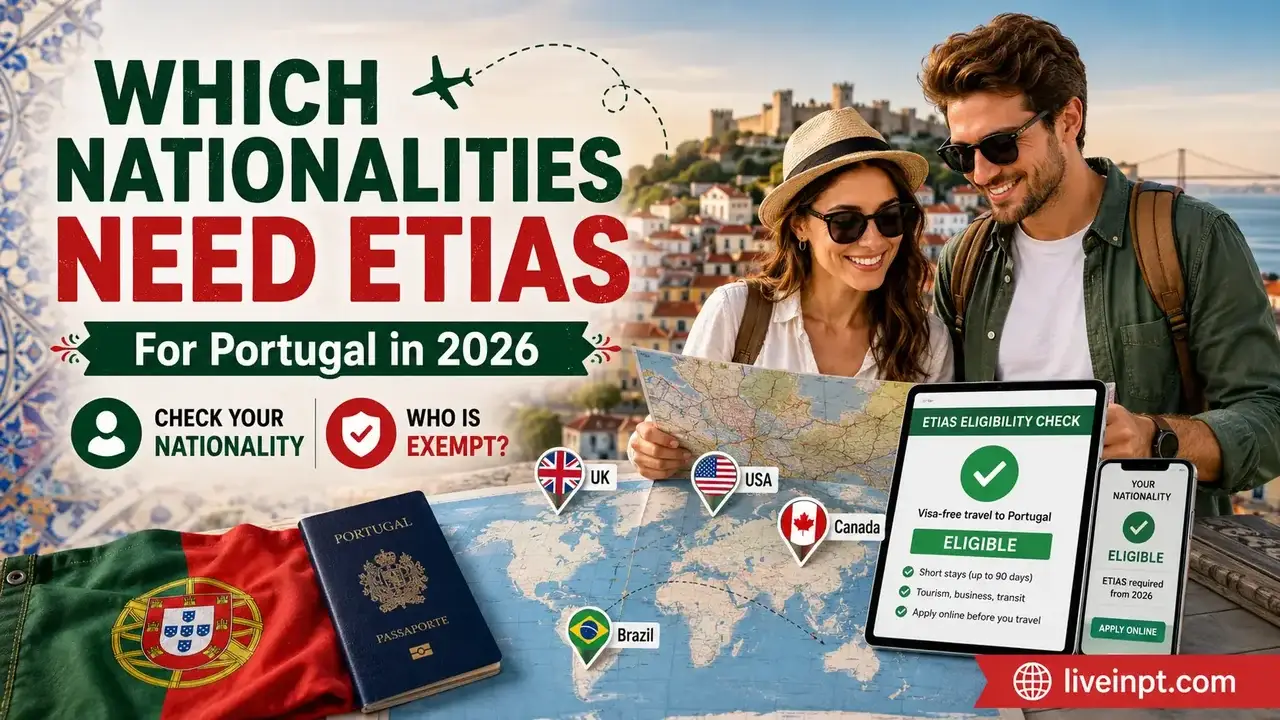
ETIAS applies to your nationality if, and only if, your country currently has visa-free short-stay access to the Schengen Area. If it does, you will need ETIAS when the system launches in Q4 2026. If your country requires a Schengen visa, ETIAS does not apply. If you live in Portugal with a valid residence permit, ETIAS does not apply to you regardless of your nationality.
For the full picture on what ETIAS is and its current status, see the ETIAS Portugal guide.
Quick Answer: Approximately 60 nationalities will need ETIAS for Portugal once the system launches in Q4 2026. These are countries that currently have visa-free access to the Schengen Area. EU, EEA, and Swiss citizens are always exempt. Nationalities that currently require a Schengen visa, including India, China, South Africa, and Nigeria, are also exempt from ETIAS (they continue to need a Schengen visa). Holders of a valid Portuguese residence permit are exempt regardless of nationality.
Three Groups, Three Different Answers
Understanding which category applies to your passport makes everything else straightforward.
Group 1, Always exempt: EU, EEA (Norway, Iceland, Liechtenstein), and Swiss citizens. Free movement applies. ETIAS is irrelevant.
Group 2, Need ETIAS: Nationals of approximately 60 countries that currently have visa-free short-stay Schengen access. The full list is below.
Group 3, Not ETIAS, need Schengen visa instead: Nationals of countries that do not have visa-free Schengen access. ETIAS does not apply. A consulate-issued Schengen visa remains the requirement. For more on which system applies based on your nationality, the comparison guide covers this directly.
The Most-Searched Nationalities
These are the nationalities people search for most. Short answers:
| Nationality | Need ETIAS for Portugal? |
|---|---|
| United States | Yes, visa-exempt, ETIAS required at launch |
| United Kingdom | Yes, post-Brexit visa-exempt, ETIAS required at launch |
| Canada | Yes, visa-exempt |
| Australia | Yes, visa-exempt |
| New Zealand | Yes, visa-exempt |
| Brazil | Yes, visa-exempt |
| Japan | Yes, visa-exempt |
| South Korea | Yes, visa-exempt |
| UAE | Yes, visa-exempt |
| Israel | Yes, visa-exempt |
| India | No, Schengen visa required instead |
| China | No, Schengen visa required instead |
| South Africa | No, Schengen visa required instead |
| Nigeria | No, Schengen visa required instead |
| Pakistan | No, Schengen visa required instead |
| Russia | No, Schengen visa required instead |
| Egypt | No, Schengen visa required instead |
| Morocco | No, Schengen visa required instead |
Full List of Nationalities That Need ETIAS
These are the confirmed ETIAS-eligible nationalities, countries whose citizens will need ETIAS authorisation to visit Portugal and other Schengen countries for short stays once the system launches. The list is alphabetical.
Albania, Antigua and Barbuda, Argentina, Australia, Bahamas, Barbados, Bosnia and Herzegovina, Brazil, Brunei Darussalam, Canada, Chile, Colombia, Costa Rica, Dominica, El Salvador, Georgia, Grenada, Guatemala, Honduras, Hong Kong SAR, Israel, Japan, Kiribati, Macau SAR, Malaysia, Marshall Islands, Mauritius, Mexico, Micronesia, Republic of Moldova, Montenegro, New Zealand, Nicaragua, North Macedonia, Palau, Panama, Paraguay, Peru, Saint Kitts and Nevis, Saint Lucia, Saint Vincent and the Grenadines, Samoa, Serbia, Seychelles, Singapore, Solomon Islands, South Korea, Taiwan, Timor-Leste, Tonga, Trinidad and Tobago, Tuvalu, Ukraine, United Arab Emirates, United Kingdom, United States of America, Uruguay, Vanuatu (suspended until further notice), Venezuela.
If your country is not on this list and you do not hold EU, EEA, or Swiss citizenship, you almost certainly need a Schengen visa rather than ETIAS.
Special Cases Worth Knowing
UK Citizens After Brexit
UK citizens are on the ETIAS list. Before Brexit, they had EU freedom of movement and no restrictions on stays in EU countries. Since December 2020, UK citizens became third-country nationals. The Schengen Area retained visa-free short-stay access for UK passports, which is why ETIAS applies to them rather than the Schengen visa requirement.
The exception: UK nationals who established residence in an EU country before 31 December 2020 and hold a Withdrawal Agreement residence document from that country are exempt from ETIAS. This is a relatively small group, mostly UK citizens who were already living in Spain, France, Portugal, or elsewhere when Brexit occurred.
UK citizens living in Portugal today under current immigration routes, D7, D8, or other AIMA-issued permits, are exempt because of their residence document, not because of the Withdrawal Agreement.
Hong Kong and Macau SAR Passports
Hong Kong SAR and Macau SAR passport holders are on the ETIAS list. These are special administrative region travel documents, separate from PRC (People’s Republic of China) passports. PRC passport holders are not on the ETIAS list, they require a Schengen visa. If you hold both a Hong Kong SAR passport and a PRC passport, travel to Portugal on your HK SAR document and apply for ETIAS with that passport.
Dual Nationals
If you hold an EU, EEA, or Swiss passport alongside any other nationality, travel on your EU/EEA/Swiss document. No ETIAS is needed, and no Schengen visa is required. You should always present your EU passport at Schengen borders.
If you hold dual nationality between two non-EU countries, for example, a US and a Brazilian passport, both are on the ETIAS list, and either passport can be used for ETIAS purposes. Apply using the passport you intend to travel on. ETIAS is linked to the specific passport number used in the application.
If one of your nationalities is on the ETIAS list and the other requires a Schengen visa (for example, a US-Indian dual national), you can travel on your US passport and use ETIAS, avoiding the Schengen visa requirement altogether. Present the US passport consistently at all Schengen borders.
Vanuatu
Vanuatu was previously on the ETIAS-eligible list but has been suspended until further notice. Vanuatu passport holders should check the official EU ETIAS site for the current status when the system launches.
British Overseas Territories Citizens
The situation for British Overseas Territories Citizens (BOTCs), holders of travel documents from places such as Gibraltar, the Falkland Islands, or the Cayman Islands, depends on the specific document and whether the holder also has a UK passport. Those who also hold a standard UK biometric passport should treat their situation as UK citizens travelling on that document: ETIAS applies. If a BOTC has any uncertainty about their travel document’s status, the relevant Portuguese consulate or the official EU ETIAS site is the place to verify before travel.
Portugal Residents Are Exempt, Regardless of Nationality
This applies no matter where your passport is from. If you hold a valid Portuguese residence permit, the Título de Residência (residence permit card) issued by AIMA, you are exempt from ETIAS. Your residence document already grants you the legal right to cross external Schengen borders. This covers all categories of AIMA-issued residence: D7, D8, and other visa-based permits.
If you are a non-EU family member of an EU citizen and hold the relevant residence card issued under EU free-movement rules, you are also exempt. EU, EEA and Swiss citizens themselves do not need ETIAS because free movement applies.
Carry your residence document when travelling internationally. Border officers may ask to see it. The AIMA Título de Residência is the physical card they are looking for.
For clarity on how your residency status relates to travel rights and the Schengen 90/180-day rule, the 90-day rule guide covers the distinction between short-stay rules for visitors and how residents sit outside that framework.
Fee Exemptions by Age
ETIAS will cost €20 per adult. The following groups are exempt from the fee but must still complete the ETIAS application:
- Children under 18
- Adults over 70
The application can be completed on behalf of a minor by a parent or legal guardian. Each traveller needs their own individual ETIAS, authorisations are not shared or transferable.
Nationalities That Need a Schengen Visa Instead
These are the major nationalities that are not on the ETIAS list and instead require a Schengen visa to enter Portugal: India, China, Russia, South Africa, Nigeria, Pakistan, Egypt, Morocco, the Philippines, Indonesia, Ghana, Kenya, Bangladesh, Sri Lanka, and Ethiopia, among many others.
If your country is not in the ETIAS list above and you do not hold EU, EEA, or Swiss citizenship, you likely need a Schengen visa. The Schengen visa is applied for at the Portuguese consulate in your country, costs €90 for adults, and typically takes 15 to 45 business days to process.
Frequently Asked Questions
Does the UK need ETIAS for Portugal after Brexit?
Yes. Following Brexit, UK citizens became third-country nationals but retained visa-free short-stay access to the Schengen Area. Because they are visa-exempt, they fall into the ETIAS category. When ETIAS launches in Q4 2026, UK citizens will need to apply online before visiting Portugal. The exception is UK nationals who hold a Withdrawal Agreement residence document from an EU country, they are exempt.
Do US citizens need ETIAS for Portugal?
Yes. US citizens currently enter Portugal visa-free for up to 90 days in any 180-day period. When ETIAS launches in Q4 2026, that visa-free access will require an approved ETIAS authorisation first. The application will be online, cost €20, and take approximately 10 minutes.
Do South Africans need ETIAS or a Schengen visa for Portugal?
A Schengen visa. South Africa does not have visa-free Schengen access. South African citizens are not on the ETIAS-eligible list and must apply for a Schengen visa through the Portuguese consulate. ETIAS does not apply to them.
Do Brazilians need ETIAS for Portugal?
Yes. Brazilian citizens have visa-free access to the Schengen Area for short stays. When ETIAS launches in Q4 2026, Brazilians visiting Portugal will need to apply for ETIAS online before travelling.
Do Indians need ETIAS for Portugal?
No. Indian citizens require a Schengen visa to enter Portugal. ETIAS applies only to nationalities with existing visa-free Schengen access. Indian passport holders should apply for a Schengen visa, not ETIAS.
Do Australians need ETIAS for Portugal?
Yes. Australian citizens currently enter Portugal visa-free. When ETIAS launches in Q4 2026, they will need to apply for ETIAS online before travelling. The process will cost €20 and take about 10 minutes.
I have dual nationality, do I need ETIAS?
It depends on which passport you use. If you hold EU, EEA, or Swiss citizenship alongside any other passport, you do not need ETIAS, but you must travel on your EU/EEA/Swiss passport. If you hold dual nationality between two non-EU countries where one requires ETIAS and one requires a Schengen visa, apply for ETIAS using the passport from the visa-exempt country.
If I live in Portugal with a residence permit, do I need ETIAS?
No. Holders of a valid Portuguese residence document, such as an AIMA residence permit or a residence card issued under EU free-movement rules, are exempt from ETIAS. Your residence document grants you the legal right to cross external Schengen borders. Carry it when you travel.
Is Vanuatu on the ETIAS list?
Vanuatu was previously on the ETIAS-eligible list but has been suspended until further notice. Vanuatu passport holders should check the official EU ETIAS site for current status when the system launches.
Does ETIAS apply to children?
Yes. Children from ETIAS-eligible nationalities must have their own ETIAS authorisation, regardless of age. Children under 18 are exempt from the €20 fee but still need to submit the application. A parent or legal guardian can complete the application on their behalf.