

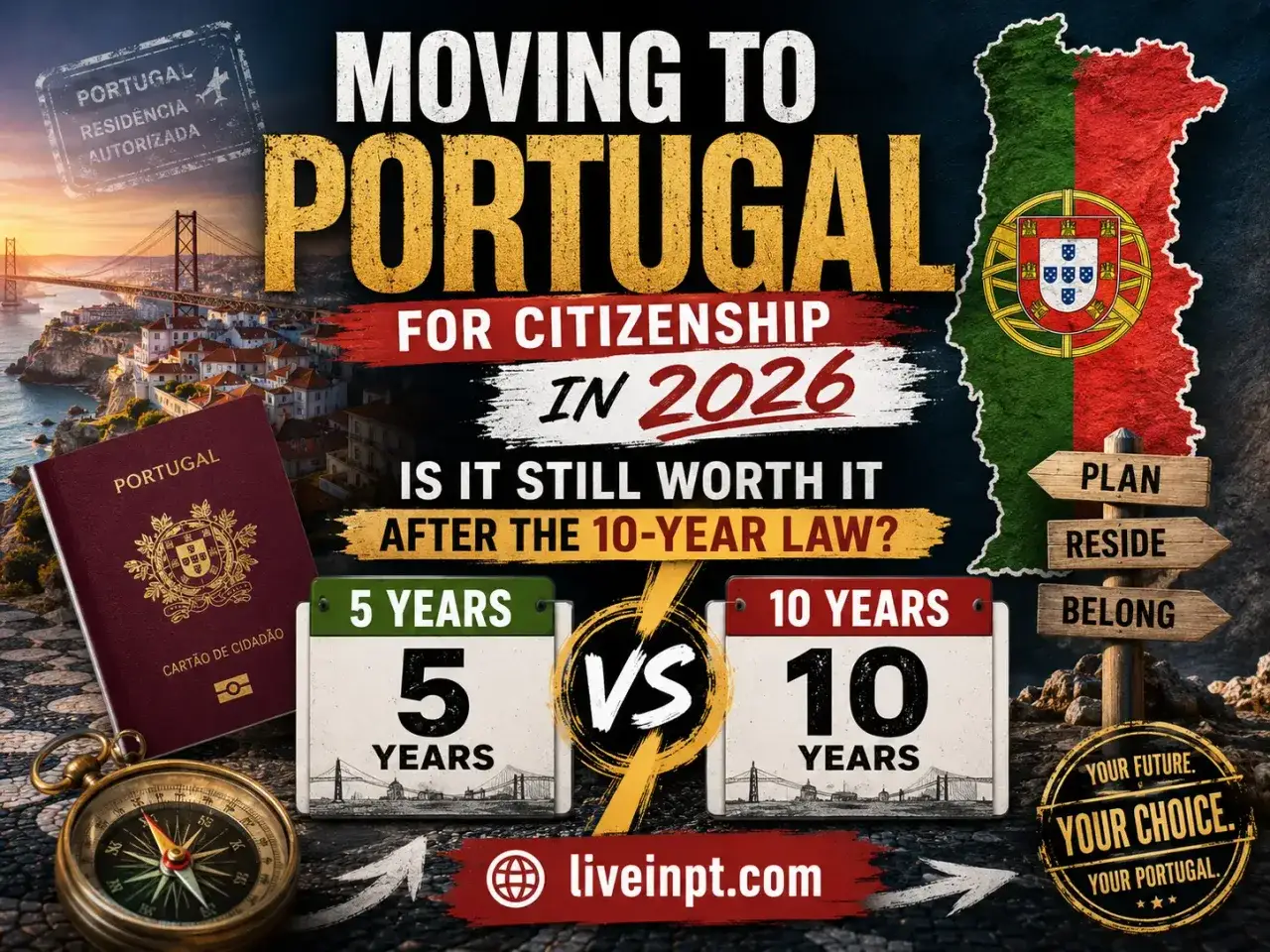
Portugal is no longer a simple five-year passport plan for many new movers. On 3 May 2026, the President promulgated the decree amending Portugal’s Nationality Law, moving the country toward a longer residence-based citizenship timeline.
For most non-EU, non-CPLP nationals, the practical planning assumption is now 10 years of legal residence before citizenship. For EU nationals and CPLP citizens, the expected timeline is 7 years. The final details still depend on the published Diário da República text, entry-into-force wording, and IRN practice, so do not calculate your exact eligibility date from social media posts.
The real question is no longer only “Can I get Portuguese citizenship?” It is: does Portugal still make sense as a long-term life plan if citizenship is a 7- or 10-year goal?
Quick Answer: Moving to Portugal for citizenship can still make sense in 2026, but not as a quick passport strategy. If you want to live in Portugal, build stability, learn Portuguese, and treat citizenship as a later milestone, it can still be a strong plan. If your only goal was a five-year route to an EU passport, the new law changes the maths significantly.
Status as of May 2026
- Promulgated: The President promulgated the decree amending Portugal’s Nationality Law on 3 May 2026.
- Final text: Check the Diário da República for the final published law, entry-into-force date, and transitional wording.
- Pending cases: The President highlighted that pending cases should not be affected, but applicants should still confirm the final published text and IRN practice.
- New integration rules: The reform adds broader civic/cultural knowledge requirements alongside the existing Portuguese-language requirement.
What the Reform Actually Changes
Portugal’s Parliament approved the nationality-law reform on 1 April 2026. The President promulgated the decree on 3 May 2026. The reform changes the way people should plan for citizenship by residence.
| Area | What changed or needs checking |
|---|---|
| Residence requirement for many non-EU nationals | Expected to move from 5 years to 10 years. |
| EU and CPLP nationals | Expected to move to a 7-year residence requirement. |
| Citizenship clock | The reform is expected to change how residence time is counted; check the final published wording before calculating eligibility. |
| Language | A2 Portuguese remains important for residence-based naturalisation. |
| Civic/cultural knowledge | The reform adds broader knowledge requirements around Portuguese culture, history, symbols, rights, duties, and democratic values. The exact test format should be checked after implementation rules are available. |
| Pending applications | The President said pending cases should not be affected, but final transitional rules and IRN practice matter. |
| Children born in Portugal | The reform tightens the rules for children born in Portugal to foreign parents. Families should check the final published wording before relying on any automatic rule. |
For the full legal update on the 5-, 7-, and 10-year rules, see our guide to Portugal citizenship requirements in 2026.
Your Citizenship Clock: Do Not Guess the Date
This is one of the most important planning points.
Many people used to count from the day they arrived in Portugal or the day they submitted paperwork. That is risky. The reform is expected to move residence counting back toward the date of legal residence/title issuance rather than the more favourable application-date approach introduced in 2024.
Until the final wording is settled, use a conservative planning approach:
- keep a copy of every residence card;
- keep proof of renewal submissions;
- keep AIMA and IRN receipts;
- track your actual card issue dates;
- do not assume waiting time automatically counts unless the law clearly says so.
This matters because AIMA delays can create a real gap between arrival and the date your legal residence is formally recognised.
What This Means for Your Next Steps
| Your situation | What it means | What to do now |
|---|---|---|
| You already applied for citizenship | You may be in the group the President said should not be affected. | Keep proof of submission, payment, and all IRN communication. Do not restart or withdraw without legal advice. |
| You are eligible but have not filed | Timing matters more than ever. | Prepare a complete file and speak with a qualified lawyer before delaying. |
| You are around year 3 or 4 | You may no longer be close to citizenship if the new rules apply to you. | Protect your residence continuity, learn Portuguese, and monitor the final rules. |
| You just arrived or are about to move | Treat citizenship as a long-term milestone, not a short relocation project. | Plan housing, tax, language, renewals, and documents around a longer stay. |
| You were moving mainly for a five-year passport | The value calculation has changed. | Compare Portugal’s lifestyle and residence stability against your real goal. Do not move only because of outdated five-year claims. |
A Realistic 10-Year Citizenship Timeline
For many new non-EU residents, the practical timeline now looks closer to this:
- Year 0: Move to Portugal and obtain legal residence.
- Years 1–5: Renew residence, keep tax/address records clean, avoid long gaps, and start Portuguese early.
- Year 5: Consider long-term residence or permanent residence options if you want stronger stability.
- Year 7: Possible citizenship point for EU/CPLP nationals, depending on the final law and your situation.
- Year 10: Possible citizenship point for many non-EU nationals, again depending on the final law and your residence history.
- After filing: IRN processing can still take significant time, so eligibility is not the same as passport-in-hand.
This is why Portugal should now be treated as a serious life plan, not a quick EU passport shortcut.
The Year-5 Alternative: EU Long-Term Residence
If citizenship moves further away, year 5 still matters.
After five years of legal residence, some residents may be able to look at Portuguese permanent residence or EU long-term residence. This is not citizenship and it does not give you a Portuguese passport. But it can offer stronger residence stability and, in some cases, a conditional route to live in another EU country under that country’s procedure.
This article will not repeat the full requirements here. For the detailed rules, documents, student-time issue, and AIMA process, read the guide to EU long-term residence in Portugal.
Which Residence Route Still Works Best?
The new citizenship timeline applies to naturalisation. It does not mean every visa route becomes equal in practice.
D7 visa: Still one of the clearest routes for retirees, passive-income applicants, and people with stable non-salary income. It is simple to understand but requires real income and residence planning.
D8 digital nomad visa: Useful for remote workers who meet the income threshold. It can work well if your job is stable and you can maintain Portugal as your real base.
D2 visa: Better for entrepreneurs and independent professionals with a credible business or freelance plan. It is not a passive route.
Golden Visa / ARI: Still attractive for people who cannot live full-time in Portugal but can make a qualifying investment. It is not a faster citizenship route, and it is much more expensive.
If citizenship is your long-term goal, the best route is not only the one that gets you into Portugal. It is the one you can realistically renew, document, and maintain for many years.
Language and Civic Requirements
The A2 Portuguese requirement remains important. Most applicants prove this through the CIPLE exam, although exemptions can apply in some cases.
The reform also adds broader civic and cultural knowledge requirements. Based on current reporting and legal commentary, this may include knowledge of Portuguese culture, history, national symbols, rights and duties, and democratic values. The exact format, pass mark, and practical process should be checked once the final law and implementation rules are available.
The practical advice is simple: do not leave Portuguese until the final year. Start early enough that the language requirement becomes easy, not stressful.
IRN Processing Reality
Even after you become eligible and submit your nationality application, the process can take time. IRN has faced heavy demand in recent years, and nationality applications are not usually a quick final step.
This matters for planning. If your legal residence requirement is 7 or 10 years, you may still need additional processing time before you actually hold a Portuguese citizen card and passport.
Treat the citizenship application as the start of the final administrative phase, not the finish line.
Is Portugal Still Worth Moving to for Citizenship?
Portugal still makes sense if…
- you actually want to live in Portugal, not just collect a passport;
- you value safety, climate, lifestyle, healthcare access, and EU residence stability;
- you are willing to learn Portuguese and build a real connection to the country;
- you can maintain legal residence and documents for many years;
- citizenship is a long-term milestone, not the only reason for moving.
Think twice if…
- your only goal was a fast five-year passport;
- you cannot realistically maintain residence continuity;
- you do not want to learn Portuguese;
- you are relying on old YouTube, TikTok, or forum advice about the five-year rule;
- your life plan depends on having an EU passport by a fixed short deadline.
Portugal can still be a strong choice. But the new timeline makes honesty more important. If you would not want to live in Portugal without the passport, the 10-year law should make you pause.
Common Mistakes When Planning Around Citizenship
Mistake: Treating old five-year content as current
Many articles, videos, and forum comments were written before the 2026 reform. Always check the date and whether the source reflects the President’s May 2026 promulgation and the final published law.
Mistake: Counting from arrival instead of legal residence
Do not calculate your citizenship eligibility from the day you landed in Portugal. Keep your residence-card history and official dates organised.
Mistake: Ignoring the year-5 stability options
Even if citizenship is further away, year 5 may still matter for long-term residence planning. Do not treat years 5 to 10 as “dead time.”
Mistake: Leaving Portuguese until the end
The longer timeline gives you more time to learn, but it also makes it easier to procrastinate. A2 is not impossible, but it is much easier if you start early.
Mistake: Choosing a visa route only because someone said it leads to citizenship
All residence routes require renewals, documents, and real-life compliance. Choose the route you can actually sustain.
The guide to common mistakes foreigners make after moving to Portugal covers related document and process errors that can create problems later.
Frequently Asked Questions
Is Portugal citizenship still 5 years in 2026?
For most new residence-based naturalisation planning, no. The reform promulgated on 3 May 2026 is expected to move many non-EU applicants toward a 10-year timeline and EU/CPLP nationals toward a 7-year timeline. Check the final published law before relying on an exact rule.
Is the 10-year law already active?
The President promulgated the decree on 3 May 2026. Before making a legal decision, check the Diário da República publication, entry-into-force wording, and current IRN practice.
Are pending applications protected?
The President highlighted the importance of pending cases not being affected. Still, keep proof of submission and confirm the final transitional wording before assuming how your case will be treated.
Should I still move to Portugal for citizenship?
Yes, if you want Portugal as a real long-term home and citizenship as a future milestone. No, or at least think carefully, if your only reason was a quick five-year EU passport.
What can I apply for after 5 years instead?
Depending on your residence history, you may be able to consider permanent residence or EU long-term residence. These do not give you a Portuguese passport, but they can offer stronger stability while citizenship eligibility is further away.
Does time waiting for AIMA count?
Do not assume it counts automatically. The reform is expected to change how residence time is counted, and the final published wording matters. Keep proof of every application, renewal, payment, and card issue date.
Do I still need Portuguese language proof?
Yes. A2 Portuguese remains central for residence-based naturalisation. The reform also adds broader civic and cultural knowledge requirements, but practical details should be checked after implementation rules are published.
Which visa is best if citizenship is my long-term goal?
The best visa is the one you can maintain legally for many years. For some people that is D7, for others D8, D2, employment, study-to-work transition, family reunification, or Golden Visa. Do not choose a route only because it sounds fast.
Does having a Portuguese-born child make citizenship easier?
The reform tightens rules for children born in Portugal to foreign parents. Families should check the final published law and get advice before relying on automatic citizenship assumptions.
Is Golden Visa still a citizenship shortcut?
No. The Golden Visa may still be useful for low-stay residence planning, but it does not create a faster naturalisation timeline.
Bottom Line
Moving to Portugal for citizenship is still possible. But in 2026, it is no longer a simple five-year passport plan for many people.
The better way to think about it is this: Portugal can be a strong long-term residence and citizenship plan if you want the country itself. If you only wanted a quick EU passport, the new timeline changes the decision completely.