

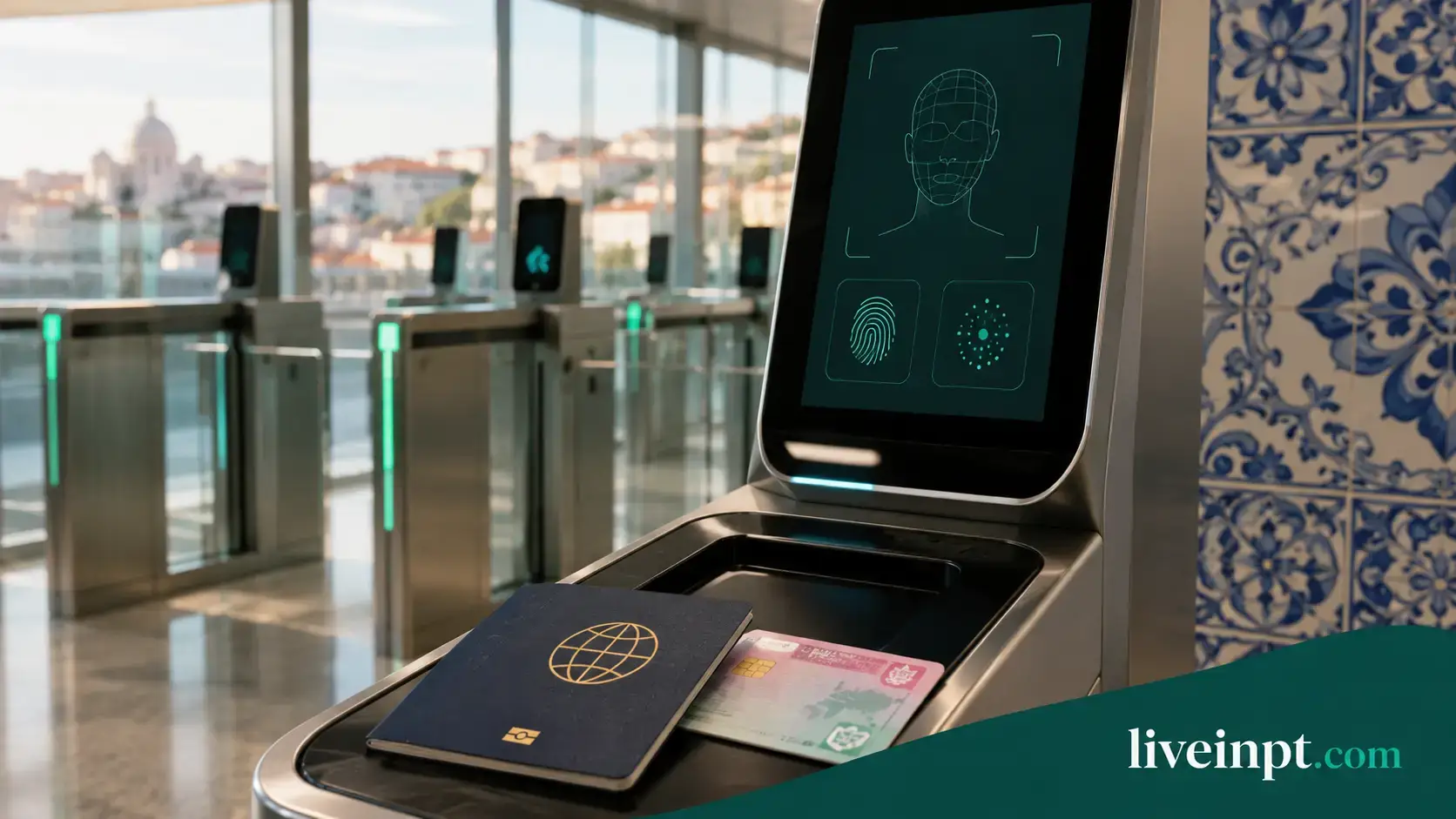
Portugal airport update — 15 September 2026: EES remains operational. PSP says Portugal collected biometrics from all passengers subject to the relevant checks during the week after 6 September; at Lisbon, the reported border process was taking roughly 15–30 minutes, while Faro was under greater pressure. The Commission said it was working with some countries on adjustments at specific crossings, and PSP told Lusa biometric capture could be skipped if technical problems arose. Expect biometric capture if you are in scope, but do not treat the reported times or “100% collection” as guarantees at every crossing.
Quick Answer: The EU Entry/Exit System records entries and exits of non-EU nationals making short visits to the Schengen Area. If you are travelling as a short-stay visitor, expect biometric checks at Portugal’s external borders. If you hold a qualifying valid Portuguese residence permit or long-stay visa, carry it with your passport because you are normally exempt from EES registration.
EES is easy to misunderstand because several different questions get mixed together: whether the system is operational, whether biometrics are being collected on a particular day, whether a traveller is exempt, and how long airport queues will take.
The 6 September deadline ended the special rollout flexibility to suspend biometric registration. It did not start EES. Later reports describe technical exceptions and operational adjustments at particular crossings, but not a general continuation of the expired rollout flexibility.
Who Has to Register in EES?
| Traveller | EES registration? | What to know |
|---|---|---|
| EU, EEA or Swiss national | No | Use the passport or national identity document that proves that nationality. |
| Holder of a valid residence permit issued by a country using EES | No | Carry the passport and residence permit together. |
| Holder of a valid long-stay visa issued by a country using EES | No | Present the valid long-stay visa with the passport. |
| Visa-exempt non-EU visitor making a short stay | Yes | First enrolment normally includes passport data, a facial image and four fingerprints. |
| Short-stay Schengen visa holder | Yes | EES records the crossing; fingerprints already held in the Visa Information System are handled through the connected systems. |
| Child under 12 who is otherwise subject to EES | Yes | A facial image is recorded, but children under 12 are exempt from fingerprinting. |
There are additional exemptions for specific categories, including some family members protected by EU free-movement law. If your answer depends on a special residence card or family relationship, check the official EU exemption list rather than deciding from passport nationality alone.
What the EU Entry/Exit System Actually Records
EES is an electronic border system for non-EU nationals entering or leaving the European countries using it for a short stay. It began progressive operation on 12 October 2025 and reached full operation on 10 April 2026.
For a traveller within its scope, the system records identity and travel-document details, the place and time of entry or exit, and any refusal of entry. It also uses biometric data to verify identity.
For first enrolment:
- visa-exempt short-stay visitors normally provide a facial image and four fingerprints;
- short-stay visa holders have fingerprints handled through the connected Visa Information System rather than stored again in EES in the same way;
- children under 12 are not fingerprinted.
Later crossings normally use the existing EES file to verify identity, although data may sometimes need to be collected again.
There is no separate EES fee and no visa-style EES application. EES is also not ETIAS. ETIAS is the separate pre-travel authorisation expected to start in the last quarter of 2026; the EU has not yet announced the precise launch date.
EES at Lisbon, Porto and Faro Airports
EES applies when a traveller crosses Portugal’s external Schengen border. That includes relevant arrivals from and departures to non-Schengen countries at Lisbon, Porto and Faro airports, as well as external-border crossings in Madeira, the Azores and Portuguese seaports.
A flight from Lisbon to Paris or Amsterdam is an internal Schengen journey. A flight from Lisbon to London, New York or Casablanca crosses the external Schengen border and involves passport control.
What changes on 6 September 2026?
Portugal has already been operating EES. Before 6 September, special rollout rules allowed biometric registration to be temporarily suspended in exceptional situations causing excessive waiting times. That temporary rollout mechanism has now expired.
On 1 September, the European Commission said it was working with a few countries on operational adjustments at specific border crossings and aimed to resolve outstanding challenges by year-end. On 13 September, PSP told Lusa that the Commission had indicated biometric capture could be skipped if technological problems arose. On 14 September, the Guardian reported that Portugal was among nine countries seeking more time for checks, while noting that the issues were not countrywide.
That does not mean EES is suspended in Portugal, or that travellers can expect biometric checks to be skipped. The special rollout exception for suspending biometrics during excessive congestion had expired; reports of technical problems or adjustments concern particular crossings and situations.
PSP’s own post-deadline data shows how both things can be true. On 13 September, it said Portugal had collected biometrics from all passengers subject to the relevant checks during the previous week, while reporting that capture could be omitted if technological problems arise.
Here, “100% biometric collection” means travellers who fall within the applicable EES biometric process. Qualifying residence-permit and long-stay-visa holders remain outside normal EES registration.
So the timeline is:
- 12 October 2025: progressive EES rollout began.
- 10 April 2026: EES reached full operation.
- 6 September 2026: the special rollout flexibility for suspending biometric registration expired.
- 13 September 2026: PSP reported full applicable biometric collection during the previous week, with Faro under the greatest pressure.
- 14 September 2026: the Guardian reported Portugal among nine countries seeking more time for checks, with issues at some crossings rather than countrywide.
What should travellers expect at Lisbon, Porto and Faro?
Expect more pressure, but do not treat any single queue estimate as a promise.
| Airport | Current practical picture |
|---|---|
| Lisbon | PSP reports roughly 15–30 minutes for the relevant border process under full biometric collection, compared with about 5–15 minutes when biometric checks could be suspended. This is not a guaranteed total airport queue time. |
| Faro | Portugal’s current pressure point. PSP says flight bunching and delays can create sharp peaks; in one recent period, more than 10 flights arrived within 25 minutes, many carrying British passengers. |
| Porto | PSP describes biometric collection as running smoothly overall and has not singled Porto out for the same current pressure seen at Faro. |
First-time EES enrolment generally has more steps than a later verification because passport information, a facial image and fingerprints may need to be captured.
For a non-Schengen departure, allow a meaningful buffer and check your airline and airport information close to travel. If your airline will not accept checked bags until a certain time, arriving extremely early does not necessarily mean you can immediately complete every stage of the airport process.
Can the Travel to Europe app save time in Portugal?
The official Travel to Europe app is free and is intended for non-EU travellers who are subject to EES and hold a biometric passport. It can be used within 72 hours before a relevant journey, but the functionality available depends on the country.
The important Portugal-specific limitation is easy to miss: current official EU guidance says Portugal supports the entry questionnaire in the app. It does not currently describe Portugal as supporting the same full passport-data and facial-image pre-registration available in Sweden.
That means:
- you can use the official app where Portugal makes the questionnaire available;
- it does not replace passport control;
- it does not guarantee a separate fast-track queue;
- it does not mean your first EES biometric enrolment is already finished before you reach Lisbon, Porto or Faro;
- do not assume a Lisbon departure can be fully pre-registered simply because the app allows journeys to be created.
If the app helps on your journey, treat it as a preparation tool rather than a guaranteed queue-skipping product.
Do you need a Portugal Digital Arrival Card or PTDAC?
Search data is starting to show people asking whether they need both EES and something called a Portugal Digital Arrival Card / PTDAC.
As of 31 August 2026, I could not verify any Portugal-wide mandatory arrival document called PTDAC on the Portuguese Government website or the official EU EES/Travel to Europe guidance.
Private commercial websites are advertising a paid “Portugal Digital Arrival Card” and presenting it as mandatory. Before paying, verify any such claim against gov.pt, portugal.gov.pt or the official travel-europe.europa.eu pages.
Do not confuse a private “PTDAC” product with:
- EES, which is the EU border-recording system;
- the official free Travel to Europe app; or
- ETIAS, which is a separate future travel authorisation.
Is There EES at the Portugal-Spain Land Border?
No, not under normal conditions. Portugal and Spain share an internal Schengen border. Driving through Vilar Formoso, Elvas-Badajoz, Valença-Tui or another ordinary road crossing does not create an EES entry or exit because you have not left the Schengen Area.
Portugal or Spain can temporarily reintroduce internal border controls in exceptional circumstances. A police check during such a period is legally different from EES registration at an external border.
Your EES crossing is created at the external Schengen border. For example, a visitor flying New York → Madrid → Lisbon normally enters Schengen in Madrid. On a direct Lisbon → New York return, the Schengen exit is recorded in Lisbon.
What Portuguese Residence Permit Holders Should Do
A valid Portuguese residence permit takes you outside the normal scope of EES. The same broad exemption applies to holders of qualifying valid long-stay visas issued by a country using the system.
At passport control:
- Carry your passport and residence permit together.
- Present both documents rather than waiting for the officer to ask for the card.
- Follow the border authority’s lane instructions, which can differ by airport and terminal.
- If a kiosk appears to be asking you to enrol as a short-stay visitor, show the residence permit and ask a border officer how you should proceed.
I would not tell residents that one named lane is always correct. The important point is proving the exempt residence status, not guessing the right sign above the queue.
Being sent to a kiosk does not automatically prove that you were admitted as a tourist
A self-service kiosk can collect or pre-check information, but the border authority remains responsible for the final border check.
If you believe your exempt residence status has been handled incorrectly, raise it with a border officer before leaving the control area where possible. People whose data is held in EES have rights to request access and seek correction, completion or deletion of inaccurate data.
An old SEF logo does not by itself invalidate a residence card
A Portuguese residence card is not defective merely because it was issued before AIMA replaced SEF.
What matters is whether the document is genuine, readable, valid for the journey and proves a status that is exempt from EES. Our AIMA residence card guide explains the document and renewal process in more detail.
Expired cards and renewal receipts need extra caution
Do not assume that an expired card, AIMA appointment confirmation or renewal receipt will be accepted abroad in the same way as a valid residence permit.
Portugal can recognise rights or extensions domestically that another Schengen country, airline or transit authority may not treat as a valid travel document. If this is your situation, use our dedicated guide on travelling with an expired Portuguese residence card before booking a route through another Schengen country.
Most importantly, EES is not an AIMA renewal database. Residence-permit absence limits and renewal status are separate legal questions.
How EES Changes the 90/180-Day Rule
For short-stay visitors, EES makes the 90-days-in-any-180-days rule easier to enforce because external entries and exits are recorded electronically rather than reconstructed only from passport stamps.
The underlying calculation has not changed:
- the day of entry counts;
- the day of exit counts;
- the calculation looks backwards across a rolling 180-day period;
- travelling between Schengen countries does not restart the allowance.
For worked examples, use our Schengen 90/180 rule guide rather than trying to reconstruct the calculation from memory.
The rule for Portuguese residents needs a careful distinction
A Portuguese residence permit allows you to reside in Portugal under that permit. Days lawfully spent in Portugal under that residence status are not counted as short-stay tourist days.
That does not give an ordinary Portuguese residence permit holder unlimited residence in every other Schengen country. A residence permit issued by one Schengen state generally allows short visits to other Schengen states for up to 90 days in any 180-day period unless another legal basis applies.
Example:
- You live in Portugal for the full year under a valid Portuguese residence permit. Those Portuguese residence days are not tourist days.
- You then spend 45 days in France and 50 days in Germany within the same rolling 180-day window. Those visits can exceed the ordinary 90-day allowance for travel in other Schengen states even though your Portuguese residence permit remains valid.
This is why “the 90/180 rule never applies to residents” is too broad. The answer depends on whether you mean residence in Portugal or visits elsewhere in Schengen.
How Long EES Keeps the Data
The retention periods are not one universal three-year rule:
- an individual entry, exit or refusal record is generally stored for three years from the relevant exit or refusal record;
- the traveller’s individual file and linked records are generally stored for three years and one day following the last exit or refusal record, where no new entry is made during that period;
- if no exit is recorded after the authorised stay expires, the data may be kept for five years from the end of the authorised stay.
Travellers can request access to their EES data and can seek correction, completion or deletion where information is inaccurate or was recorded unlawfully.
Practical Checklist Before an External-Border Trip
- Check that your passport is valid and in acceptable condition.
- If you are a resident, carry the original valid residence permit or qualifying long-stay visa with the passport.
- Present both documents together at passport control.
- If you are subject to EES, expect biometric capture. Technical problems or operational adjustments may affect a particular crossing, but do not assume checks will be skipped.
- For first-time EES enrolment, allow more time than for a simple later verification.
- If you use the Travel to Europe app for Portugal, remember that current official support is the entry questionnaire, not full remote biometric enrolment.
- Do not pay for a “Portugal Digital Arrival Card / PTDAC” without verifying the requirement on an official Portuguese or EU website.
- Do not assume a residence-renewal receipt is a travel document.
- Check airport and airline information close to travel rather than relying on an old queue estimate.
- Count visits to other Schengen countries separately from time lawfully spent residing in Portugal.
Frequently Asked Questions
What changes at Portugal airports on 6 September 2026?
EES did not start on 6 September. The special rollout flexibility for suspending biometric registration expired. The Commission later reported adjustments at specific crossings, and PSP told Lusa that biometric capture could be skipped if technical problems arose. This does not mean EES was suspended or that the expired general rollout exception remains in force.
Is EES still active in Portugal if my biometrics are not taken?
Yes. PSP reported full applicable biometric collection during the week after 6 September, while also reporting that capture could be skipped if technical problems arose. A missing fingerprint or facial image alone does not show EES was cancelled or that your crossing was not recorded. Follow the instructions of border staff.
Do I need to register for EES if I have a valid Portuguese residence permit?
No. Holders of qualifying valid residence permits and long-stay visas are outside normal EES registration. Carry your passport and residence document together so border staff can verify the exemption.
Can I pre-register EES online before arriving in Portugal?
Partly. Eligible travellers can use the official Travel to Europe app, but country support varies. Current EU guidance says Portugal supports the entry questionnaire. The app does not replace border control, does not complete all biometrics remotely and does not guarantee a shorter queue.
Do I need a Portugal Digital Arrival Card or PTDAC?
As of 31 August 2026, I could not verify a Portugal-wide mandatory PTDAC requirement on official Portuguese Government or EU EES pages. Be cautious with private websites selling a paid “Portugal Digital Arrival Card”. It is not the same thing as EES, the official Travel to Europe app or ETIAS.
What should I do if airport staff send me to an EES kiosk as a resident?
Show your passport and valid residence permit and explain that you are exempt from EES registration. Ask a border officer which process you should use. If you believe inaccurate EES data has been created, raise it promptly.
Does EES apply at the Portugal-Spain land border?
No under normal conditions. Portugal and Spain share an internal Schengen border. Temporary internal border controls are possible in exceptional circumstances, but that is separate from EES.
Does the 90/180 rule apply to Portuguese residence permit holders?
Days spent lawfully residing in Portugal under a valid permit are not short-stay days. Ordinary visits to other Schengen countries are generally still limited to 90 days in any 180-day period unless another right or exception applies.
Is an old SEF-issued residence card automatically a problem under EES?
No. The old SEF logo by itself does not invalidate a genuine, otherwise valid residence card. A damaged, expired or unclear document can still cause problems.
Can I travel with an expired residence card or an AIMA renewal receipt?
Do not assume an expired card or renewal receipt will be accepted like a valid residence permit by an airline, transit country or another Schengen authority. Check the current travel rules for your route before leaving Portugal.
Is EES the same as ETIAS?
No. EES records eligible travellers at the external border. ETIAS will be a separate pre-travel authorisation for visa-exempt visitors. The official EU timetable still places ETIAS in the last quarter of 2026, but the precise launch date has not yet been announced.
How long is EES data kept?
Entry, exit and refusal records are generally stored for three years. The individual file is generally stored for three years and one day after the last exit or refusal record. Where no exit is recorded after the authorised stay expires, data may be retained for five years.
Does EES completely replace passport stamps?
For travellers registered in EES, electronic records generally replace manual entry and exit stamps. Border authorities can still use alternative procedures where EU rules allow this during technical or operational disruption.