

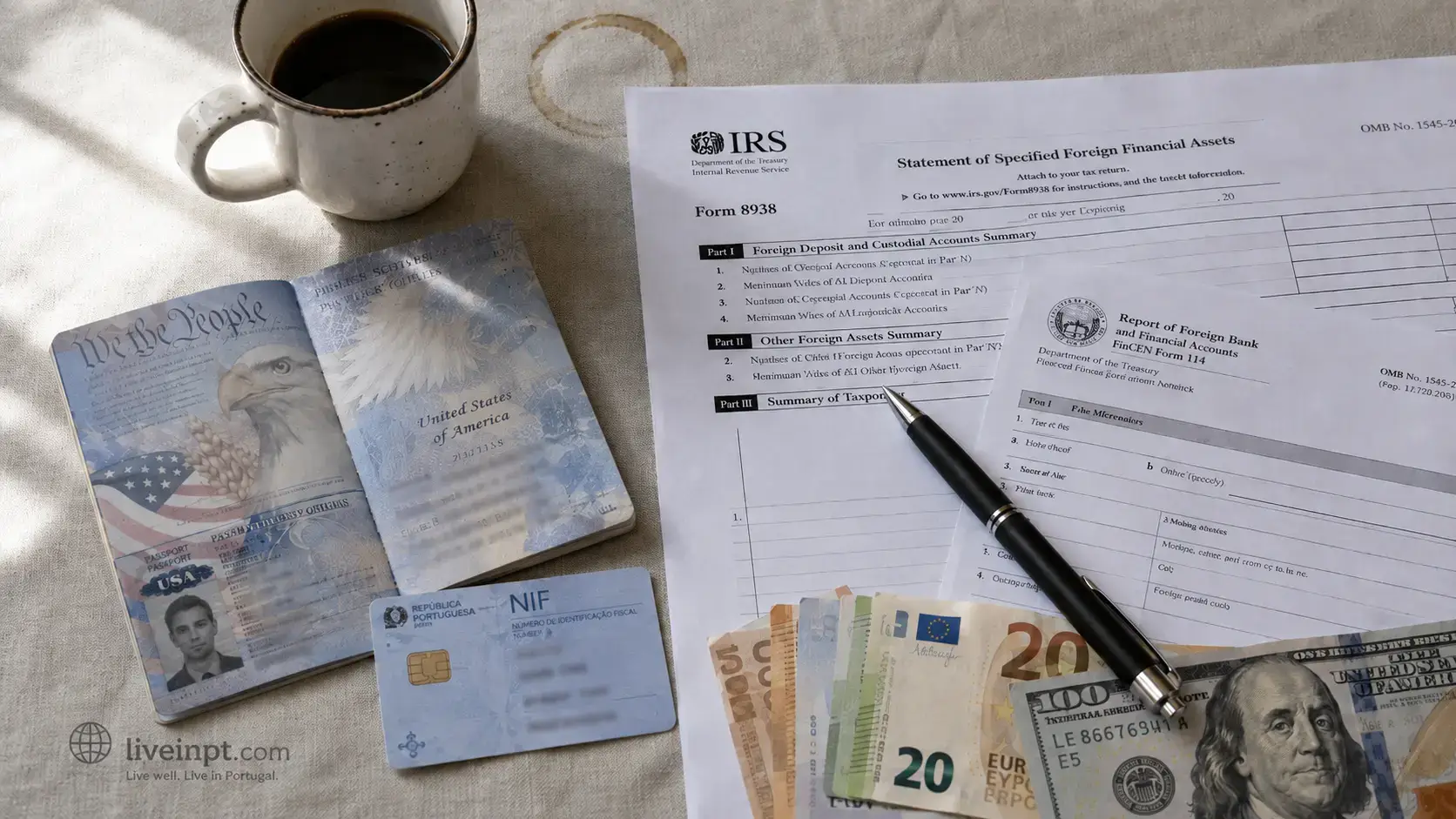
If you are an American living in Portugal, the reporting goes in both directions. Portuguese accounts can create US reporting, while US accounts and US-source income can create Portuguese reporting.
FATCA is only one part of it.
| What you have | What to check |
|---|---|
| Foreign financial accounts over $10,000 combined at any time | FBAR, FinCEN Form 114 |
| Higher-value foreign financial assets | FATCA Form 8938 |
| US bank, brokerage or other foreign income while Portuguese tax resident | Portugal Anexo J |
| Portuguese or other non-US fund | Possible PFIC / Form 8621 |
| Missing old US returns or FBARs | Late-filing or Streamlined route |
The key is to separate bank reporting, your US filings and your Portuguese filing. They overlap, but one does not replace another.
FATCA Portugal: what your Portuguese bank does
Portugal implements FATCA reporting for US reportable accounts. That is why a Portuguese bank may ask a US citizen for US tax identification details or a FATCA self-certification when opening or reviewing an account.
That is the bank’s reporting obligation. It does not file your FBAR or Form 8938 for you.
Keep this distinction straight: your bank’s FATCA reporting is not your FBAR. You can be fully identified by the bank and still have your own US filing obligation.
FBAR: the $10,000 rule most Americans hit first
FBAR is FinCEN Form 114. It is filed separately from Form 1040.
You generally file if you have a financial interest in, or signature or other authority over, reportable foreign financial accounts whose aggregate value exceeded $10,000 at any time during the calendar year.
The $10,000 test is across the accounts together. It is not $10,000 per Portuguese account.
If the threshold is crossed, each reportable account is listed. For euro accounts, determine each account’s maximum value during the year and convert that maximum to dollars using the Treasury year-end exchange rate.
Common examples include Portuguese current and savings accounts, brokerage accounts and some other financial accounts. Signature authority can matter even when the money is not yours.
FBAR deadline: April 15, with an automatic extension to October 15. You do not file an extension request for the FBAR itself.
Form 8938: FATCA uses higher thresholds abroad
Form 8938 is attached to your US income-tax return. For taxpayers who meet the IRS living-abroad conditions, the thresholds are:
| Filing status | More than this at year-end | Or more than this at any time |
|---|---|---|
| Single or married filing separately | $200,000 | $300,000 |
| Married filing jointly | $400,000 | $600,000 |
The living-abroad test is not simply “I have a Portuguese residence permit.” It uses a foreign tax home plus the IRS bona fide residence or physical-presence rules.
Form 8938 also has a broader asset scope than FBAR. That is why you can need FBAR without Form 8938, and why the same Portuguese account can sometimes appear on both.
Portugal’s side: Anexo J includes US accounts even with zero income
This is the part many US-focused guides miss.
If you are a Portuguese tax resident, Portugal requires foreign income to be reported through Anexo J of the Modelo 3 return. Quadro 11 also identifies foreign deposit and securities accounts where you are the holder, beneficiary or authorised operator even if the account produced no income.
For a US account without an IBAN or BIC, Autoridade Tributaria says to use the account number.
So an American in Portugal can end up doing both:
- reporting Portuguese financial accounts to the US; and
- identifying US bank or brokerage accounts in Portugal.
Interest, dividends, salary, pensions, rents and gains can also enter Anexo J depending on the income type. The normal Portuguese filing window is April 1 to June 30.
If Quadro 11 is only identifying an account and there is no associated income, that identification does not itself change the tax calculation. Portugal’s official 2026 guidance also notes that the IRS simulator does not simulate Anexo J.
See our Portuguese IRS guide for foreigners for the broader Modelo 3 process.
Which return comes first: Portugal or the US?
Recent first-year expat discussions keep getting stuck here because the calendars do not line up neatly.
There is no universal “file the US first” or “file Portugal first” rule. The right order depends on the income, where it was taxed and which country is giving the foreign-tax credit.
This is where the calendar matters. Portugal has a specific mechanism for one version of the problem.
If you need a Portuguese foreign-tax credit but the final foreign tax assessment has not been issued by the Portuguese Modelo 3 deadline, AT says you can submit Modelo 49 by that deadline in qualifying cases. That extends the Portuguese return deadline until the end of the year without a late-filing penalty.
Do not use Modelo 49 as a generic extension. AT ties it to situations where the final foreign tax assessment needed for international double-tax relief is not yet available.
On the US side, qualifying Americans abroad normally receive an automatic two-month filing extension, with a further extension available through Form 4868. The US-Portugal pension and tax-treaty guide covers treaty treatment rather than repeating it here.
FATCA-compliant does not mean PFIC-safe
This matters if you are searching for a “FATCA-compliant Portugal fund” or considering a Portuguese investment fund.
FATCA compliance tells you about reporting by the institution. It does not tell you whether the investment is simple under US tax rules.
A US person holding shares in a foreign corporation that is a PFIC can have Form 8621 reporting and a different tax regime. Many non-US pooled funds need PFIC analysis, including funds and UCITS products commonly offered in Europe.
For a QEF election, the IRS instructions require information from a PFIC Annual Information Statement or qualifying intermediary statement.
Do this check before you buy the fund. Ask whether it is expected to be a PFIC for US purposes and, if a QEF election is planned, whether the fund actually provides the required annual statement. “We accept US investors” is not the same answer.
This is particularly relevant to US investors looking at the Portugal Golden Visa investment-fund route.
If you missed FBAR or FATCA filings
Do not assume the answer is simply “pay a penalty.”
For qualifying US taxpayers residing outside the United States whose failures were non-willful, the Streamlined Foreign Offshore Procedures generally require:
- the most recent 3 years of delinquent or amended US tax returns for which the due date has passed;
- the most recent 6 years of delinquent FBARs for which the due date has passed; and
- payment of tax and interest due.
Eligible foreign-procedure filers who comply with the rules are not subject to the listed failure-to-file, failure-to-pay, accuracy-related, information-return and FBAR penalties under that procedure.
The familiar 5% miscellaneous offshore penalty is part of the domestic Streamlined procedure, not the qualifying foreign procedure.
If only FBARs were missed and the related income was correctly reported, a different delinquent-FBAR route may apply. Work out exactly what was missing before choosing a catch-up procedure.
2026 filing dates to keep together
| Date | Filing point |
|---|---|
| April 15, 2026 | Regular US Form 1040 date; FBAR due date |
| June 15, 2026 | Automatic US filing extension for qualifying taxpayers abroad |
| June 30, 2026 | Portugal Modelo 3 / Anexo J deadline for 2025 income |
| October 15, 2026 | Extended US return if Form 4868 was filed; automatic FBAR extension |
The automatic US extension changes the filing date, not the original due date for paying US tax. For Portugal’s other deadlines, use the Portugal tax calendar 2026.
Frequently asked questions
Do Americans in Portugal have to file an FBAR?
Yes, if the aggregate value of your reportable foreign financial accounts exceeded $10,000 at any time during the calendar year. The threshold is across the accounts together, not $10,000 per account.
Is FATCA Form 8938 the same as FBAR?
No. FBAR is FinCEN Form 114. Form 8938 is an IRS form attached to your tax return. They have different thresholds and scope, and the same account can sometimes appear on both.
Do I report my US bank account in Portugal?
If you are a Portuguese tax resident, Anexo J Quadro 11 requires identification of qualifying foreign deposit and securities accounts even when they produced no income. If there is no IBAN or BIC, AT says to use the account number.
Which tax return should I file first, US or Portugal?
There is no universal order. If the final foreign tax assessment needed for a Portuguese foreign-tax credit is not ready by June 30, Modelo 49 can extend the Portuguese filing deadline to year-end in qualifying cases.
Is a FATCA-compliant Portuguese fund safe from PFIC rules?
No. FATCA compliance and PFIC classification are separate. A fund can accept US investors and still create Form 8621 obligations. For a planned QEF election, check whether the fund provides the required PFIC Annual Information Statement.
What if I forgot my FBARs after moving to Portugal?
First determine whether only FBARs were missed or whether tax returns, income or other information forms were also omitted. Qualifying non-willful taxpayers abroad may be eligible for the Streamlined Foreign Offshore Procedures.
Does the US-Portugal tax treaty remove FATCA or FBAR filing?
No. The treaty can affect taxation and double-tax relief for particular income, but it does not replace FBAR, Form 8938 or other US information-reporting requirements.