

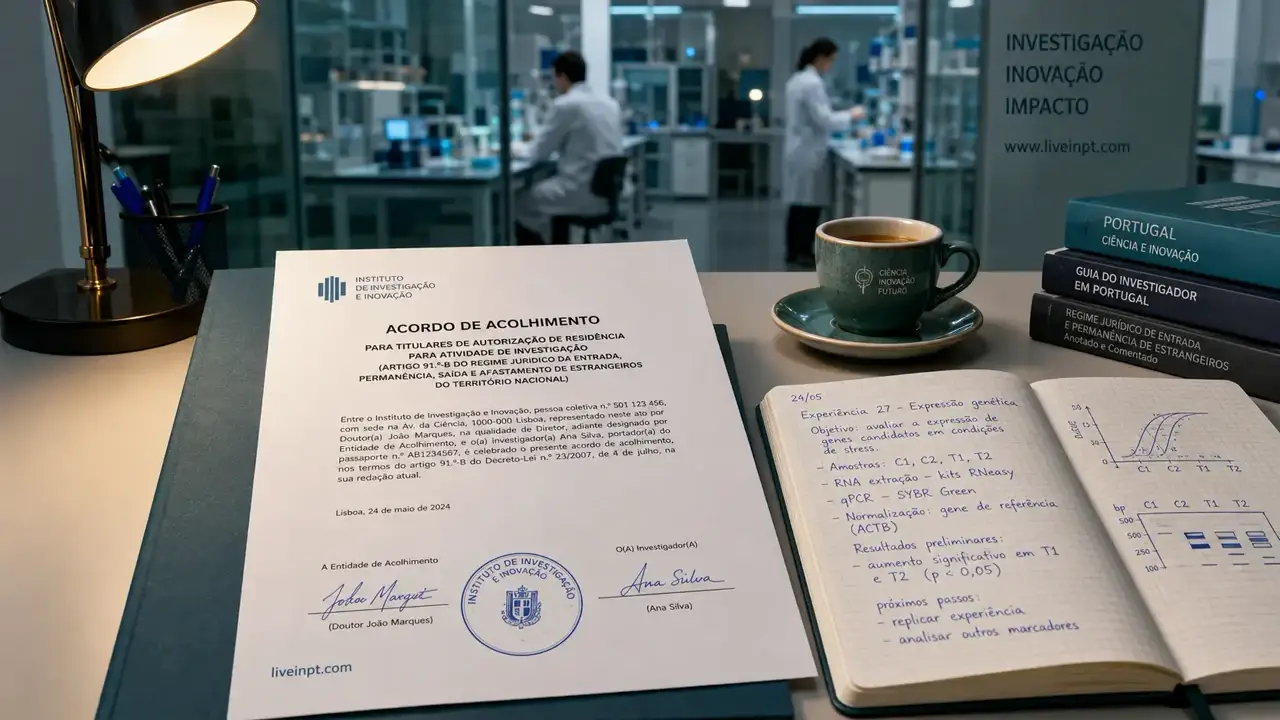
Portugal has been positioning itself as a European research destination for over a decade — through FCT-funded programmes, EU research infrastructure investment, and competitive salaries relative to southern European peers. The residence permit route that supports this is Article 91-B of Lei n.º 23/2007, and it comes with a set of practical advantages that most people on this route have not been told about clearly.
Article 91-B is the residence permit for researchers: specifically, third-country nationals admitted to collaborate with a formally recognised research organisation in Portugal. The permit is not an offshoot of the employment permit framework and not an alternative to the highly qualified activity permit under Article 90. It is its own category, with its own document logic, its own exemptions, and its own intra-EU mobility rights.
This article starts with what the permit actually grants and why the recognised research centre exemptions change the document calculus so much.
Quick Answer: Article 91-B of Lei n.º 23/2007 grants a two-year residence permit to third-country national researchers admitted to a recognised research organisation in Portugal via an employment contract, service provision contract, research grant, or hosting agreement. Researchers at officially recognised centres are exempt from proving means of subsistence, accommodation, and social security registration. The permit includes family reunification rights, and both applications can be submitted simultaneously.
What Makes Article 91-B Different
The clearest way to understand Article 91-B is to contrast it with Article 90, the highly qualified activity permit, which covers senior professionals, executives, and workers in specialised technical roles meeting specific qualification and salary thresholds.
Article 91-B is not for workers in general, however qualified. It is specifically for researchers: people admitted to carry out research activity at an officially recognised research institution. The admission mechanism can be an employment contract, a service provision contract, a research grant, or a hosting agreement. That last option, the hosting agreement, is particular to the researcher route and deserves a separate explanation below.
The other major structural difference is the exemption regime. Researchers admitted to officially recognised research centres are explicitly exempt from providing: proof of means of subsistence, proof of accommodation, and proof of social security registration. These are three of the most document-intensive requirements in a standard permit application. In practice, this means the file a researcher at a recognised centre submits to AIMA is substantially lighter than what most other permit applicants bring to the counter.
What “Officially Recognised Research Centre” Means
The document exemptions under Article 91-B apply specifically to researchers admitted to research centres that have official recognition. In Portugal, this recognition system is administered primarily by FCT — the Fundação para a Ciência e Tecnologia, Portugal’s national research funding and policy agency.
FCT maintains an accreditation process through which research units at universities and independent institutes are formally evaluated and classified. A research centre that has received FCT accreditation qualifies as officially recognised for the purposes of Article 91-B. Most established university research units, national laboratories, and major scientific institutes in Portugal fall into this category.
If you are not certain whether your host organisation has official recognition, ask the institution directly before assuming the exemptions apply to you. The FCT website maintains information about recognised research units. Getting this wrong can force you to reschedule the appointment entirely. A file prepared without means of subsistence documentation, only to discover at the AIMA appointment that the organisation is not recognised, will not survive review.
The Hosting Agreement
The hosting agreement (acordo de acolhimento) is the admission mechanism specific to the researcher route. It is the document used when a researcher is not being hired under a standard employment contract or a service provision arrangement, but is instead being formally admitted by a research organisation to carry out a defined research project.
A valid hosting agreement for Article 91-B purposes sets out: the nature of the research being conducted, the duration of the collaboration, the conditions under which the researcher is working, and the identity of the responsible party at the research organisation. It must be signed by both the researcher and an authorised representative of the host institution.
In my view, the hosting agreement is one of the more underappreciated documents in Portuguese immigration. It is specifically designed for postdoctoral researchers, visiting scientists, grant-funded researchers, and those working on collaborative EU-funded projects who do not have a traditional employer-employee relationship with the host institution. If you are coming to Portugal to pursue a research project under a FCT grant, a Horizon Europe project, or a bilateral scientific cooperation agreement, the hosting agreement is almost certainly the right instrument.
This point deserves emphasis for FCT scholarship holders specifically. An FCT bolsa de investigação, Portugal’s scientific research grant, is not an employment contract under Portuguese law. It is a grant governed by the Scientific Research Grant Statute (Lei n.º 40/2004 and its subsequent amendments). Researchers arriving on an individual FCT grant should use the hosting agreement as their Article 91-B admission document, not an employment contract. The host research institution will typically issue the hosting agreement alongside the official grant documentation, but it is worth confirming this explicitly before your AIMA appointment rather than discovering the gap on the day.
Documents for the AIMA Application
The AIMA appointment for an Article 91-B permit requires you to appear in person at an AIMA shop, where biometric data will be collected. Applications must be complete at submission — since April 2025, AIMA does not process incomplete files.
The standard document file includes:
Passport or valid travel document — valid for the full intended period in Portugal, with some margin beyond the expected permit duration.
Valid residence visa — issued at a Portuguese consulate before travel, unless you are applying under the visa exemption provision of Article 91-B(9) and can instead demonstrate legal entry by another route.
Proof of research admission — one of the following: a signed employment contract; a service provision contract; a scientific research grant (for example, a FCT scholarship or Horizon Europe grant agreement); or a hosting agreement with the research institution. Only one of these is required, corresponding to the nature of your admission.
Professional certification — where applicable, depending on your research field and the nature of the admission document.
Criminal record certificate — from your country of nationality, and from any country where you have lived for more than one year before Portugal. Must be apostilled or legalised, and translated if not in Portuguese or English. The FBI background check and apostille guide covers this step for researchers arriving from the United States. Order this document close to your application date rather than months in advance — criminal record certificates can become stale.
Proof of accommodation, means of subsistence, and social security registration — only required if you are NOT admitted to an officially recognised research centre. If your host institution holds FCT accreditation or equivalent official recognition, these three documents are explicitly waived.
Tax registration proof — confirmation that you are registered with the Portuguese tax authority (Finanças). Your NIF (Número de Identificação Fiscal) is the relevant number. If you have not already obtained your NIF, this should be a priority before or immediately after arrival. The NIF guide covers the current process, including consulate applications if you want your NIF active before you travel.
The AIMA Application Process
Book the AIMA appointment through the online portal or by telephone. The AIMA appointment guide covers the current booking routes and what to expect from current wait times. Prepare your file before booking — knowing your appointment is next week is not a reason to start gathering documents; documents for this application, particularly the criminal record certificate with apostille, can take weeks to obtain.
If I were doing this today, I would book the AIMA appointment only once I had every document in hand, including the apostilled criminal record and a signed hosting agreement or employment contract. Booking early and then scrambling for documents creates pressure that is entirely avoidable.
At the appointment, biometric data is collected and your file is submitted. You leave with a receipt confirming the application. The residence card is issued separately, in the weeks following approval. The AIMA residence card guide explains how to track the card and what documentation to carry in the meantime.
Family Reunification Under Article 91-B
Researchers holding an Article 91-B permit have the right to family reunification, and this is the detail that distinguishes the researcher route from most other permit categories: both applications can be submitted simultaneously as part of the same process.
In practice, and this is something I would highlight to anyone arriving with a partner or children, a researcher does not need to wait for the researcher permit to be granted before beginning the family reunification process. The two applications move through AIMA at the same time. For families planning a move to Portugal together, this is a material advantage over employment-based permit holders, who typically must establish their own residence first before sponsoring family members.
The family reunification guide covers the document requirements and AIMA process for the family members themselves in detail.
Permit Duration and Renewal
The Article 91-B permit is valid for two years, or for the duration of the hosting agreement if it is shorter than two years. It is renewable for equal periods.
For researchers admitted under EU or multilateral programmes with formal mobility measures, the same two-year framework applies — or the duration of the hosting agreement if that is shorter. There is one exception: where the researcher did not meet the standard residence visa conditions under Article 62 at the time of granting, AIMA issues a one-year permit instead.
At renewal, AIMA will check that the research activity is ongoing and that the conditions under which the original permit was granted are still met. An updated hosting agreement or renewed employment/grant documentation will typically be required. Researchers whose project has changed — a shift in host institution, a new grant agreement, or an extension of the original project — should update AIMA proactively rather than presenting changes for the first time at renewal.
Intra-EU Mobility Rights
Researchers holding an Article 91-B permit are not limited to Portugal. Under Article 91-C of Lei n.º 23/2007, the researcher mobility provision, holders can conduct part of their research in another EU member state for up to 180 days in any 360-day period after notifying AIMA at least 30 days before the mobility begins. For stays longer than 180 days in another EU state, a long-term mobility application must be submitted to that country’s immigration authority.
This intra-EU mobility right is a direct implementation of Directive 2016/801 and is one of the practical advantages of the researcher route over other permit categories. A researcher based primarily in Lisbon who needs to spend time at a partner institution in Germany or the Netherlands can do so without applying for a separate German or Dutch visa or permit for stays within the 180-day threshold.
The IFICI Tax Regime: What Researchers Should Know
Researchers who establish tax residency in Portugal through Article 91-B may be eligible for the IFICI regime, the Tax Incentive for Scientific Research and Innovation, sometimes referred to as NHR 2.0. It replaced Portugal’s Non-Habitual Residency scheme at the start of 2025.
IFICI is not a coincidental overlap with the researcher route. It was specifically designed for highly qualified professionals in science, research, technology, and innovation. It explicitly covers scientific research roles, academic positions in higher education, and work at national innovation centres — the exact activities that Article 91-B researchers undertake.
Under IFICI, qualifying individuals pay a flat 20% personal income tax rate on Portuguese-source employment and self-employment income for a period of ten consecutive years. In my opinion, IFICI is the most underused benefit available to incoming researchers in Portugal — most people only discover it after they have already missed the registration window for their first year of tax residency. The IFICI guide covers eligibility, the registration process, and how it compares to what NHR offered.
The eligibility conditions: you must be a new tax resident in Portugal (meaning you have not held Portuguese tax residency in the five years before establishing it), and you must earn income from a qualifying activity. The application must be submitted by January 15 of the year following your first year as a tax resident — this deadline is absolute. If you become a tax resident in Portugal in, say, October, you have until January 15 of the following year to file for IFICI. Researchers who previously benefited from the NHR regime or the Regressar programme are not eligible. IFICI can only be used once per taxpayer.
The IRS guide for foreigners in Portugal covers the broader tax picture. For IFICI registration specifically, the application goes through the Portuguese tax authority (Finanças) after establishing tax residency — your NIF must be active first.
From Researcher Permit Toward Long-Term Residence
Researchers who build their careers in Portugal will encounter the standard residence timeline: five years of legal continuous residence opens the path to permanent residence under Portuguese law and, subject to the relevant citizenship rules, eventually to a Portuguese passport. The permanent residence after five years guide covers that process. The EU long-term residence permit explains the alternative EU-level status, which carries its own rights for living and working across EU member states.
For researchers who move into academic roles or spin-outs after their research period, Article 90 (highly qualified activity) and Article 89 (self-employed and entrepreneurs) are the natural next steps depending on whether employment or independent activity follows. Article 122 of the same law also provides a bridge: existing permit holders, including researchers, can change the basis of their residence permit in Portugal without leaving the country, provided the conditions of the new category are met. The Article 122 guide covers the specific sub-paragraphs for researchers transitioning to employment status.
Frequently Asked Questions
What is the Article 91-B residence permit in Portugal?
Article 91-B grants a two-year residence permit to third-country national researchers admitted to a recognised research organisation in Portugal via employment contract, service provision contract, scientific research grant, or hosting agreement. Researchers at officially recognised centres are exempt from the standard means of subsistence, accommodation, and social security documentation requirements.
What is a hosting agreement?
A formal document between the researcher and the host institution setting out the research project, its duration, and the conditions of the collaboration. It is the admission mechanism used when the researcher is not a standard employee of the institution. It must be signed by both parties, with the institution having official recognition under FCT or equivalent.
Do I need to prove I have enough money to live in Portugal?
Not if your host organisation has official recognition. Researchers at recognised research centres are explicitly exempt from this requirement. If the host organisation does not hold official recognition, the standard means of subsistence documentation under Ordinance 1563/2007 applies.
Can I bring my family?
Yes. Family reunification rights are part of Article 91-B, and the applications can be submitted simultaneously. This is faster than most other residence permit categories, where the main applicant typically waits for their own permit before sponsoring dependants.
How long is the permit valid?
Two years, or the hosting agreement duration if shorter. Renewable. Exception: one-year initial permit if the researcher did not meet Article 62 visa conditions at time of granting.
What is the difference between Article 91-B and Article 90?
Article 90 covers highly qualified employees in professional, technical, and managerial roles meeting specific qualification and salary criteria. Article 91-B is specifically for researchers admitted to a recognised research institution through a research agreement. The hosting agreement mechanism, document exemptions, and intra-EU mobility rights under Article 91-C are unique to the researcher category.
The Article 91-B route is better designed for researchers than most people give it credit for. The hosting agreement mechanism covers the gap between employment contracts and grant-funded positions. The document exemptions for recognised research centres significantly reduce the administrative burden at AIMA. The family reunification pathway is faster and can run concurrently with the researcher permit application. And the intra-EU mobility rights add flexibility that most other Portuguese residence permit holders simply do not have.
What the route requires is that the host institution has its official recognition in order before the application is filed. That is a question worth asking your host organisation early in the process — not after you have started gathering documents.
If you are planning a longer stay in Portugal that eventually leads toward permanent status, the NISS guide covers social security registration, which becomes relevant both for employment-related contributions and for establishing the continuous legal residence record that permanent residence and citizenship applications depend on.